Inference chips are reshaping the AI compute landscape
💡Learn why the GPU monopoly is cracking and how specialized inference chips are becoming the new standard for AI efficien
⚡ 30-Second TL;DR
What Changed
Inference is becoming the primary bottleneck, shifting focus from raw FLOPs to token-per-watt efficiency.
Why It Matters
This trend signals a move toward heterogeneous computing systems where GPUs, LPUs, and CPUs are combined to optimize specific AI workloads.
What To Do Next
Evaluate if your inference workload can benefit from specialized hardware like Groq or custom ASICs instead of relying solely on standard GPU clusters.
Key Points
- •Inference is becoming the primary bottleneck, shifting focus from raw FLOPs to token-per-watt efficiency.
- •Companies like OpenAI, Anthropic, and Google are developing custom ASICs to handle specific stages like prefill and decode.
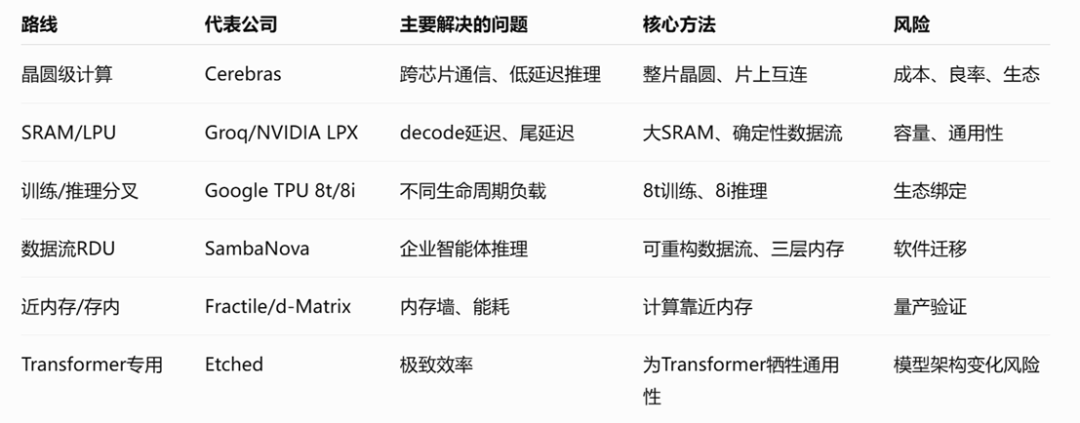
- •New architectures like Cerebras (wafer-scale) and Groq (LPU) are emerging to solve communication bottlenecks in multi-chip systems.
🧠 Deep Insight
AI-generated analysis for this event — not the original article.
🔑 Enhanced Key Takeaways
- •The shift toward inference-specific silicon is driving a transition from HBM3e-heavy architectures to LPDDR5x-based memory subsystems to reduce TCO in memory-bound inference tasks.
- •Hardware-software co-design is now prioritizing 'quantization-aware' silicon, where chips include native support for FP8, INT4, and even sub-4-bit precision to maximize throughput without significant accuracy loss.
- •Interconnect technologies like UCIe (Universal Chiplet Interconnect Express) are becoming critical for inference scaling, allowing companies to mix-and-match chiplets from different vendors to avoid supply chain lock-in.
- •The rise of 'Agentic AI' workloads is forcing inference chips to incorporate larger on-chip SRAM caches to handle long-context windows and iterative reasoning loops that exceed standard GPU cache capacities.
- •Energy efficiency mandates in data centers are leading to the adoption of liquid cooling and direct-to-chip power delivery systems specifically optimized for the thermal profiles of high-density inference ASICs.
📊 Competitor Analysis▸ Show
| Feature | NVIDIA Blackwell (GPU) | Groq LPU | Cerebras WSE-3 | Custom ASICs (TPU/Trainium) |
|---|---|---|---|---|
| Primary Strength | Versatility/Ecosystem | Ultra-low Latency | Massive On-chip Memory | Cost/Power Efficiency |
| Memory Architecture | HBM3e (High Bandwidth) | SRAM (High Speed) | Wafer-Scale SRAM | HBM/LPDDR Hybrid |
| Target Workload | Training & Inference | Real-time Inference | Large Model Inference | Scale-out Inference |
🛠️ Technical Deep Dive
- Inference ASICs are increasingly utilizing Dataflow Architectures rather than traditional Von Neumann architectures to minimize data movement between memory and compute units.
- Prefill-decode decoupling: New silicon designs implement separate compute engines for the prefill phase (compute-bound) and the decode phase (memory-bound) to optimize utilization.
- Weight-stationary vs. Output-stationary dataflows: Modern inference chips are being optimized for weight-stationary dataflows to reduce the energy cost of fetching model parameters from external memory.
- Integration of dedicated hardware blocks for KV-cache management to reduce the latency overhead of long-context token generation.
🔮 Future ImplicationsAI analysis grounded in cited sources
⏳ Timeline
Weekly AI Recap
Read this week's curated digest of top AI events →
👉Related Updates

AI-curated news aggregator. All content rights belong to original publishers.
Original source: 虎嗅 ↗
This is a summary, not the original. Read the source, or get the weekly briefing.
Weekly AI briefing
One email a week. Unsubscribe anytime.