Manus Founders Plan Buyback and Hong Kong IPO
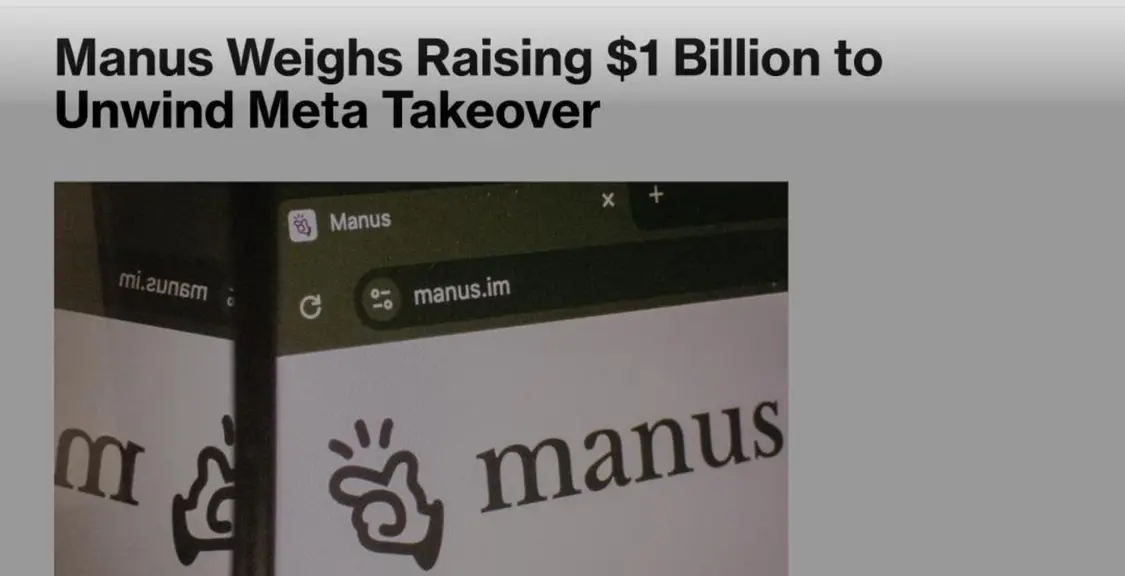
A major AI startup buyback from Meta could set a new precedent for founder-led independence and IPO strategies.
30-Second TL;DR
What Changed
Founders Xiao Hong, Ji Yichao, and Zhang Tao leading the buyback effort
Why It Matters
This move signals a potential reversal of M&A trends in the AI sector, where founders seek independence from big tech to pursue public markets. It may influence how other startups negotiate exit strategies with major tech conglomerates.
What To Do Next
Monitor the valuation metrics of this deal as a benchmark for high-end AI startup equity in the current market.
Key Points
- •Founders Xiao Hong, Ji Yichao, and Zhang Tao leading the buyback effort
- •Targeting $1 billion in external funding for the acquisition
- •Valuation matches Meta's original acquisition price of $2-3 billion
- •Strategic shift toward establishing a joint venture for public listing
Deep Insight
AI-generated analysis for this event — not the original article.
Enhanced Key Takeaways
- •The buyback effort by Manus founders is a direct consequence of China's National Development and Reform Commission blocking Meta's acquisition on April 27, 2026, due to concerns over sensitive technology transfer. [7, 8]
- •Manus AI, founded by Xiao Hong, Ji Yichao, and Zhang Tao, originated in China but strategically relocated its headquarters and key staff to Singapore in 2025, a move that is now being partially reversed as part of the restructuring. [8, 28]
- •Prior to Meta's acquisition, Manus AI demonstrated rapid growth, achieving over $100 million in annual recurring revenue (ARR) within eight months of its launch and was projected to generate approximately $1 billion in revenue in 2026. [21, 28]
- •The company's core offering involves general-purpose AI agents capable of performing complex, multi-step tasks like research, automation, and coding, powered by a proprietary 'virtualization infrastructure' running on cloud-based virtual machines. [4, 13, 21]
- •The proposed restructuring plan includes establishing Manus as a Chinese joint venture with new external backers, which would then precede an initial public offering (IPO) in Hong Kong, aiming to attract US-dollar funding while complying with Chinese regulatory demands. [8, 14]
Technical Deep Dive
- Manus AI operates on a proprietary "virtualization infrastructure" that deploys its AI agents across a large fleet of cloud-based virtual machines. [4]
- This architecture enables the AI agents to perform sandboxed actions, allowing them to safely write and execute code (e.g., Python) for data processing. [4]
- The system is designed to maintain state through complex web sessions, enabling agents to log into websites and extract data without losing progress. [4]
- Manus AI agents are capable of working asynchronously, handling tasks that may require minutes or even hours to complete. [4]
- The platform is built for "autonomous, task-driven AI," focusing on enabling AI to execute multi-step processes. [5]
- Technical analysis has indicated that Manus AI integrates Anthropic's Claude and utilizes the open-source project "Browser-Use" to facilitate web access for its AI agents. [15]
Future ImplicationsAI analysis grounded in cited sources
Timeline
- 2022Monica.im, the company behind Manus AI, founded by Xiao Hong.
- 2024Founders Xiao Hong, Ji Yichao, and Zhang Tao partnered through ZhenFund's introductions.
- 2025-04Manus AI raised approximately US$75 million in a Series B round, valuing the company at around US$500 million. [7, 28]
- 2025Manus AI relocated its headquarters and key staff from China to Singapore. [8, 28]
- 2025-12Meta acquired Singapore-based Manus AI for over $2 billion. [4, 7, 21, 28]
- 2026-01China's Ministry of Commerce announced an 'evaluative investigation' into Meta's acquisition of Manus AI. [7]
- 2026-04-27China's National Development and Reform Commission blocked Meta's acquisition of Manus AI, ordering the transaction to be unwound. [7]
- 2026-05-22Manus founders began exploring options to raise $1 billion to buy back the company from Meta and plan a Hong Kong IPO. [8, 13, 14, 16]
Weekly AI Recap
Read this week's curated digest of top AI events →
Related Updates

AI-curated news aggregator. All content rights belong to original publishers.
Original source: cnBeta (Full RSS) ↗
This is a summary, not the original. Read the source, or get the weekly briefing.
The weekly digest
One email a week. Unsubscribe anytime.