Loudoun’s Data Center Model Cuts Taxes
💡Loudoun shows how taxes and politics can reshape the economics of AI data center deployment.
⚡ 30-Second TL;DR
What Changed
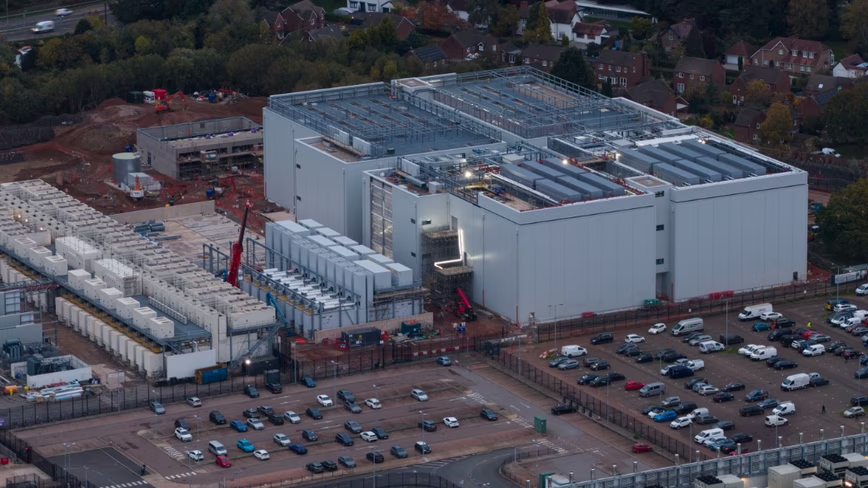
Loudoun County hosts more than 250 data centers.
Why It Matters
The article highlights how data center location decisions depend not only on power and connectivity but also on local tax policy and political acceptance. For AI companies, these factors can materially affect the cost and stability of large-scale model training and inference.
What To Do Next
Use AWS Pricing Calculator to compare regional infrastructure costs while adding local taxes, power constraints, and permitting timelines to your deployment plan.
Key Points
- •Loudoun County hosts more than 250 data centers.
- •Data center activity has generated enough local wealth to support property tax cuts.
- •Other jurisdictions are studying the model as opposition to new facilities grows nationwide.
🧠 Deep Insight
AI-generated analysis for this event.
🔑 Enhanced Key Takeaways
- •Loudoun County's 'Data Center Alley' accounts for approximately 70% of the world's global internet traffic, cementing its status as the largest data center hub globally.
- •The county's tax revenue from data centers has allowed it to maintain one of the lowest real estate tax rates in Northern Virginia, despite significant infrastructure demands.
- •Local opposition is primarily driven by concerns over 'energy sprawl,' specifically the massive demand for electricity that necessitates new high-voltage transmission lines and substations.
- •Data centers in Loudoun are increasingly facing scrutiny regarding their water consumption for cooling systems, leading to new requirements for water-efficient technologies.
- •The rapid expansion has triggered legislative debates in the Virginia General Assembly regarding the balance between local zoning authority and state-level oversight of critical infrastructure.
🛠️ Technical Deep Dive
- Data centers in the region utilize high-density server configurations often exceeding 30kW per rack, requiring advanced liquid cooling or specialized CRAC (Computer Room Air Conditioning) systems.
- Facilities are connected via a dense, redundant fiber-optic mesh network that provides low-latency access to major cloud service providers (AWS, Microsoft Azure, Google Cloud).
- Power delivery infrastructure typically involves N+1 or 2N redundancy, with massive on-site diesel generator farms and UPS (Uninterruptible Power Supply) systems to ensure 99.999% uptime.
- Many newer facilities are integrating modular data center designs to accelerate deployment timelines and improve PUE (Power Usage Effectiveness) ratings.
🔮 Future ImplicationsAI analysis grounded in cited sources
⏳ Timeline
Weekly AI Recap
Read this week's curated digest of top AI events →
👉Related Updates
AI-curated news aggregator. All content rights belong to original publishers.
Original source: New York Times Technology ↗