Europe’s Data Centre Growth Moves Beyond the Big Five
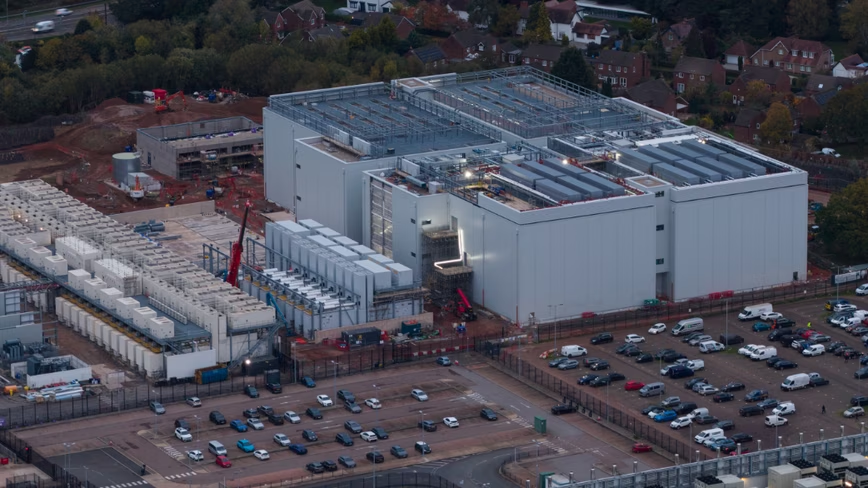
💡AI compute is spreading beyond Europe’s traditional hubs, changing where infrastructure teams can deploy workloads.
⚡ 30-Second TL;DR
What Changed
Europe’s total data centre capacity is expected to reach 13 gigawatts by the end of 2026.
Why It Matters
The geographic shift could broaden access to compute capacity while increasing the importance of regional power, connectivity, and regulatory planning. AI companies may gain more location options, but must evaluate latency and local infrastructure constraints carefully.
What To Do Next
Reassess your AI deployment shortlist by comparing secondary European regions on power availability, network latency, and data-residency requirements.
Key Points
- •Europe’s total data centre capacity is expected to reach 13 gigawatts by the end of 2026.
- •The market is growing about 20% compared with last year.
- •Only 37% of roughly 700 megawatts added in Q2 went to the established five markets.
- •Most new capacity is shifting toward secondary European locations.
🧠 Deep Insight
AI-generated analysis for this event.
🔑 Enhanced Key Takeaways
- •Secondary markets such as Madrid, Milan, Warsaw, and Berlin are benefiting from power grid constraints and land scarcity in the FLAPD (Frankfurt, London, Amsterdam, Paris, Dublin) region.
- •The surge in secondary market development is heavily driven by the need to support sovereign cloud initiatives and local data residency requirements mandated by EU regulations.
- •Energy availability and the ability to secure grid connections have become the primary determinants for site selection, often outweighing traditional proximity to major financial hubs.
- •Hyperscalers are increasingly investing in 'edge' data center clusters in Nordic countries to leverage abundant renewable energy and natural cooling capabilities.
- •Local government incentives and streamlined permitting processes in emerging markets are actively competing with the established FLAPD hubs to attract large-scale digital infrastructure investments.
🛠️ Technical Deep Dive
- Shift toward liquid cooling technologies to manage high-density AI workloads in secondary markets where power density per rack is increasing.
- Implementation of modular data center designs to accelerate deployment timelines in regions with less established construction infrastructure.
- Integration of advanced Power Usage Effectiveness (PUE) monitoring systems to comply with the EU Energy Efficiency Directive (EED).
- Adoption of onsite microgrid solutions, including battery energy storage systems (BESS) and hydrogen fuel cells, to mitigate grid instability in emerging locations.
🔮 Future ImplicationsAI analysis grounded in cited sources
⏳ Timeline
Weekly AI Recap
Read this week's curated digest of top AI events →
👉Related Updates



AI-curated news aggregator. All content rights belong to original publishers.
Original source: The Next Web (TNW) ↗