AI Borrowing Helps Push U.S. Bond Yields Higher
💡AI's infrastructure boom is colliding with costly debt, threatening project returns and tech valuations.
⚡ 30-Second TL;DR
What Changed
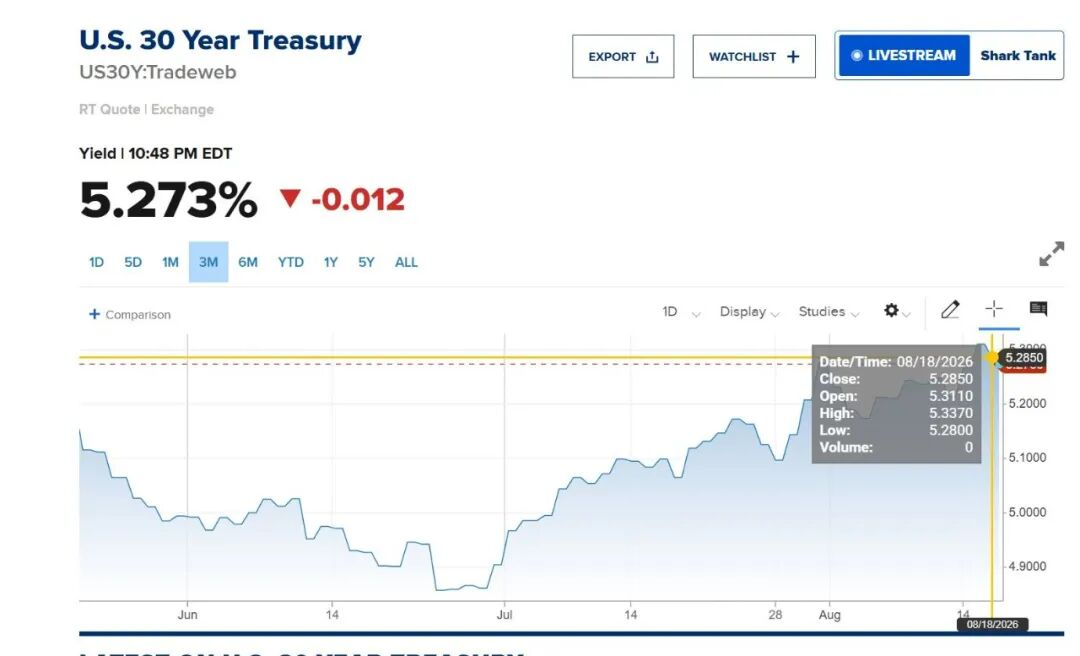
The U.S. 30-year Treasury yield briefly exceeded 5.3%, its highest level since 2007.
Why It Matters
Higher risk-free yields raise the hurdle rate for AI projects and can slow data-center expansion. Startups and infrastructure providers with heavy capital needs may face tighter financing, lower valuations, and stronger pressure to demonstrate near-term returns.
What To Do Next
Recalculate your AI product's data-center and GPU payback period using a 5%–6% long-term financing-rate scenario before committing to new capacity.
Key Points
- •The U.S. 30-year Treasury yield briefly exceeded 5.3%, its highest level since 2007.
- •Federal debt could pass $40 trillion, while the government is spending nearly $1.2 trillion on interest in the current fiscal year.
- •Amazon, Alphabet, Meta, Microsoft, and Oracle issued more than $120 billion in credit bonds in 2025.
- •AI and hyperscale data-center bond and loan issuance reached $269 billion year-to-date, more than twice 2025's full-year level.
- •Nine major technology companies disclosed roughly $3 trillion in off-balance-sheet commitments, mostly linked to AI infrastructure.
🧠 Deep Insight
AI-generated analysis for this event.
🔑 Enhanced Key Takeaways
- •The surge in AI-related debt issuance has led to a 'crowding out' effect, where private sector demand for capital is increasingly competing with Treasury auctions, contributing to a term premium expansion in long-dated bonds.
- •Credit rating agencies have begun incorporating 'AI infrastructure intensity' as a specific risk factor in corporate credit assessments, noting that the long payback periods for data centers make these companies more sensitive to interest rate volatility.
- •Institutional investors, particularly pension funds, are shifting allocations away from traditional corporate bonds toward AI-linked infrastructure debt, attracted by the higher yields but exposing themselves to potential asset-liability mismatches.
- •The Federal Reserve's quantitative tightening (QT) program has reduced the central bank's role as a buyer of Treasuries, exacerbating the supply-demand imbalance as AI firms aggressively tap debt markets to fund GPU procurement and energy grid upgrades.
- •Energy sector utilities are increasingly issuing 'AI-dedicated' green bonds to finance the massive power grid expansions required by hyperscalers, further fragmenting the corporate bond market and complicating yield curve analysis.
🔮 Future ImplicationsAI analysis grounded in cited sources
⏳ Timeline
📰 Event Coverage
Weekly AI Recap
Read this week's curated digest of top AI events →
👉Related Updates

AI-curated news aggregator. All content rights belong to original publishers.
Original source: 虎嗅 ↗