Loop Engineering: The New Era of Agentic Systems
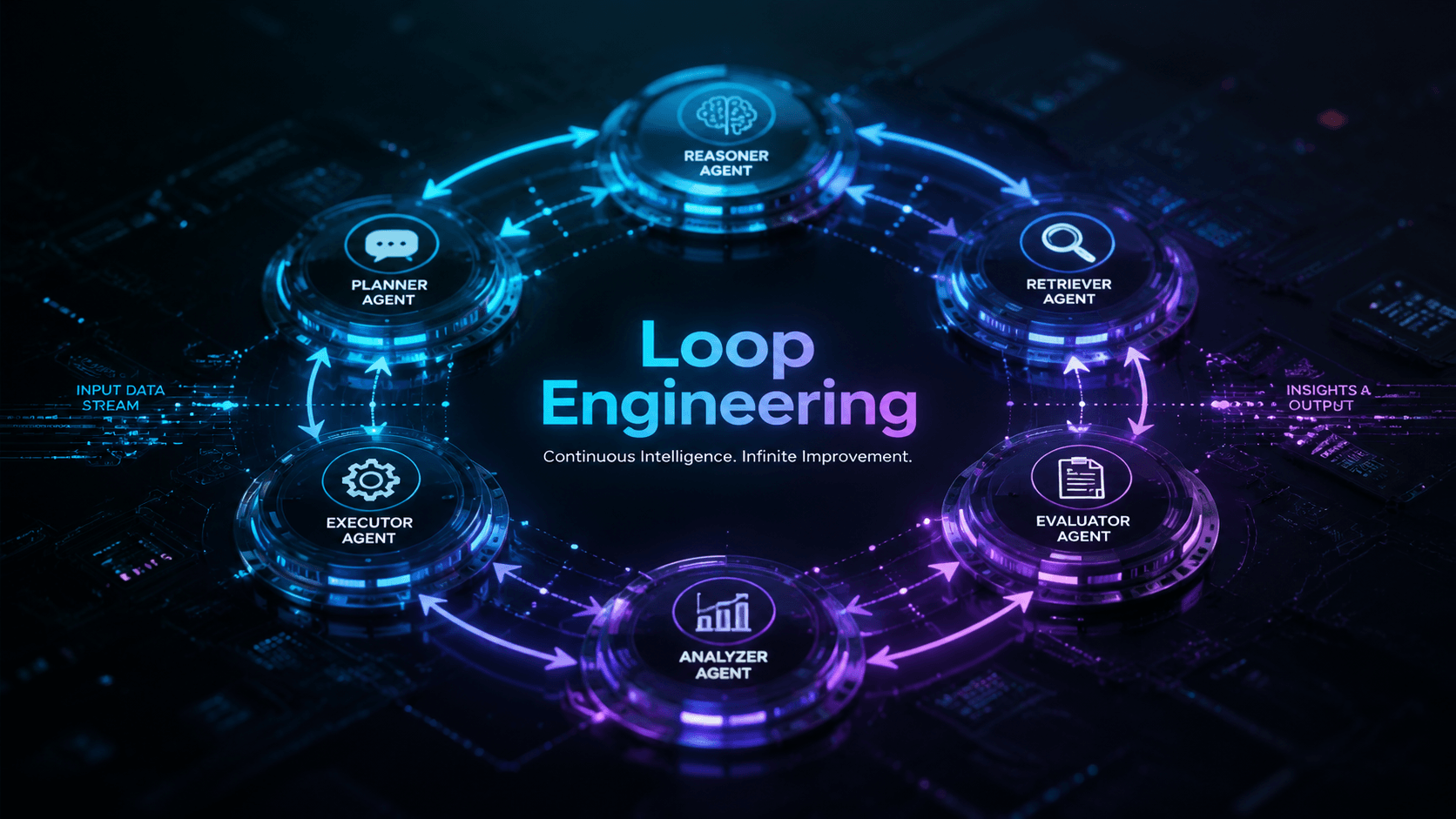
💡Learn why moving from Prompt Engineering to Loop Engineering is critical for building autonomous AI agents.
⚡ 30-Second TL;DR
What Changed
Shift from manual prompting to automated system design
Why It Matters
This shift necessitates a change in developer skill sets, moving from linguistic prompt crafting to systems architecture for autonomous agents.
What To Do Next
Start building agentic workflows using frameworks like LangGraph or CrewAI to move beyond simple prompt chains.
Key Points
- •Shift from manual prompting to automated system design
- •Focus on self-sustaining agent workflows
- •Redefining the developer's role in AI orchestration
🧠 Deep Insight
Background and context from public sources — not the original article. 16 sources cited.
🔑 Enhanced Key Takeaways
- •Loop Engineering is the practice of designing AI systems that operate in iterative cycles, taking action, observing results, reasoning, and repeating until a goal is achieved, distinguishing it from single-shot prompting or linear AI chains.
- •The foundational concept for modern agent loops in Loop Engineering traces back to the ReAct (Reason + Act) pattern, which interleaves reasoning steps with action steps, allowing models to 'think out loud' and adapt based on observed outcomes.
- •Effective implementation of Loop Engineering requires meticulous design, including establishing clear, verifiable goals, providing robust assessment mechanisms, incorporating human feedback checkpoints, defining precise stoppage rules, and thorough testing to manage resource consumption and prevent unintended actions.
- •This discipline represents a higher layer in the AI stack, building upon and integrating concepts like prompt engineering, context engineering (shaping the environment an AI operates in), and harness engineering (designing the environment a single agent runs in).
- •The emergence of Loop Engineering is significantly driven by the maturation of AI coding agents, such as Claude Code and OpenAI Codex, which can autonomously perform complex tasks like reading, editing, running tests, and calling tools, shifting the development bottleneck from individual prompts to system design.
🛠️ Technical Deep Dive
- Iterative Cycle: A core loop involves a repeating cycle where an AI agent takes an action, receives feedback from its environment, uses that feedback to decide its next move, and continues until a termination condition is met.
- ReAct Pattern: Most modern agent loops are rooted in the ReAct (Reason + Act) pattern, which interleaves reasoning steps with action steps. This allows the model to 'think out loud,' take an action, observe the result, reason again, and act again.
- Coding Agent Workflow: In coding contexts, this translates to understanding the goal, writing code, running the code and observing output/errors, reasoning about what went wrong, revising and re-running, and repeating until tests pass or the task is complete.
- Essential Loop Properties: A well-engineered loop requires a clear, testable goal, access to useful tools (e.g., file access, terminal, test runner, version control), effective context management, defined termination logic, robust error handling, observable intermediate states, explicit retry logic, and a recovery path for when the agent encounters issues.
- Core Components (Addy Osmani's view): Five key components include Skills (reusable instruction sets), Context Injection (reading the current world state), Sub-agents (focused autonomous subtasks), Connectors (post-task actions like creating pull requests), and State Files (persisting progress).
- Multi-Agent Architectures: Production agent systems often utilize specialized sub-agents, where different agents handle distinct tasks (e.g., one writes code, another performs adversarial review, a third focuses on architecture, and a fourth monitors for regressions).
- Security and Control: Implementing guardrails on LLM input and output, as well as pre- and post-tool calls (e.g., via an MCP Gateway), is crucial for security, prompt injection prevention, and secrets detection, ensuring governed tool access and adherence to policies.
🔮 Future ImplicationsAI analysis grounded in cited sources
⏳ Timeline
📎 Sources (16)
Factual claims are grounded in the sources below. Forward-looking analysis is AI-generated interpretation.
Weekly AI Recap
Read this week's curated digest of top AI events →
👉Related Updates


AI-curated news aggregator. All content rights belong to original publishers.
Original source: Pandaily ↗
This is a summary, not the original. Read the source, or get the weekly briefing.
Weekly AI briefing
One email a week. Unsubscribe anytime.