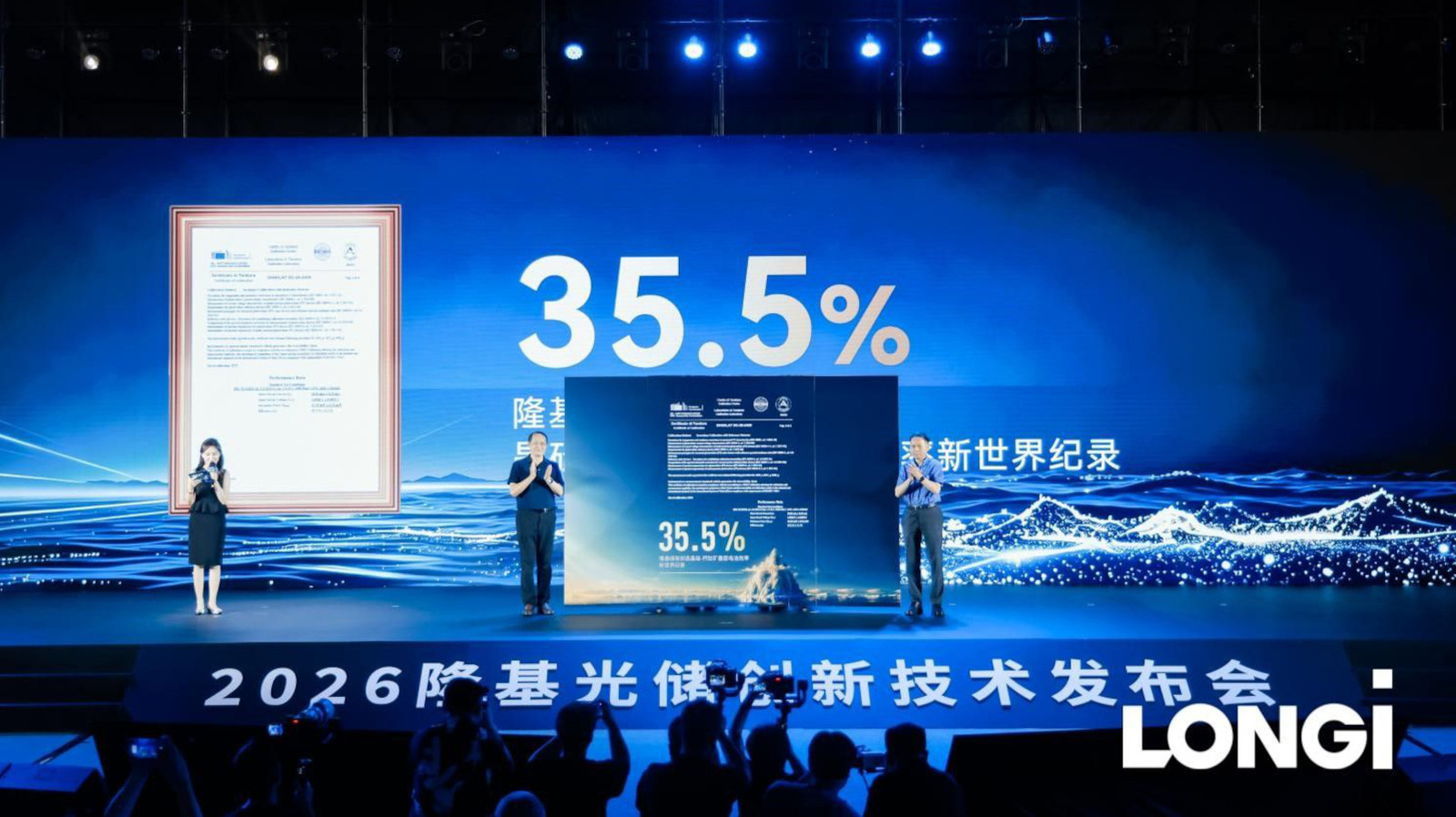
LONGi achieves 35.5% efficiency in tandem solar cells
💡Higher solar efficiency directly impacts the sustainability and operational costs of future AI data centers.
⚡ 30-Second TL;DR
What Changed
LONGi achieved a record-breaking 35.5% conversion efficiency.
Why It Matters
Higher efficiency solar cells are critical for powering large-scale data centers and edge AI infrastructure sustainably. This could lower the long-term energy costs for compute-intensive AI operations.
What To Do Next
Monitor the commercial availability of high-efficiency tandem cells for potential integration into future green data center infrastructure projects.
Key Points
- •LONGi achieved a record-breaking 35.5% conversion efficiency.
- •The technology utilizes a crystalline silicon-perovskite tandem structure.
- •This advancement pushes the theoretical limits of commercial solar energy harvesting.
🧠 Deep Insight
AI-generated analysis for this event.
🔑 Enhanced Key Takeaways
- •The 35.5% efficiency record was certified by the European Solar Test Installation (ESTI), a leading independent testing body.
- •LONGi utilized a proprietary interface passivation technology to minimize carrier recombination losses at the silicon-perovskite junction.
- •This tandem cell architecture specifically targets the optimization of the bandgap to capture a broader spectrum of solar radiation, particularly in the blue and green light wavelengths.
- •The development addresses long-standing stability concerns associated with perovskite materials by integrating advanced encapsulation techniques to prevent moisture and thermal degradation.
- •This achievement surpasses the previous industry benchmark for silicon-perovskite tandem cells, which had hovered around the 34% threshold for the preceding 18 months.
📊 Competitor Analysis▸ Show
| Competitor | Technology | Efficiency Benchmark | Status |
|---|---|---|---|
| JinkoSolar | TOPCon / Tandem | ~33.2% | R&D Phase |
| Trina Solar | HJT / Tandem | ~33.8% | Pilot Production |
| Oxford PV | Perovskite-on-Silicon | ~34.6% | Commercialization |
| Qcells | Tandem / Perovskite | ~33.5% | R&D Phase |
🛠️ Technical Deep Dive
- Cell Architecture: Monolithic two-terminal (2T) perovskite/crystalline silicon tandem structure.
- Passivation Layer: Utilizes atomic layer deposition (ALD) to create a high-quality interface between the perovskite top cell and the silicon bottom cell.
- Spectral Response: Enhanced external quantum efficiency (EQE) in the 300-800 nm range due to the wide-bandgap perovskite layer.
- Substrate: High-efficiency Czochralski (CZ) silicon wafer serving as the bottom cell base.
- Stability Protocol: Tested under damp-heat conditions (85C/85% relative humidity) to validate industrial viability.
🔮 Future ImplicationsAI analysis grounded in cited sources
⏳ Timeline
Weekly AI Recap
Read this week's curated digest of top AI events →
👉Related Updates


AI-curated news aggregator. All content rights belong to original publishers.
Original source: Engadget ↗