LimX Dynamics Secures $200M for Embodied AI Expansion
💡A major funding round for a leading humanoid robotics firm with a focus on open-source embodied AI infrastructure.
⚡ 30-Second TL;DR
What Changed
Secured $200M Pre-IPO funding with a $2.1B post-money valuation.
Why It Matters
The funding signals strong investor confidence in the commercial viability of humanoid robotics. By providing standardized tools like FluxVLA, LimX is lowering the barrier for developers to build vertical embodied AI applications.
What To Do Next
Explore the FluxVLA Engine documentation if you are building embodied AI agents to reduce engineering overhead in your model training pipeline.
Key Points
- •Secured $200M Pre-IPO funding with a $2.1B post-money valuation.
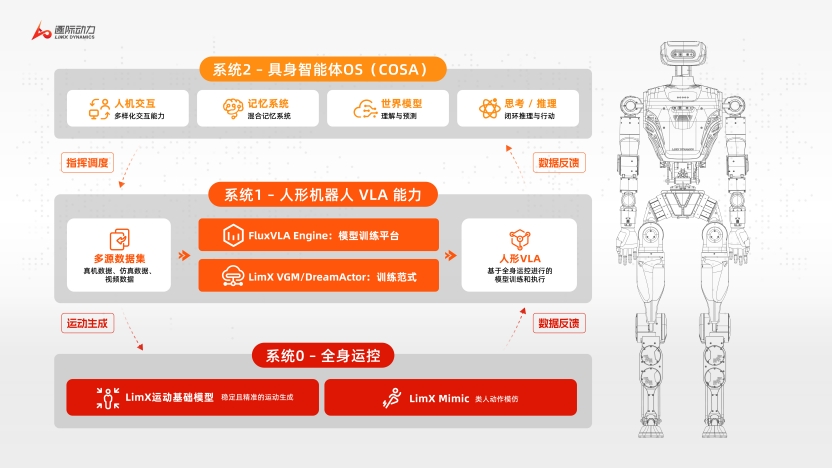
- •Developed a three-layer technical architecture: System 0 (motion), System 1 (VLA/WAM), and System 2 (COSA).
- •Launched FluxVLA Engine as an enterprise-grade open platform for embodied AI developers.
- •Released LimX Luna (full-size humanoid) and TRON 2 (modular multi-form robot) with commercial orders.
🧠 Deep Insight
AI-generated analysis for this event — not the original article.
🔑 Enhanced Key Takeaways
- •LimX Dynamics has established a strategic partnership with major automotive manufacturers in the Yangtze River Delta to pilot its TRON 2 modular robots in assembly line quality inspection.
- •The company's proprietary 'COSA' (Cognitive Operating System for Agents) utilizes a transformer-based architecture specifically optimized for low-latency inference on edge hardware, reducing dependency on cloud connectivity.
- •LimX Dynamics has successfully integrated its motion foundation models with NVIDIA's Isaac Sim platform, allowing for high-fidelity digital twin training before physical deployment.
- •The $200M funding round was led by a consortium including state-backed industrial funds and prominent venture capital firms focusing on deep-tech and advanced manufacturing.
- •The FluxVLA Engine features a unique 'human-in-the-loop' data collection pipeline that allows the robot to request human intervention when encountering edge cases in unstructured environments.
📊 Competitor Analysis▸ Show
| Feature | LimX Dynamics (Luna/TRON 2) | Unitree (G1/H1) | Tesla (Optimus Gen 3) |
|---|---|---|---|
| Architecture | 3-Layer (System 0/1/2) | End-to-End RL | End-to-End Neural Net |
| Primary Focus | Industrial/Modular | Cost-Efficiency/Consumer | Mass Production/Scale |
| OS/Platform | COSA / FluxVLA | Proprietary | FSD-derived Stack |
| Market Positioning | Enterprise/B2B | Prosumer/Research | Consumer/Industrial |
🛠️ Technical Deep Dive
- System 0 (Motion): Utilizes Whole-Body Control (WBC) integrated with Reinforcement Learning to achieve dynamic balance on uneven terrain and stairs.
- System 1 (VLA/WAM): Employs a Vision-Language-Action model trained on large-scale multimodal datasets to map visual inputs directly to joint torque commands.
- System 2 (COSA): Acts as the cognitive middleware, managing task planning, long-term memory, and multi-agent coordination for complex workflows.
- FluxVLA Engine: An open-source-friendly API that supports standard ROS2 interfaces, enabling developers to deploy custom embodied agents on LimX hardware.
🔮 Future ImplicationsAI analysis grounded in cited sources
⏳ Timeline
Weekly AI Recap
Read this week's curated digest of top AI events →
👉Related Updates

AI-curated news aggregator. All content rights belong to original publishers.
Original source: 36氪 ↗
This is a summary, not the original. Read the source, or get the weekly briefing.
The weekly digest
One email a week. Unsubscribe anytime.