Learning Bayesian Statistics for Data Analysis with Python
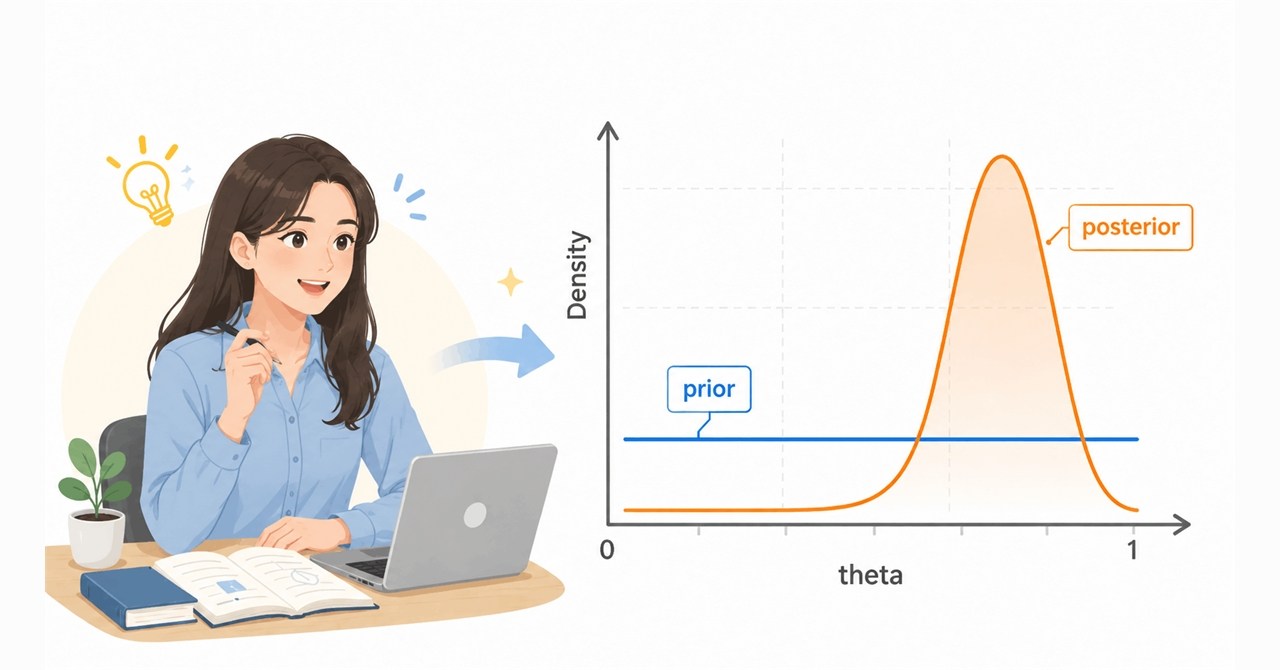
💡Master Bayesian inference in Python to improve your model's uncertainty estimation and decision-making capabilities.
⚡ 30-Second TL;DR
What Changed
Step-by-step introduction to Bayesian statistics
Why It Matters
Provides practitioners with a foundational understanding of Bayesian methods, which are essential for robust uncertainty quantification in AI models.
What To Do Next
Implement a simple Bayesian update loop in Python to compare it against frequentist methods for your current classification task.
Key Points
- •Step-by-step introduction to Bayesian statistics
- •Practical application using Python for data analysis
- •Focus on binomial distribution parameter estimation and testing
🧠 Deep Insight
Background and context from public sources — not the original article. 24 sources cited.
🔑 Enhanced Key Takeaways
- •Bayesian statistics, initially formulated by Thomas Bayes in 1763 and further developed by Pierre-Simon Laplace, faced disfavor throughout much of the 20th century due to computational challenges, but experienced a resurgence in the late 1980s and early 1990s with the advent of powerful computers and new algorithms like Markov Chain Monte Carlo (MCMC).
- •Modern Bayesian data analysis in Python is primarily facilitated by probabilistic programming languages (PPLs) such as PyMC (formerly PyMC3) and PyStan, which provide high-level APIs for specifying and fitting complex Bayesian models, abstracting away the intricacies of underlying computational methods.
- •Beyond binomial distributions, Bayesian methods are increasingly applied across diverse fields including machine learning, epidemiology, finance, weather forecasting, and natural language processing, offering robust uncertainty quantification and the ability to incorporate prior knowledge, especially valuable in scenarios with limited data or hierarchical structures.
- •A core philosophical distinction of Bayesian statistics from frequentist approaches is its treatment of unknown parameters as random variables with probability distributions, allowing for a direct quantification of belief and uncertainty, and enabling the continuous updating of these beliefs with new data.
📊 Competitor Analysis▸ Show
| Feature/Aspect | PyMC (Python) | Stan (Python via PyStan/CmdStanPy) | ArviZ (Python) |
|---|---|---|---|
| Primary Function | Probabilistic programming for Bayesian modeling and inference | Probabilistic programming language (C++ backend) for Bayesian inference | Exploratory analysis, visualization, and diagnostics for Bayesian models |
| Backend/Engine | PyTensor (fork of Theano), JAX, Numba for computations; NUTS, Metropolis-Hastings, SMC for inference. | C++ backend; NUTS (No-U-Turn Sampler) as default HMC engine. | Integrates with PyMC, Stan, Pyro, NumPyro, TensorFlow Probability, etc. |
| Ease of Use/Syntax | Pythonic syntax, often considered easier for Python users; infers variable types and data from Python environment. | Requires learning Stan's domain-specific language; model compilation can be slow and debugging challenging. | Backend-agnostic, provides standardized data structures and plotting functions. |
| Key Algorithms | Advanced MCMC (NUTS, Metropolis-Hastings), Variational Inference (VI). | Hamiltonian Monte Carlo (HMC), NUTS. | Post-processing, data storage, sample diagnostics, model checking, comparison. |
| Community/Support | Strong, active community, fiscally sponsored by NumFOCUS. | Large, active community; comprehensive but dense documentation. | Community-driven open-source project, central to the Bayesian Python ecosystem. |
| Licensing | Apache License, Version 2.0. | BSD-3 or Apache 2 (for most packages). | Apache 2.0 licensed. |
🛠️ Technical Deep Dive
- Markov Chain Monte Carlo (MCMC): This is the foundational computational technique that enabled the modern resurgence of Bayesian methods. MCMC algorithms generate samples from complex posterior distributions by constructing a Markov chain whose stationary distribution is the target posterior.
- Hamiltonian Monte Carlo (HMC): An advanced MCMC algorithm that uses gradients of the posterior distribution to propose new samples, allowing for more efficient exploration of the parameter space compared to simpler random-walk MCMC methods. It simulates a physical system with position (parameters) and momentum, leveraging Hamiltonian dynamics.
- No-U-Turn Sampler (NUTS): An adaptive variant of HMC, NUTS automatically tunes the integration time (number of 'leapfrog' steps) in the Hamiltonian simulation to avoid inefficient 'U-turns' in the trajectory, making it highly efficient for many complex models and the default inference engine in PyMC and Stan for continuous variables.
- Variational Inference (VI): An alternative to MCMC, VI reframes Bayesian inference as an optimization problem. It approximates the posterior distribution with a simpler, tractable distribution by minimizing the Kullback-Leibler (KL) divergence between the approximation and the true posterior. PyMC also supports VI algorithms.
- Probabilistic Programming Language (PPL) Backends: Libraries like PyMC (formerly PyMC3) rely on computational backends for efficient numerical operations and automatic differentiation. PyMC currently uses PyTensor (a fork of Theano, with JAX and Numba compilation added), while Stan is written in C++ for performance.
🔮 Future ImplicationsAI analysis grounded in cited sources
⏳ Timeline
📎 Sources (24)
Factual claims are grounded in the sources below. Forward-looking analysis is AI-generated interpretation.
Weekly AI Recap
Read this week's curated digest of top AI events →
👉Related Updates
AI-curated news aggregator. All content rights belong to original publishers.
Original source: ITmedia AI+ (日本) ↗
This is a summary, not the original. Read the source, or get the weekly briefing.
The weekly digest
One email a week. Unsubscribe anytime.