Largest Cosmic Magnetic Field Map Created
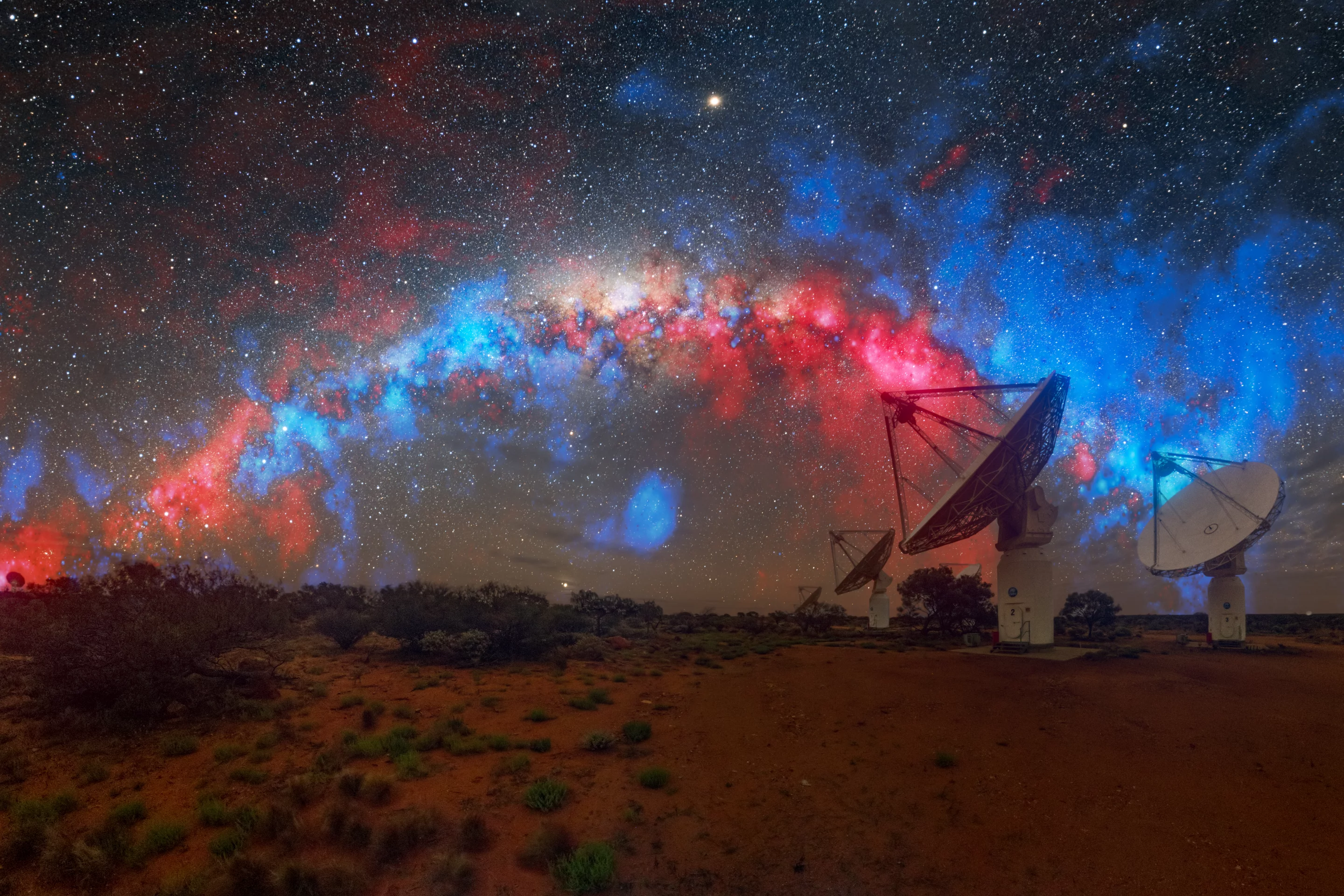
💡Access massive, high-fidelity astrophysical datasets for training complex pattern recognition and simulation models.
⚡ 30-Second TL;DR
What Changed
Map covers five times the area of all previous studies combined
Why It Matters
This high-resolution data set provides new opportunities for researchers to model large-scale cosmic phenomena using machine learning and advanced data analysis techniques.
What To Do Next
Explore the SKAO public data archives to integrate large-scale astrophysical datasets into your pattern recognition models.
Key Points
- •Map covers five times the area of all previous studies combined
- •Utilizes data from the SPICE-RACS project
- •Reveals previously 'invisible' cosmic magnetic structures
🧠 Deep Insight
Background and context from public sources — not the original article. 15 sources cited.
🔑 Enhanced Key Takeaways
- •The map was created by measuring how radio light twists as it travels through cosmic magnetic fields, a phenomenon known as Faraday rotation.
- •The data for the SPICE-RACS map was derived from reprocessed observations of nearly four million galaxies, originally detected during the Rapid ASKAP Continuum Surveys (RACS).
- •This extensive mapping effort is part of the Polarisation Sky Survey of the Universe's Magnetism (POSSUM) collaboration, an international team dedicated to studying cosmic magnetism.
- •The SPICE-RACS map covers approximately 87.5% of the celestial sphere, extending across the entire Southern Sky up to a declination of +49 degrees.
- •The second data release (DR2) of SPICE-RACS provides an areal density of 6.7 Faraday Rotation Measures (RMs) per square degree, representing a significant increase of about four times over previous state-of-the-art RM catalogues.
🛠️ Technical Deep Dive
- Telescope Used: CSIRO's Australian Square Kilometre Array Pathfinder (ASKAP) radio telescope.
- Observatory Location: Inyarrimanha Ilgari Bundara, the CSIRO Murchison Radio-astronomy Observatory on Wajarri Yamaji Country in Western Australia.
- Measurement Principle: Utilizes the Faraday rotation effect, where the plane of polarization of radio waves twists as they pass through magnetized plasma, to infer the presence and strength of magnetic fields.
- Data Source: Reprocessed data from the Rapid ASKAP Continuum Surveys (RACS), specifically the low-band component (RACS-low).
- Frequency Range: RACS-low operates at a central frequency of 887.5 MHz with a bandwidth of 288 MHz, and SPICE-RACS DR1 images across 744-1032 MHz with 1 MHz spectral resolution.
- Angular Resolution: The resulting images have an angular resolution of 25 arcseconds.
- Data Processing: A bespoke, highly parallelized software pipeline was developed to rapidly process wide-area spectro-polarimetric ASKAP observations.
- Output Data Products: The project produces 'cutout' spectral cubes in Stokes I, Q, and U around identified radio sources, and a broadband polarized radio component catalogue.
- Noise Performance: Stokes Q and U images exhibit an RMS noise of approximately 80 μJy PSF⁻¹.
- Polarization Sensitivity: The system can characterize components with a polarization fraction greater than or equal to 1%.
- Rotation Measure Density: The SPICE-RACS DR2 catalogue contains 3.4 x 10⁵ Faraday Rotation Measures (RMs) for components with a linearly polarized signal above 6σ, achieving an areal density of 6.7 RMs per square degree.
🔮 Future ImplicationsAI analysis grounded in cited sources
⏳ Timeline
📎 Sources (15)
Factual claims are grounded in the sources below. Forward-looking analysis is AI-generated interpretation.
Weekly AI Recap
Read this week's curated digest of top AI events →
👉Related Updates
AI-curated news aggregator. All content rights belong to original publishers.
Original source: cnBeta (Full RSS) ↗
This is a summary, not the original. Read the source, or get the weekly briefing.
The weekly digest
One email a week. Unsubscribe anytime.