來源cnBeta (Full RSS)•較早收集於 16h
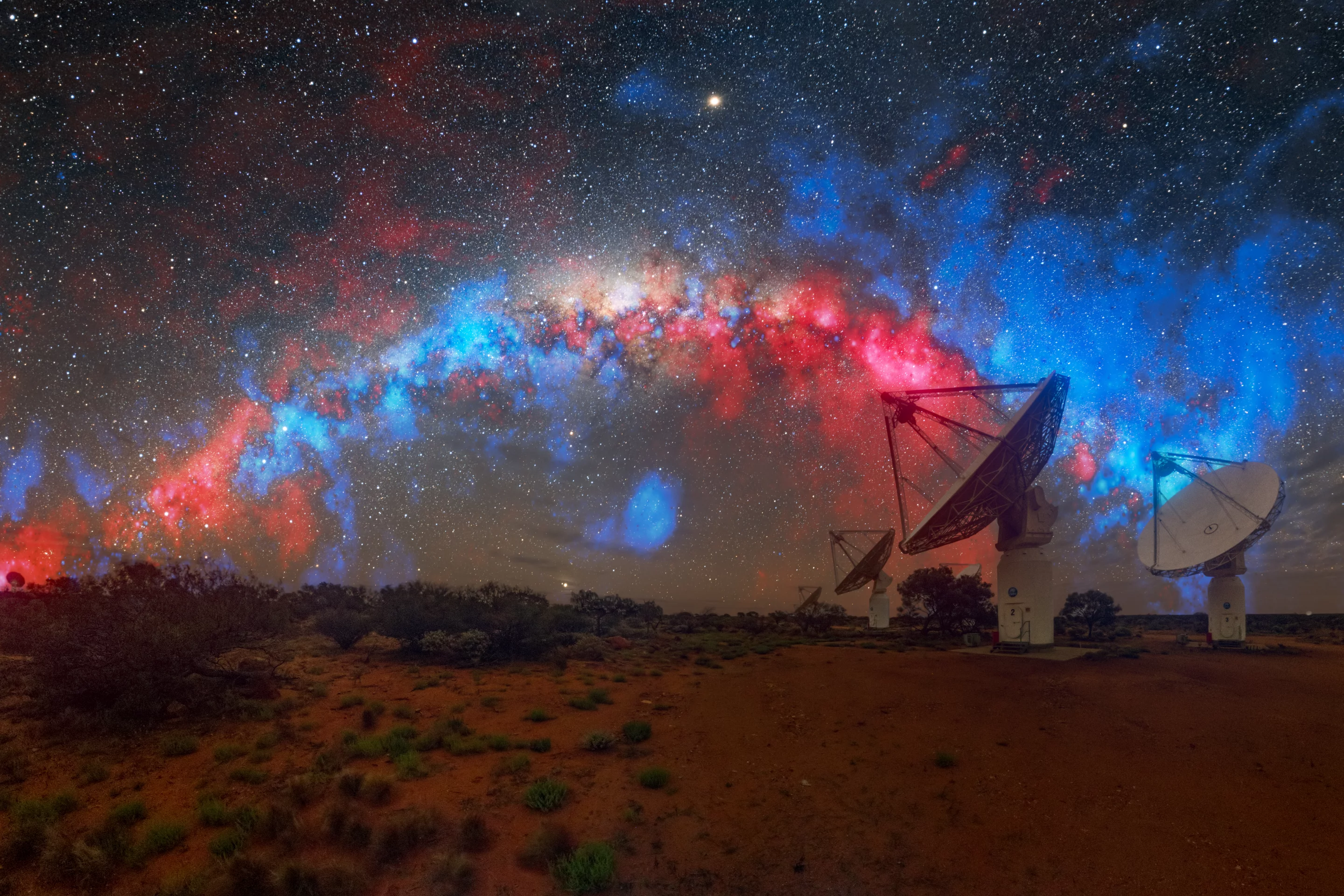
宇宙最大磁場地圖繪成
#astronomy#data-science#simulationspice-racscsiroskaospice-racs
💡獲取海量高保真天體物理數據集,用於訓練複雜的模式識別與模擬模型。
⚡ 30 秒速覽
有什麼變化
地圖覆蓋範圍超過以往所有研究總和的五倍
為什麼重要
此高解析度數據集為研究人員提供了利用機器學習與先進數據分析技術,對大規模宇宙現象進行建模的新機會。
下一步行動
探索 SKAO 公共數據存檔,將大規模天體物理數據集整合至您的模式識別模型中。
誰應關注:Researchers & Academics
關鍵要點
- •地圖覆蓋範圍超過以往所有研究總和的五倍
- •利用 SPICE-RACS 專案的觀測數據
- •揭示了原本「看不見」的宇宙磁場結構
🧠 深度解析
背景與延伸:來自公開資料,非原文內容。引用 15 個來源。
🔑 增強重點摘要
- •The map was created by measuring how radio light twists as it travels through cosmic magnetic fields, a phenomenon known as Faraday rotation.
- •The data for the SPICE-RACS map was derived from reprocessed observations of nearly four million galaxies, originally detected during the Rapid ASKAP Continuum Surveys (RACS).
- •This extensive mapping effort is part of the Polarisation Sky Survey of the Universe's Magnetism (POSSUM) collaboration, an international team dedicated to studying cosmic magnetism.
- •The SPICE-RACS map covers approximately 87.5% of the celestial sphere, extending across the entire Southern Sky up to a declination of +49 degrees.
- •The second data release (DR2) of SPICE-RACS provides an areal density of 6.7 Faraday Rotation Measures (RMs) per square degree, representing a significant increase of about four times over previous state-of-the-art RM catalogues.
🛠️ 技術深入
- Telescope Used: CSIRO's Australian Square Kilometre Array Pathfinder (ASKAP) radio telescope.
- Observatory Location: Inyarrimanha Ilgari Bundara, the CSIRO Murchison Radio-astronomy Observatory on Wajarri Yamaji Country in Western Australia.
- Measurement Principle: Utilizes the Faraday rotation effect, where the plane of polarization of radio waves twists as they pass through magnetized plasma, to infer the presence and strength of magnetic fields.
- Data Source: Reprocessed data from the Rapid ASKAP Continuum Surveys (RACS), specifically the low-band component (RACS-low).
- Frequency Range: RACS-low operates at a central frequency of 887.5 MHz with a bandwidth of 288 MHz, and SPICE-RACS DR1 images across 744-1032 MHz with 1 MHz spectral resolution.
- Angular Resolution: The resulting images have an angular resolution of 25 arcseconds.
- Data Processing: A bespoke, highly parallelized software pipeline was developed to rapidly process wide-area spectro-polarimetric ASKAP observations.
- Output Data Products: The project produces 'cutout' spectral cubes in Stokes I, Q, and U around identified radio sources, and a broadband polarized radio component catalogue.
- Noise Performance: Stokes Q and U images exhibit an RMS noise of approximately 80 μJy PSF⁻¹.
- Polarization Sensitivity: The system can characterize components with a polarization fraction greater than or equal to 1%.
- Rotation Measure Density: The SPICE-RACS DR2 catalogue contains 3.4 x 10⁵ Faraday Rotation Measures (RMs) for components with a linearly polarized signal above 6σ, achieving an areal density of 6.7 RMs per square degree.
🔮 前景展望基於引用來源的 AI 分析
The map will significantly advance understanding of the origin and evolution of cosmic magnetic fields.
By providing unprecedented detail and coverage, the map allows astronomers to investigate fundamental questions about how magnetic fields began in the Universe and how they have changed over billions of years.
The research will provide critical insights into galaxy formation and evolution.
Magnetic fields are known to influence how galaxies grow, how matter moves through space, and the overall evolution of the Universe, and this map offers a new perspective on these processes.
The methodologies and data will serve as a precursor and guide for the upcoming Square Kilometre Array (SKA) telescopes.
ASKAP is a precursor to the SKA, and the techniques developed for SPICE-RACS will inform future SKA observations, enabling even more detailed mapping of the cosmic web.
⏳ 時間線
1945-10
First successful radio astronomy observation in Australia by CSIR (later CSIRO) scientists.
1962
CSIRO's Parkes radio telescope opens, marking a significant milestone in Australian radio astronomy.
2019-04
Rapid ASKAP Continuum Survey (RACS-low) observations commenced, covering the entire Southern Sky.
2020
The first record-breaking RACS survey was completed, becoming the fastest and largest radio sky survey at the time.
2023-08
The first data release (DR1) of SPICE-RACS, the linearly polarized counterpart to RACS, was published.
2026-05
The second data release (DR2) of SPICE-RACS was published, establishing it as the largest single Rotation Measure catalogue ever produced.
📎 來源 (15)
Factual claims are grounded in the sources below. Forward-looking analysis is AI-generated interpretation.
📰
AI 週報
閱讀本週精選 AI 大事摘要 →
👉相關動態
AI 策展新聞聚合。所有內容版權歸原始發布者所有。
原始來源: cnBeta (Full RSS) ↗
每週電子報
每週一封,可隨時退訂。