Lab simulation validates Penrose's black hole energy theory
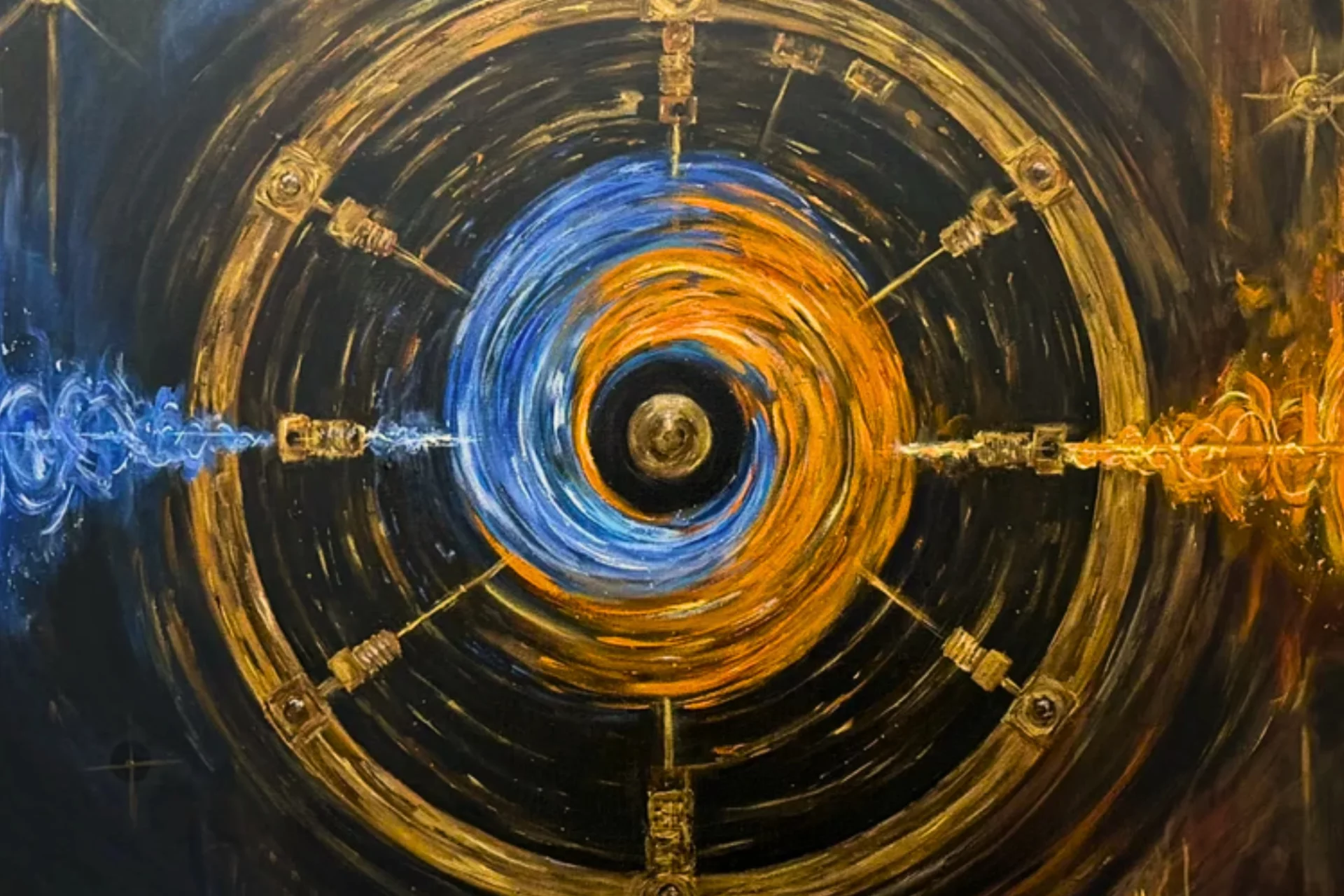
💡Groundbreaking physics experiment validates energy extraction theories from extreme celestial bodies.
⚡ 30-Second TL;DR
What Changed
Successfully simulated black hole energy extraction in a lab
Why It Matters
While theoretical, this research expands our understanding of energy extraction at extreme scales, which may influence future long-term energy physics research.
What To Do Next
Follow developments in high-energy physics simulations to understand potential long-term shifts in energy generation paradigms.
Key Points
- •Successfully simulated black hole energy extraction in a lab
- •Validates Sir Roger Penrose's theoretical prediction
- •Opens new paths for studying extreme celestial physics
🧠 Deep Insight
AI-generated analysis for this event — not the original article.
🔑 Enhanced Key Takeaways
- •The experiment utilized twisted sound waves (vortical acoustic waves) in a laboratory fluid to mimic the frame-dragging effect of a rotating black hole, known as the ergosphere.
- •Researchers observed the amplification of these sound waves, confirming the 'superradiance' phenomenon where waves extract rotational energy from the system.
- •This simulation provides the first direct empirical evidence for the Penrose process, which theorizes that particles entering the ergosphere can split, with one part falling into the event horizon and the other escaping with more energy than it started with.
- •The study demonstrates that the physics governing black hole energy extraction is universal and can be replicated in classical wave systems, not just in general relativity contexts.
- •This breakthrough bridges the gap between theoretical astrophysics and condensed matter physics, allowing researchers to study extreme gravitational phenomena using accessible tabletop experiments.
🛠️ Technical Deep Dive
- The experimental setup employed a rotating absorber (a rotating disk or fluid medium) to create a vortex that interacts with incident acoustic waves.
- The system relies on the conservation of angular momentum where the wave's frequency and azimuthal mode number determine the energy extraction efficiency.
- The amplification occurs when the wave frequency omega satisfies the condition 0 < omega < m * Omega, where m is the azimuthal mode number and Omega is the angular velocity of the rotating medium.
- The experiment measures the reflection coefficient of the acoustic waves, which exceeds unity when the superradiant condition is met, indicating energy gain from the rotating background.
🔮 Future ImplicationsAI analysis grounded in cited sources
⏳ Timeline
Weekly AI Recap
Read this week's curated digest of top AI events →
👉Related Updates
AI-curated news aggregator. All content rights belong to original publishers.
Original source: cnBeta (Full RSS) ↗
This is a summary, not the original. Read the source, or get the weekly briefing.
The weekly digest
One email a week. Unsubscribe anytime.