🐯虎嗅•Stalecollected in 21m
Karpathy: Software 3.0 Era Dawns
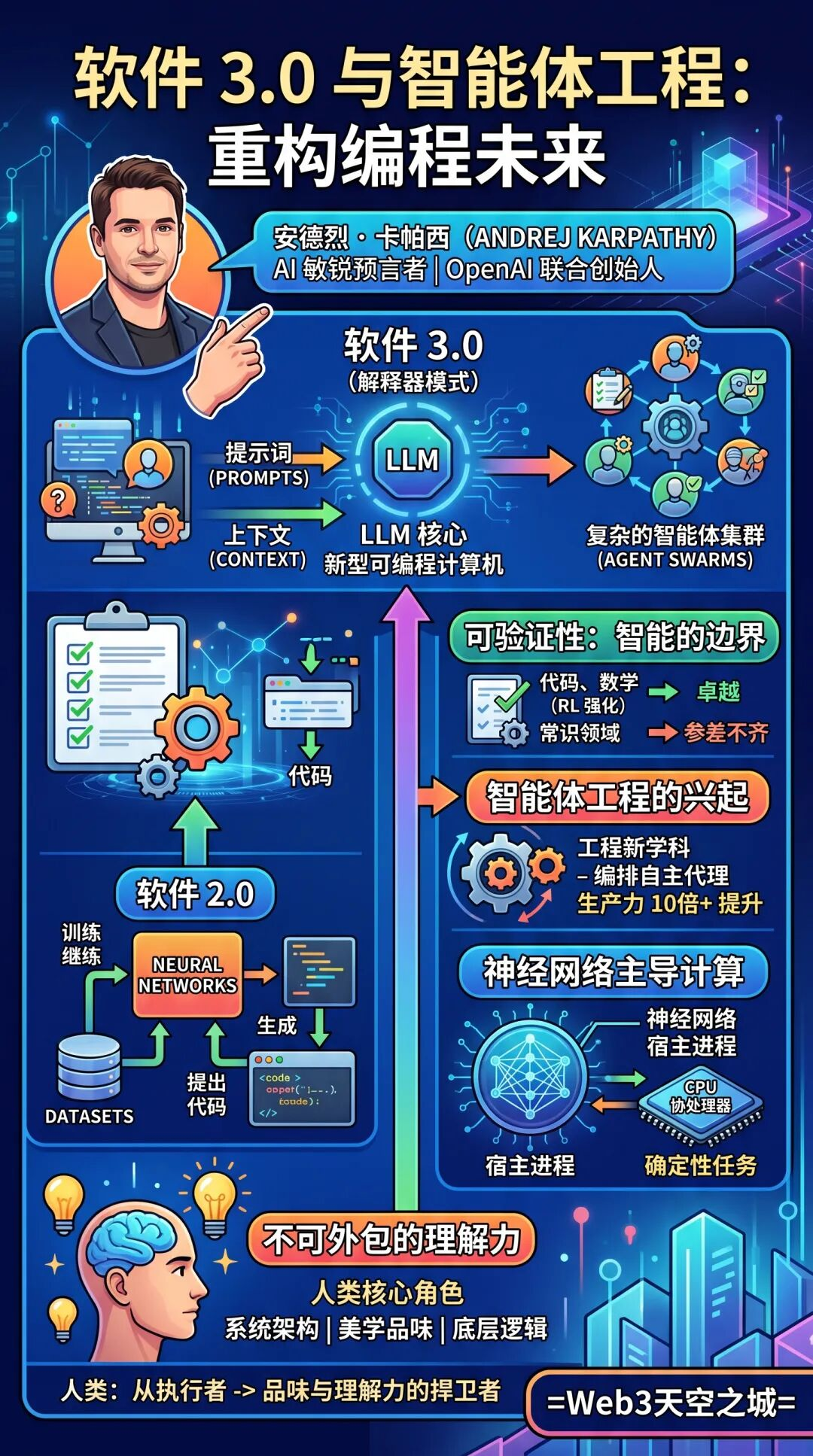
💡Karpathy's Software 3.0: prompts > code, agents 10x devs—your skills at risk
⚡ 30-Second TL;DR
What Changed
Software 3.0: prompts engineer LLMs as context interpreters
Why It Matters
Redefines programming paradigms, enabling massive productivity gains for agent-savvy developers. Shifts hiring to tool-using system builders. Prepares infrastructure for agent-native web.
What To Do Next
Build a multi-agent workflow with prompts in your LLM playground to test 3.0 productivity.
Who should care:Developers & AI Engineers
Key Points
- •Software 3.0: prompts engineer LLMs as context interpreters
- •AI excels in verifiable areas like code/math via RL training
- •Agentic engineering: orchestrate agents maintaining quality/safety
- •Human moat: taste, judgment, irreplaceable understanding
🧠 Deep Insight
AI-generated analysis for this event.
🔑 Enhanced Key Takeaways
- •Karpathy's 'Software 3.0' framework emphasizes a shift from explicit instruction-based programming to 'context-aware' systems where LLMs act as the primary interface for interpreting unstructured data and intent.
- •The transition relies heavily on the 'System 2' thinking paradigm, where agentic workflows incorporate iterative verification loops to mitigate the inherent hallucination risks of standard LLM inference.
- •The paradigm shift necessitates a move away from traditional software engineering roles toward 'AI Orchestration,' where the primary skill set involves managing the lifecycle, safety guardrails, and cost-efficiency of multi-agent clusters.
🛠️ Technical Deep Dive
- •Shift from Software 1.0 (human-written code) and 2.0 (neural network weights via backpropagation) to 3.0 (LLM-based orchestration of modular, agentic workflows).
- •Implementation of 'Chain-of-Thought' (CoT) and 'Tree-of-Thoughts' (ToT) architectures to enable agents to decompose complex tasks into verifiable sub-steps.
- •Integration of 'Self-Correction' loops where LLMs evaluate their own output against predefined constraints or external compilers before finalizing execution.
- •Utilization of RAG (Retrieval-Augmented Generation) as the primary mechanism for grounding LLM context in dynamic, domain-specific data environments.
🔮 Future ImplicationsAI analysis grounded in cited sources
Software development will transition from a syntax-heavy discipline to a systems-design discipline.
As LLMs handle the generation of boilerplate and logic, human engineers will focus on architectural oversight and the orchestration of agentic workflows.
The 'Software 3.0' era will lead to a significant reduction in the total lines of code (LOC) maintained in production systems.
Agentic systems replace static codebases with dynamic, prompt-driven logic that adapts to requirements without requiring manual refactoring.
⏳ Timeline
2017-06
Karpathy joins Tesla as Director of AI, pioneering large-scale neural network deployment for autonomous driving.
2022-11
Karpathy joins OpenAI, contributing to the development and scaling of the GPT-4 architecture.
2023-11
Karpathy departs OpenAI to focus on independent research, education, and the exploration of 'Software 2.0' and '3.0' paradigms.
2024-07
Karpathy launches Eureka Labs, an AI-native education platform, applying his theories on AI-human collaborative learning.
📰
Weekly AI Recap
Read this week's curated digest of top AI events →
👉Related Updates



AI-curated news aggregator. All content rights belong to original publishers.
Original source: 虎嗅 ↗