Jensen Huang's AI Future Vision Revealed
💡Nvidia CEO's take on real-time AI defining next decade—must for infra builders
⚡ 30-Second TL;DR
What Changed
Jensen Huang shares profound AI thoughts via blog
Why It Matters
Huang's views could influence Nvidia's roadmap and investor sentiment in AI hardware and compute.
What To Do Next
Read Jensen Huang's latest Nvidia blog for real-time AI strategy insights.
Key Points
- •Jensen Huang shares profound AI thoughts via blog
- •AI shifts to real-time intelligence generation
- •Debate on who shapes AI's next decade
🧠 Deep Insight
Background and context from public sources — not the original article. 8 sources cited.
🔑 Enhanced Key Takeaways
- •Nvidia's Rubin platform, named after astronomer Vera Rubin, is a six-chip AI system in full production, offering 5x inference and 3.5x training performance over Blackwell, potentially reducing AI token costs to one-tenth.[1][2][3]
- •Alpamayo introduces open-source reasoning vision-language-action models for autonomous vehicles, enabling cars to explain decisions, with first deployment in Mercedes-Benz CLA in early 2026.[1][3]
- •Nvidia unveiled domain-specific open AI models including Clara (healthcare), Cosmos (robotics), GR00T (embodied intelligence), and Nemotron (multimodal reasoning), trained on supercomputers to top leaderboards.[3]
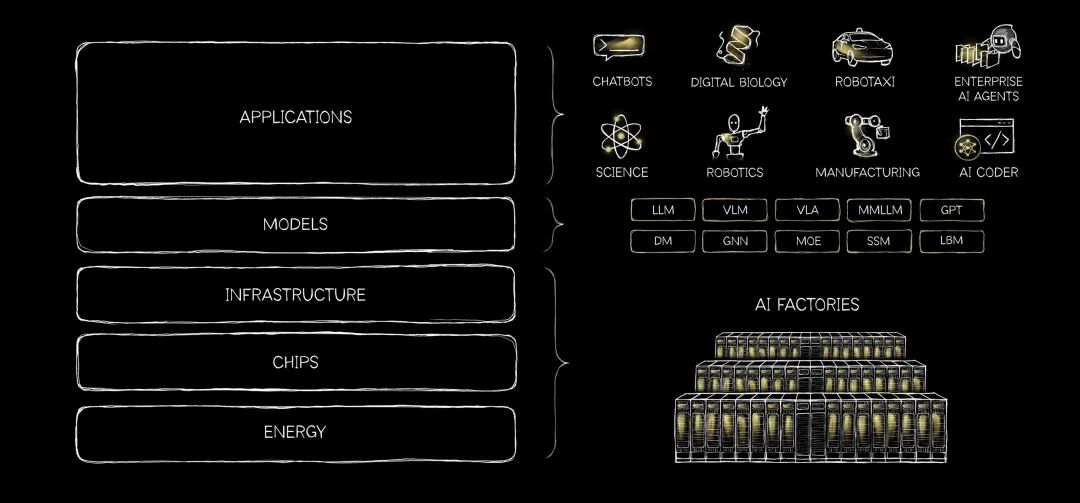
- •Huang described AI as a five-layer stack (energy, chips, cloud, models, applications) undergoing reinvention, with software now trained rather than programmed, driving a trillion-dollar infrastructure buildout.[2][5][6]
🔮 Future ImplicationsAI analysis grounded in cited sources
⏳ Timeline
📎 Sources (8)
Factual claims are grounded in the sources below. Forward-looking analysis is AI-generated interpretation.
- leverageshares.com — Nvidia at Ces 2026 Jensen Huang Reveals AI Roadmap
- quantumzeitgeist.com — Nvidias Vision for the AI Era Jensen Huang 2026
- iotm2mcouncil.org — Nvidia Chief Reveals AI Vision at Ces Opening
- timesofindia.indiatimes.com — 129408750
- weforum.org — Nvidia CEO Jensen Huang on the Future of AI
- ainvest.com — Decoding Vision AI 5 Layer Cake Nvidia Jensen Huang Means Investors 2603
- nvidianews.nvidia.com — Nvidia CEO Jensen Huang and Global Technology Leaders to Showcase Age of AI at Gtc 2026
- youtube.com — Watch
Weekly AI Recap
Read this week's curated digest of top AI events →
👉Related Updates
AI-curated news aggregator. All content rights belong to original publishers.
Original source: 钛媒体 ↗
This is a summary, not the original. Read the source, or get the weekly briefing.
Weekly AI briefing
One email a week. Unsubscribe anytime.