Jensen Huang's Sudden Long Article
💡Nvidia CEO's timely article may hint at AI strategy shifts
⚡ 30-Second TL;DR
What Changed
Jensen Huang releases long article
Why It Matters
Could preview Nvidia's next AI infrastructure moves. Relevant for practitioners tracking GPU and AI chip strategies.
What To Do Next
Locate and read Jensen Huang's full article on Nvidia blog.
Key Points
- •Jensen Huang releases long article
- •Unclear reasons for sudden timing
- •Potential Nvidia strategy signal
- •Sparks industry speculation
🧠 Deep Insight
Background and context from public sources — not the original article. 7 sources cited.
🔑 Enhanced Key Takeaways
- •Jensen Huang's blog post in early 2026 marks only his seventh long-form essay since 2016, making it a rare strategic communication that signals major industry inflection points rather than routine updates[1]
- •Huang explicitly framed 2025 as a turning point where AI systems achieved measurable reliability and economic value delivery across industries, positioning 2026 as the infrastructure scaling phase[1]
- •The timing aligns with GTC 2026 (keynote March 16, 2026) where Huang will outline NVIDIA's full-stack advancements across accelerated compute, AI factories, open models, agentic systems and physical AI[5]
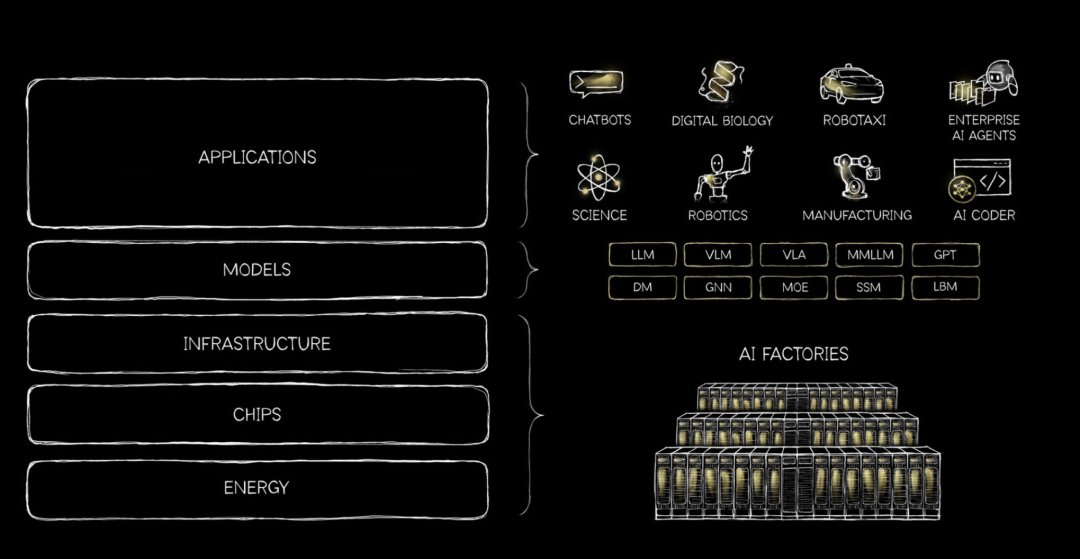
- •Huang emphasized that AI infrastructure build-out represents 'the largest infrastructure build-out in human history' requiring five interconnected layers (energy, chips, cloud, models, applications) to scale simultaneously[4]
- •The article addresses governance and access questions as critical determinants of AI's trajectory, reflecting growing regulatory scrutiny and geopolitical competition around AI sovereignty initiatives[1]
🛠️ Technical Deep Dive
- •NVIDIA's CUDA platform (launched 2006) functions as the foundational 'operating system' for the Intelligence Age, enabling GPU-based general-purpose parallel processing that became essential for deep learning[3]
- •The AI stack comprises five layers: energy/power infrastructure, semiconductor chips (GPUs, networking chips, CPUs), cloud computing infrastructure, AI models themselves, and applications[2][4]
- •Recent innovations include hybrid transformer-SSM models that balance speed and reasoning depth, with Nemotron 3 representing groundbreaking work in model architecture[2]
- •NVIDIA operates proprietary DGX clouds (AI supercomputers) built and operated internally to develop full-stack capabilities and guide industry direction[2]
- •Product roadmap accelerated to one-year cadence, indicating rapid iteration cycles across the full-stack platform[3]
🔮 Future ImplicationsAI analysis grounded in cited sources
⏳ Timeline
📎 Sources (7)
Factual claims are grounded in the sources below. Forward-looking analysis is AI-generated interpretation.
- timesofindia.indiatimes.com — 129408750
- youtube.com — Watch
- markets.chroniclejournal.com — Finterra 2026 3 10 Nvidia Nvda the Full Stack Architect of the AI Era March 2026 Analysis
- weforum.org — Nvidia CEO Jensen Huang on the Future of AI
- barchart.com — Nvidia CEO Jensen Huang and Global Technology Leaders to Showcase Age of AI at Gtc 2026
- investor.nvidia.com — Default
- aol.com — CEO Jensen Huang Just Delivered 082200609
Weekly AI Recap
Read this week's curated digest of top AI events →
👉Related Updates
AI-curated news aggregator. All content rights belong to original publishers.
Original source: 钛媒体 ↗
This is a summary, not the original. Read the source, or get the weekly briefing.
Weekly AI briefing
One email a week. Unsubscribe anytime.