Japan’s $4,000 Monster Wolf Robot Effectively Deters Wildlife
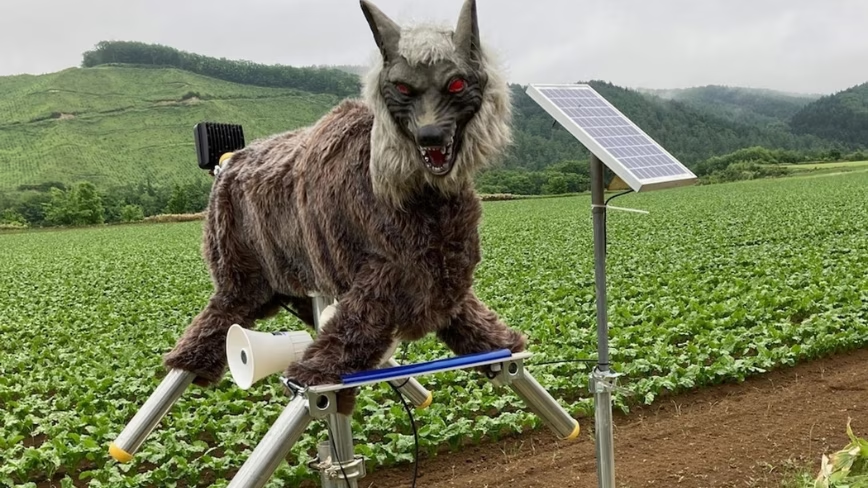
A practical example of embodied AI in the wild; see how simple robotics solve real-world environmental problems.
30-Second TL;DR
What Changed
Robot features glowing red LED eyes and realistic howling audio
Why It Matters
This highlights the growing market for embodied AI and specialized robotics in non-industrial, environmental management sectors.
What To Do Next
Analyze the sensor-to-actuator latency in this robot to understand basic autonomous response loops for your own hardware projects.
Key Points
- •Robot features glowing red LED eyes and realistic howling audio
- •Developed by Hokkaido-based manufacturer Ohta Seiki
- •Priced at $4,000 for wildlife management applications
Deep Insight
Background and context from public sources — not the original article. 16 sources cited.
Enhanced Key Takeaways
- •The Monster Wolf robot was initially introduced by Ohta Seiki in 2016 to deter deer, boars, and bears from crops, though it was initially perceived as a novelty.
- •A significant surge in demand for the Monster Wolf has occurred due to a record increase in bear encounters and attacks across Japan, with 13 fatalities reported during the 2025-2026 season.
- •Ohta Seiki is actively developing advanced versions of the robot, including mobile units equipped with wheels for patrolling routes, smaller handheld models for personal use by hikers and schoolchildren, and future iterations that may incorporate AI-powered cameras for automated wildlife detection.
- •The robot is capable of emitting over 50 distinct sounds, such as growls, howls, electronic noises, and human voices, which can be heard up to a kilometer away, and also features blue LED lights on its tail in addition to the red LED eyes.
- •Over 380 Monster Wolf units have been sold, and due to the high demand, customers currently face a waiting period of two to three months for delivery.
Technical Deep Dive
- The robot is powered by solar panels and utilizes motion sensors to automatically activate when animals approach.
- It can emit more than 50 different sound patterns, including growls, howls, electronic noises, and human voices, at a volume of up to 90 decibels, audible up to one kilometer (or half a mile) away.
- Visual deterrents include flashing red LED eyes and blue LED lights on its tail, with its head designed to waggle back and forth.
- The physical design features artificial fur draped over a pipe-frame body, topped with a menacing, open-mouthed face with white fangs.
- A portable version, the Monster Wolf Mini, is approximately 20 centimeters long, with an adjustable speaker volume up to 80 decibels.
- Future models are planned to integrate AI-powered cameras for automatic wildlife detection.
Future ImplicationsAI analysis grounded in cited sources
Timeline
- 2008Ohta Seiki developed an initial device to combat crop damage from deer.
- 2016Ohta Seiki first introduced the 'Monster Wolf' to deter wildlife, initially met with skepticism.
- 2017Farmers began deploying Monster Wolves in trials to protect crops from wild boars.
- 2018The Monster Wolf was officially launched and installed in various fields.
- 2024-12Ohta Seiki began development of the Monster Wolf Mini, a portable version.
- 2025-2026Japan experienced a record surge in bear encounters and attacks, leading to a significant increase in demand for the Monster Wolf.
Sources (16)
Factual claims are grounded in the sources below. Forward-looking analysis is AI-generated interpretation.
Weekly AI Recap
Read this week's curated digest of top AI events →
Related Updates




AI-curated news aggregator. All content rights belong to original publishers.
Original source: The Next Web (TNW) ↗
This is a summary, not the original. Read the source, or get the weekly briefing.
The weekly digest
One email a week. Unsubscribe anytime.