Japan Launches FRONTia Project for Physical AI Development
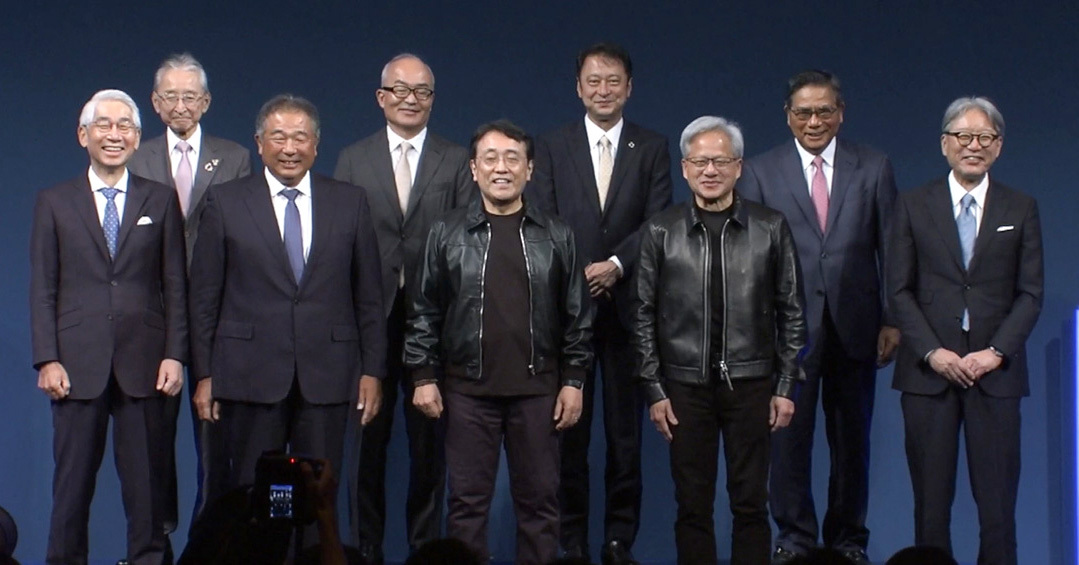
💡Japan's new national project targets 'Physical AI' by 2030, backed by NVIDIA and 44 major domestic firms.
⚡ 30-Second TL;DR
What Changed
METI launched the FRONTia Project to develop domestic physical AI foundation models.
Why It Matters
This project signals a major strategic shift for Japan to secure sovereignty in physical AI and robotics. It will likely create new opportunities for local hardware-software integration and industrial automation.
What To Do Next
Monitor the development of Noetra's foundation models and explore potential partnership opportunities for industrial robotics integration.
Key Points
- •METI launched the FRONTia Project to develop domestic physical AI foundation models.
- •The initiative involves Noetra, a joint venture of 44 Japanese companies, and AIST.
- •The long-term goal is to realize 'real-world native AI' applications by 2030.
- •NVIDIA CEO Jensen Huang expressed strong support for Japan's AI infrastructure development.
🧠 Deep Insight
AI-generated analysis for this event.
🔑 Enhanced Key Takeaways
- •The FRONTia Project focuses specifically on 'embodied AI' that integrates multimodal foundation models with robotic hardware to enable autonomous operation in unstructured environments.
- •Noetra serves as a centralized consortium platform designed to aggregate proprietary industrial data from its 44 member companies to train models that are more robust than general-purpose LLMs.
- •AIST (National Institute of Advanced Industrial Science and Technology) is providing the ABCI (AI Bridging Cloud Infrastructure) supercomputing resources to host the training workloads for FRONTia.
- •The project aims to solve the 'sim-to-real' gap by utilizing synthetic data generation pipelines that mirror Japanese manufacturing floor conditions.
- •METI has allocated a specific budget for the project to reduce Japan's reliance on US-based cloud providers for critical industrial AI infrastructure.
📊 Competitor Analysis▸ Show
| Feature | FRONTia (Japan) | Project GR00T (NVIDIA) | Google DeepMind Robotics |
|---|---|---|---|
| Focus | Industrial/Manufacturing | General Purpose Embodied | Research/General Purpose |
| Data Source | Consortium Proprietary | Synthetic/Simulation | Web/Video/Simulation |
| Primary Goal | Domestic Sovereignty | Ecosystem Dominance | Scientific Advancement |
🛠️ Technical Deep Dive
- Architecture utilizes a transformer-based foundation model capable of processing sensor fusion data (LiDAR, tactile, visual) in real-time.
- Implementation relies on a hierarchical control system where the foundation model handles high-level reasoning and a secondary low-latency layer manages motor control.
- Training pipeline incorporates Reinforcement Learning from Human Feedback (RLHF) specifically tuned for industrial safety protocols.
- Integration with ROS 2 (Robot Operating System) is standard to ensure interoperability across different hardware manufacturers within the consortium.
🔮 Future ImplicationsAI analysis grounded in cited sources
⏳ Timeline
Weekly AI Recap
Read this week's curated digest of top AI events →
👉Related Updates

AI-curated news aggregator. All content rights belong to original publishers.
Original source: ITmedia AI+ (日本) ↗