Jamf Enforces Real-Time Bedrock Spending Limits
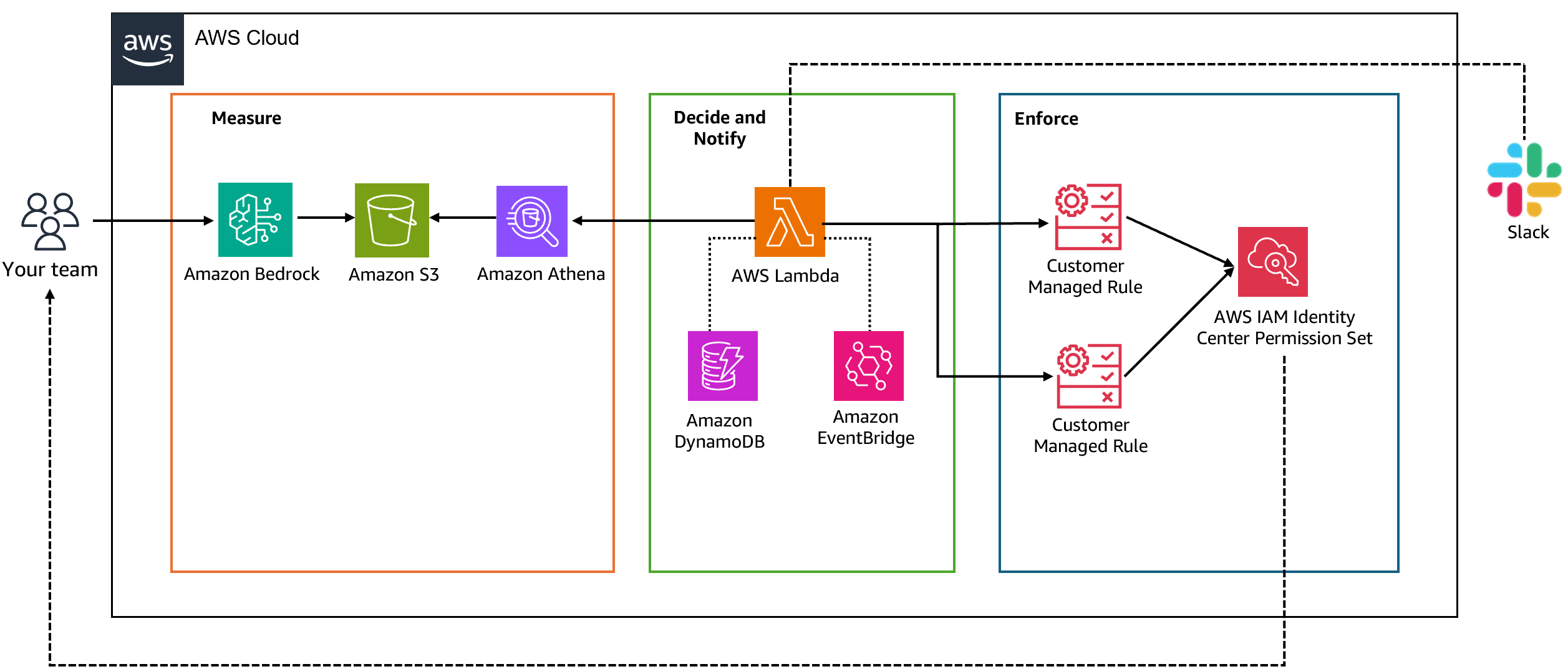
💡Learn how to cap per-user Bedrock costs in near-real-time without disrupting active AI sessions.
⚡ 30-Second TL;DR
What Changed
Jamf implemented per-user spend enforcement for Amazon Bedrock.
Why It Matters
This approach gives enterprises a practical way to control generative AI costs at individual-user granularity. It can reduce runaway usage while preserving access for active workloads instead of relying on disruptive hard shutdowns.
What To Do Next
Prototype a Bedrock budget controller that reads an Athena cost view and updates IAM Customer Managed Policies through AWS Lambda.
Key Points
- •Jamf implemented per-user spend enforcement for Amazon Bedrock.
- •Amazon Athena provides a cost view used to determine usage tiers.
- •AWS Lambda applies tiered model limits near-real-time without interrupting active sessions.
- •IAM Customer Managed Policies provide the enforcement mechanism.
🧠 Deep Insight
Background and context from public sources — not the original article. 9 sources cited.
🔑 Enhanced Key Takeaways
- •Jamf's architecture specifically addresses the 'tokenomics' challenge where agentic coding loops can cause exponential cost spikes that traditional cloud billing models fail to capture.
- •The system utilizes a tiered access strategy, allowing users to downgrade to lower-cost models like Claude Haiku when they hit 80% of their daily budget, rather than cutting off access entirely.
- •The solution leverages evolving AWS native capabilities such as Application Inference Profiles and IAM principal-based cost allocation to achieve granular, individual-level cost attribution.
- •Jamf's implementation serves as a 'best-in-class' pattern for enterprises to solve the 'spend blindness' issue inherent in shared, token-based AI services.
- •The development of this system was driven by the need to provide engineers with broad AI access while maintaining financial guardrails, a requirement necessitated by the rapid scaling of Bedrock usage in large enterprises.
📊 Competitor Analysis▸ Show
| Feature | Jamf (AWS Native) | AI Gateways (Portkey/LiteLLM) | Observability Platforms (Helicone/Amnic) |
|---|---|---|---|
| Architecture | Serverless (Lambda/IAM) | Proxy-based | Agentless/Proxy-based |
| Enforcement | IAM Policy modification | Request interception | Monitoring/Alerting |
| Integration | AWS Native | Middleware | API-based |
| Latency | Near-real-time | Adds network hop | Minimal impact |
🛠️ Technical Deep Dive
- Enforcement Loop: Uses a serverless AWS Lambda function to poll cost data and update IAM Customer Managed Policies (CMPs) dynamically.
- Data Source: Amazon Athena queries AWS Cost and Usage Reports (CUR) to aggregate per-user token consumption.
- Policy Management: Dynamically attaches/detaches IAM policies to restrict or grant access to specific Bedrock model ARNs based on real-time budget thresholds.
- Attribution: Relies on IAM principal-based cost allocation tags to map Bedrock API calls to individual engineers.
- Tiering Logic: Implements a threshold-based state machine that transitions users between model access tiers (e.g., High-cost to Low-cost) without requiring session re-authentication.
🔮 Future ImplicationsAI analysis grounded in cited sources
⏳ Timeline
📎 Sources (9)
Factual claims are grounded in the sources below. Forward-looking analysis is AI-generated interpretation.
Weekly AI Recap
Read this week's curated digest of top AI events →
👉Related Updates

AI-curated news aggregator. All content rights belong to original publishers.
Original source: AWS Machine Learning Blog ↗
This is a summary, not the original. Read the source, or get the weekly briefing.
Weekly AI briefing
One email a week. Unsubscribe anytime.