Isaac ROS 5.0 Pushes Agentic Robotics Forward
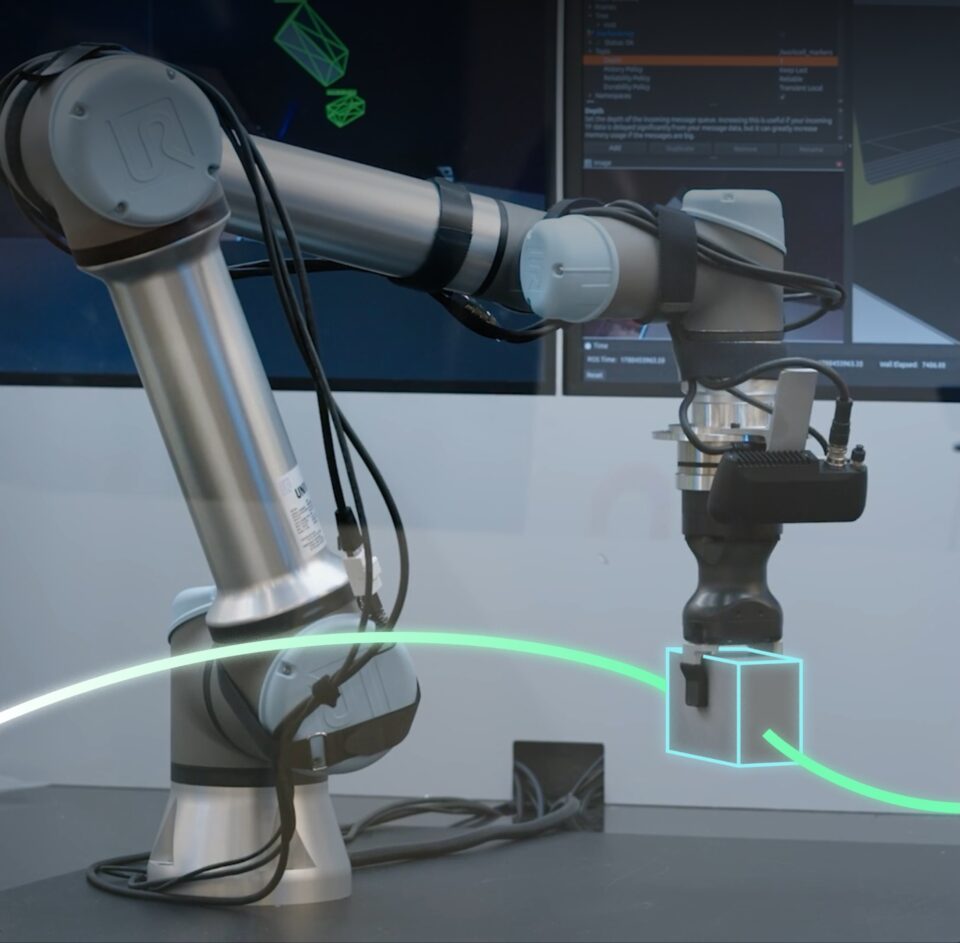
NVIDIA’s latest ROS stack targets robots that reason and act, not just perceive.
30-Second TL;DR
What Changed
Isaac ROS 5.0 provides GPU-accelerated packages for the ROS ecosystem.
Why It Matters
The release could lower the engineering effort needed to connect perception, planning, and action in robotic systems. Better ROS integration may accelerate experimentation with physical AI across research and industrial settings.
What To Do Next
Install Isaac ROS 5.0 in a ROS 2 test workspace and validate one perception-to-action pipeline on your target NVIDIA GPU.
Key Points
- •Isaac ROS 5.0 provides GPU-accelerated packages for the ROS ecosystem.
- •The release targets robots that perceive, reason, and act in dynamic environments.
- •NVIDIA positions the update as supporting agentic and open-source robotics development.
- •The tools are intended to help developers build and deploy physical AI applications.
Deep Insight
Background and context from public sources — not the original article. 11 sources cited.
Enhanced Key Takeaways
- •Isaac ROS 5.0 was unveiled at ROSCon in Toronto, explicitly tailored to reach the global community of approximately 1.3 million ROS developers.
- •The release introduces agentic development workflows, featuring prebuilt skills like 'migrate-node-to-rosidl-buffer' and LLM-ready documentation that allow AI coding agents to refactor nodes and tune pipelines autonomously.
- •NVIDIA partnered with the Open Source Robotics Alliance (OSRA) to upstream 'rosidl::buffer' into ROS Lyrical Luth, enabling zero-copy GPU memory transport across middleware like Zenoh and Fast DDS.
- •Performance optimizations yielded up to a 5.5x inference speedup for FoundationPose 6D tracking and enabled warehouse arm trajectory calculations within 2 to 5 milliseconds via isaac_ros_cumotion.
- •Package management was modernized using Prefix.dev's Pixi to achieve reproducible, container-light developer environments across platforms spanning Jetson Orin Nano to Jetson Thor.
Technical Deep Dive
- Zero-Copy Transport Architecture: Upstream contribution of
rosidl::bufferto ROS Lyrical allows GPU-resident memory payloads to transfer across nodes without traversing CPU memory or incurring serialization bottlenecks, supporting middleware backends such asrmw_fastrtps_cppandrmw_zenoh_cpp. - Full CUDA Buffer Backend Migration: Every native Isaac ROS 5.0 perception and inference node (including FoundationStereo and metric depth nodes) was migrated to the CUDA buffer backend to completely bypass host-device copy overhead.
- Agentic Automation Primitives: Incorporates purpose-built agent tools, including the
migrate-node-to-rosidl-bufferskill, alongside machine-readable API documentation engineered for autonomous LLM coding agents. - Accelerated Pose and Motion Models: Optimized TensorRT runtime deployment provides a 5.5x inference acceleration for FoundationPose (6D pose estimation/tracking) and reduces
isaac_ros_cumotioncollision-free arm trajectory planning latency to 2–5 ms. - Runtime & Environment Support: Direct support for Ubuntu 24.04 LTS and ROS Lyrical Luth, unified dependency management via Pixi, and compatibility across hardware tiers from Jetson Orin Nano up to Jetson Thor developer kits.
Future ImplicationsAI analysis grounded in cited sources
rosidl::buffer into ROS Lyrical removes the longstanding CPU serialization bottleneck across standard transports like Zenoh and DDS, making host-to-device memory copies obsolete in multi-sensor perception stacks.Timeline
- 2026-09NVIDIA launches Isaac ROS 5.0 with zero-copy CUDA buffers and agentic workflows at ROSCon Toronto
Sources (11)
Factual claims are grounded in the sources below. Forward-looking analysis is AI-generated interpretation.
Weekly AI Recap
Read this week's curated digest of top AI events →
AI-curated news aggregator. All content rights belong to original publishers.
Original source: NVIDIA Blog ↗
This is a summary, not the original. Read the source, or get the weekly briefing.
The weekly digest
One email a week. Unsubscribe anytime.