SourceThe Next Web (TNW)•Stalecollected in 50m
iPhone Factory Builds Marathon-Running Assembly Robot
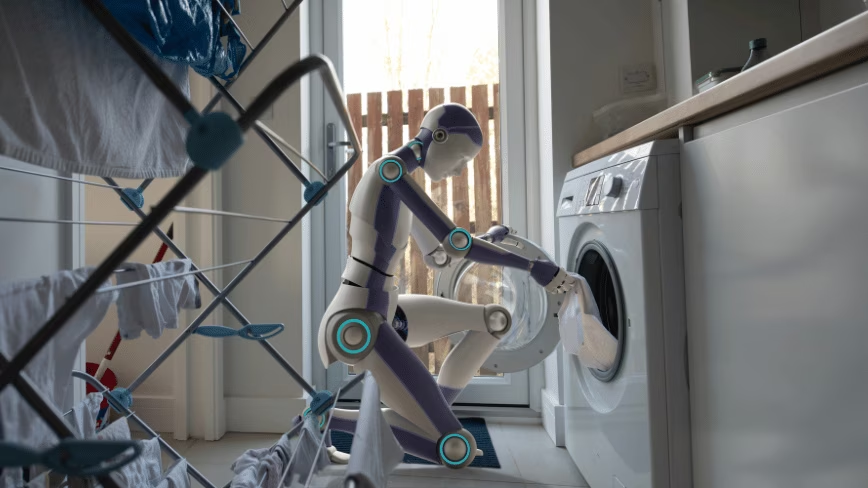
Humanoid robot aces half-marathon: key for factory automation in AI hardware.
30-Second TL;DR
What Changed
Honor D1: 48:19 remote, 50:26 autonomous half-marathon
Why It Matters
Advances embodied AI for manufacturing, potentially automating iPhone production and reducing labor costs.
What To Do Next
Benchmark your embodied AI robot against Honor D1's marathon times for mobility progress.
Who should care:Researchers & Academics
Key Points
- •Honor D1: 48:19 remote, 50:26 autonomous half-marathon
- •Beat all 112 robots in Beijing race
- •Liquid-cooling from Honor smartphones
- •iPhone factory shifting to robot production for assembly
Deep Insight
AI-generated analysis for this event — not the original article.
Enhanced Key Takeaways
- •The Honor D1 utilizes a proprietary 'Honor AI Motion Engine' that integrates real-time gait optimization, allowing it to adapt to uneven terrain during the half-marathon without falling.
- •The transition of the iPhone assembly facility involves a 'Digital Twin' manufacturing strategy, where the robots are trained in a virtual environment that mirrors the exact physical constraints of the assembly line before deployment.
- •Beyond liquid cooling, the robot incorporates Honor's 'Silicon-Carbon' battery technology, which provides a 20% higher energy density compared to standard lithium-ion packs used in competing humanoid platforms.
Competitor Analysis
Primary Focus
- Honor D1
- Precision Assembly
- Tesla Optimus Gen 3
- General Purpose
- Figure 02
- Industrial/Logistics
Cooling Tech
- Honor D1
- Smartphone Liquid Cooling
- Tesla Optimus Gen 3
- Air/Passive
- Figure 02
- Active Liquid
Half-Marathon Time
- Honor D1
- 50:26 (Autonomous)
- Tesla Optimus Gen 3
- N/A
- Figure 02
- N/A
Target Market
- Honor D1
- Electronics Manufacturing
- Tesla Optimus Gen 3
- Consumer/Industrial
- Figure 02
- Commercial/Logistics
| Feature | Honor D1 | Tesla Optimus Gen 3 | Figure 02 |
|---|---|---|---|
| Primary Focus | Precision Assembly | General Purpose | Industrial/Logistics |
| Cooling Tech | Smartphone Liquid Cooling | Air/Passive | Active Liquid |
| Half-Marathon Time | 50:26 (Autonomous) | N/A | N/A |
| Target Market | Electronics Manufacturing | Consumer/Industrial | Commercial/Logistics |
Technical Deep Dive
- Actuation: Uses high-torque harmonic drive actuators with integrated force-torque sensors at every joint for sub-millimeter precision.
- Vision System: Dual-depth 3D LiDAR sensors combined with 8K resolution stereoscopic cameras for spatial awareness.
- Thermal Management: Employs a micro-pump liquid cooling loop derived from the Honor Magic series, specifically targeting the CPU/NPU cluster to prevent thermal throttling during high-intensity assembly tasks.
- Architecture: Distributed control system with a dedicated real-time OS for motor control and a secondary Linux-based layer for high-level AI reasoning and path planning.
Future ImplicationsAI analysis grounded in cited sources
Humanoid robots will replace 30% of manual assembly labor in iPhone factories by 2028.
The successful integration of high-precision liquid-cooled robots into existing assembly lines demonstrates technical readiness for complex, repetitive electronics manufacturing tasks.
Smartphone thermal management patents will become a primary revenue stream for mobile OEMs in the robotics sector.
The adaptation of smartphone-specific cooling tech to solve overheating issues in high-performance humanoid robots creates a new licensing opportunity for hardware manufacturers.
Timeline
2024-03
Honor announces strategic pivot toward AI-integrated robotics research.
2025-06
First prototype of the Honor D1 humanoid platform undergoes internal testing.
2026-04
Honor D1 completes the Beijing half-marathon, setting a new record for autonomous humanoid performance.
- 2024-03Honor announces strategic pivot toward AI-integrated robotics research.
- 2025-06First prototype of the Honor D1 humanoid platform undergoes internal testing.
- 2026-04Honor D1 completes the Beijing half-marathon, setting a new record for autonomous humanoid performance.
Weekly AI Recap
Read this week's curated digest of top AI events →
Related Updates


AI-curated news aggregator. All content rights belong to original publishers.
Original source: The Next Web (TNW) ↗
This is a summary, not the original. Read the source, or get the weekly briefing.
The weekly digest
One email a week. Unsubscribe anytime.