iPhone 17 Pro Prices Surge on Chip Shortage
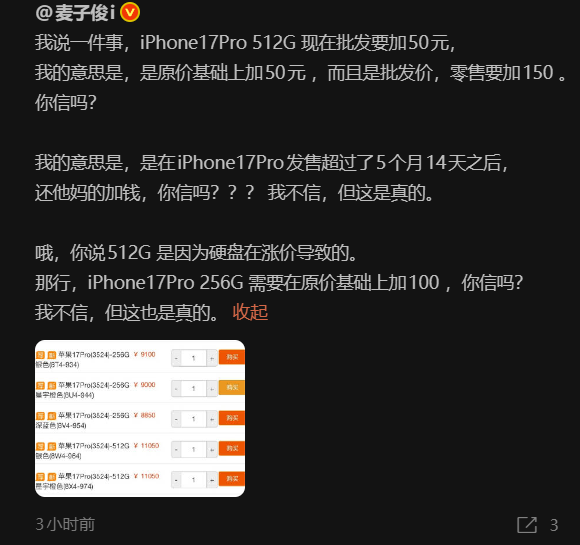
💡AI data centers spike storage prices 83%—budget more for ML infra now
⚡ 30-Second TL;DR
What Changed
512GB iPhone 17 Pro wholesale +50 RMB, retail +150 RMB amid stock shortages.
Why It Matters
AI data centers exacerbate storage shortages, hiking costs for ML hardware and consumer devices. Short-term price surges likely until new capacity online in 1.5-2 years.
What To Do Next
Secure DRAM/NAND supplies now for your AI training rigs before further AI demand spikes.
Key Points
- •512GB iPhone 17 Pro wholesale +50 RMB, retail +150 RMB amid stock shortages.
- •Apple accepts Samsung's 100% LPDDR5X memory price hike.
- •DRAM prices up 83%, NAND 1.5x since Sep 2025 due to AI-driven supply shift.
🧠 Deep Insight
Background and context from public sources — not the original article. 9 sources cited.
🔑 Enhanced Key Takeaways
- •Apple's iPhone 17 Pro uses TSMC's N3P fabrication technology, and foundry capacity constraints are structurally harder to resolve than memory shortages because production is booked well in advance and cannot be easily shifted between process nodes without chip redesign[1].
- •The global smartphone market is expected to contract by 12.9% in 2026 (shipping 1.1 billion units versus 1.26 billion in 2025), with budget Android devices disproportionately affected due to thin profit margins, while Apple's premium positioning allows it to absorb higher memory costs better than competitors[4][6].
- •Memory manufacturers Samsung, SK Hynix, and Micron are redirecting production capacity from consumer-grade DRAM to data center-grade HBM, which yields fewer chips per wafer and requires more silicon wafers, creating a structural supply imbalance expected to persist through H2 2027[2][8].
- •IDC forecasts 2026 DRAM and NAND supply growth at only 16% and 17% year-on-year respectively—below historical norms—and memory prices are not expected to return to 2025 levels even after the shortage resolves, signaling a permanent market shift[3][4].
🛠️ Technical Deep Dive
- •iPhone 17 and iPhone 17 Pro use Apple's A19 and A19 Pro chips manufactured by TSMC using N3P (3nm-class) fabrication technology[1]
- •Apple sources approximately 60% of its DRAM from Samsung Electronics, with the remainder from SK Hynix and Micron; NAND supply comes primarily from Samsung, SK Hynix, and Kioxia[7]
- •The memory types affected include LPDDR5X (used in iPhone 17 models), HBM (high-bandwidth memory for AI servers), and 3D NAND flash storage; Apple has qualified YMTC's 3D NAND memory for iPhones sold in China[1][5]
- •HBM production is more complex than standard DRAM and yields fewer chips per wafer, requiring significantly more silicon wafers to meet AI server demand[2]
🔮 Future ImplicationsAI analysis grounded in cited sources
⏳ Timeline
📎 Sources (9)
Factual claims are grounded in the sources below. Forward-looking analysis is AI-generated interpretation.
- Tom's Hardware — Apple Concedes It Is Constrained by Tsmcs Supply of Advanced Chips Storage and Memory Are Also in Short Supply Firm Isnt Projecting Supply Conditions Beyond the Second Quarter
- appleinsider.com — The Global Ram and Ssd Shortage Crisis Explained
- idc.com — Global Memory Shortage Crisis Market Analysis and the Potential Impact on the Smartphone and Pc Markets in 2026
- macrumors.com — Dram Shortage Apple Less Affected
- appleinsider.com — Ram Supply Is So Tight Samsung May Be Charging Apple Double
- 9to5mac.com — Iphone Could Benefit From Memory Chip Crisis in One Key Way Report
- techradar.com — Is Apple Set to Turn to China for Its Next Memory Partner Mac Maker Reportedly Searching for New Friends As Negotiations Get Tricky
- TechCrunch — Memory Shortage Could Cause the Biggest Smartphone Shipments Dip in Over a Decade
- letemsvetemapplem.eu — Analytici Vyssi Ceny Pametovych Cipu Iphony Neohrozi
Weekly AI Recap
Read this week's curated digest of top AI events →
👉Related Updates

AI-curated news aggregator. All content rights belong to original publishers.
Original source: 虎嗅 ↗
This is a summary, not the original. Read the source, or get the weekly briefing.
Weekly AI briefing
One email a week. Unsubscribe anytime.