iOS 27 and iPadOS 27 maintain broad device support
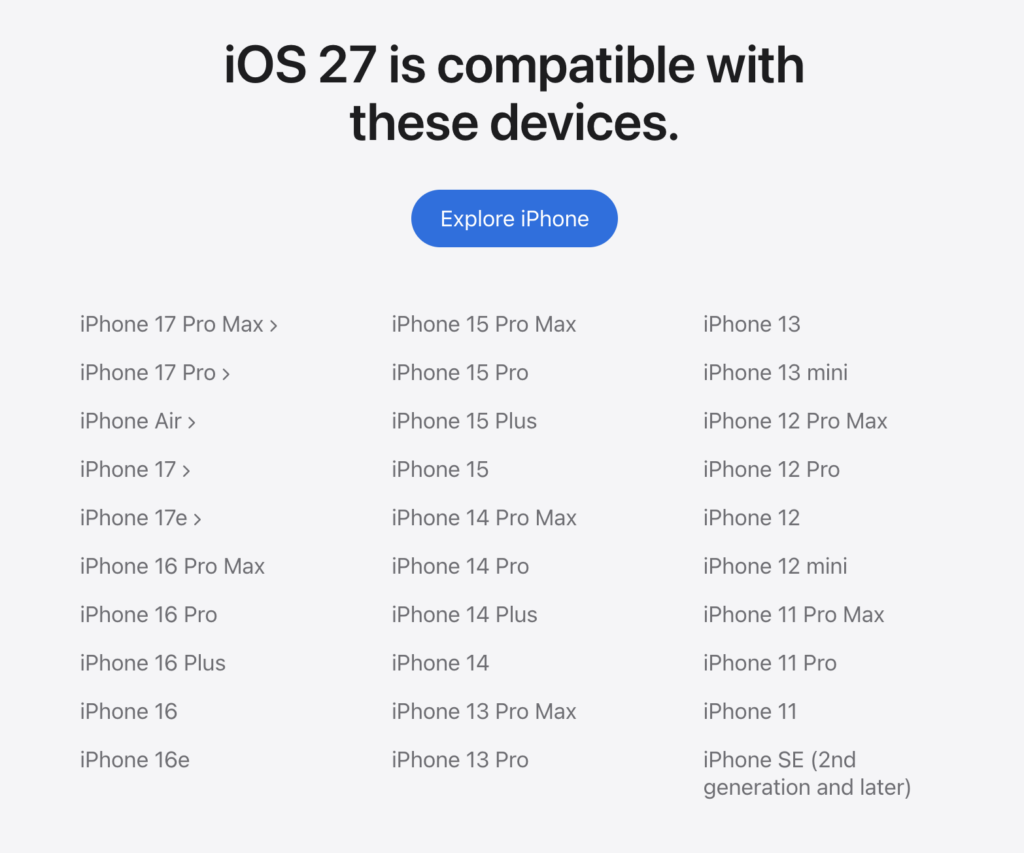
💡Check if your target user base remains supported for the latest AI-integrated mobile OS features.
⚡ 30-Second TL;DR
What Changed
No iPhone models dropped from support
Why It Matters
Maintaining broad support allows developers to target a larger user base for applications leveraging Apple's on-device AI frameworks.
What To Do Next
Review Apple's Core ML documentation to prepare your apps for the latest OS-level AI capabilities.
Key Points
- •No iPhone models dropped from support
- •Minimal iPad models removed from compatibility list
- •Broad reach for upcoming OS-level AI features
🧠 Deep Insight
Background and context from public sources — not the original article. 21 sources cited.
🔑 Enhanced Key Takeaways
- •Apple's on-device AI features, including those in the upcoming iOS 27 and iPadOS 27, are primarily powered by its custom-designed Neural Engine, first introduced in the A11 Bionic chip in 2017.
- •Apple maintains a competitive advantage through its long-term software support, typically providing 6-8 years of major iOS and iPadOS updates and often extending security patches for older devices beyond that period.
- •The advanced generative AI capabilities, collectively known as Apple Intelligence, were introduced with iOS 18 and iPadOS 18 and require devices equipped with an M-series chip or an A17 Pro chip or newer, indicating a hardware-specific cutoff for the most sophisticated AI features.
- •Apple's vertical integration, encompassing both hardware (A-series and M-series chips with Neural Engines) and software (iOS/iPadOS and Core ML framework), is fundamental to optimizing performance, ensuring broad device compatibility, and enabling efficient on-device AI processing.
📊 Competitor Analysis▸ Show
| Feature | Apple (iOS) | Android (General / Flagships) |
|---|---|---|
| OS Update Consistency | High, unified, rapid deployment across compatible devices. | Fragmented, varies significantly by OEM and carrier; often delayed. |
| Major OS Update Lifespan | Typically 6-8 years for major OS updates. | Flagship models offer up to 5 years of major updates; budget models have shorter lifespans. |
| Security Update Lifespan | Often extends beyond major OS updates for several additional years. | Major manufacturers (e.g., Google Pixel, Samsung) offer multi-year security patch commitments. |
| On-device AI Approach | Dedicated Neural Engine in A-series and M-series chips; Core ML framework for developers; Apple Intelligence for system-level generative AI. | NPUs integrated into SoCs (e.g., Qualcomm Hexagon, Google Tensor, Samsung Exynos); AI capabilities vary widely by hardware and OEM implementation. |
| Ecosystem Integration | Tight hardware-software control leads to seamless cross-device features and a cohesive user experience. | Open ecosystem offers flexibility and customization but can result in inconsistent experiences and optimization issues. |
🛠️ Technical Deep Dive
- Neural Engine (NPU): Apple's dedicated AI accelerator, first introduced in the A11 Bionic chip in September 2017.
- Functionality: Designed to accelerate machine learning tasks, particularly matrix multiplications, which are core to neural networks. It handles real-time AI-driven applications like Face ID, Siri, augmented reality, and computational photography.
- Performance Evolution: The Neural Engine has significantly increased in processing power over generations. The A11 Bionic offered 0.6 trillion operations per second (TOPS), the A14 reached 11 TOPS, the A15 achieved 15.8 TOPS, the A17 Pro delivered 35 TOPS, and the M4 chip can perform up to 38 TOPS.
- Software Integration: Fully integrated with Apple's Core ML framework, allowing developers to run machine learning models efficiently on-device.
- Hardware-Software Synergy: Apple's vertical integration, designing its own custom A-series and M-series chips, enables deep optimization between hardware components (CPU, GPU, Neural Engine) and the iOS/iPadOS operating system. This includes custom memory controllers and unified memory architecture for low-latency data access, crucial for sustained performance and AI tasks.
- Apple Intelligence Requirements: The generative AI features of Apple Intelligence specifically require devices powered by an Apple M-series chip or an A17 Pro chip or newer, indicating a baseline Neural Engine performance and RAM requirement for these advanced capabilities.
🔮 Future ImplicationsAI analysis grounded in cited sources
⏳ Timeline
📎 Sources (21)
Factual claims are grounded in the sources below. Forward-looking analysis is AI-generated interpretation.
Weekly AI Recap
Read this week's curated digest of top AI events →
👉Related Updates
AI-curated news aggregator. All content rights belong to original publishers.
Original source: Ars Technica ↗
This is a summary, not the original. Read the source, or get the weekly briefing.
The weekly digest
One email a week. Unsubscribe anytime.