Intel launches OpenVINO Physical AI Framework for robotics
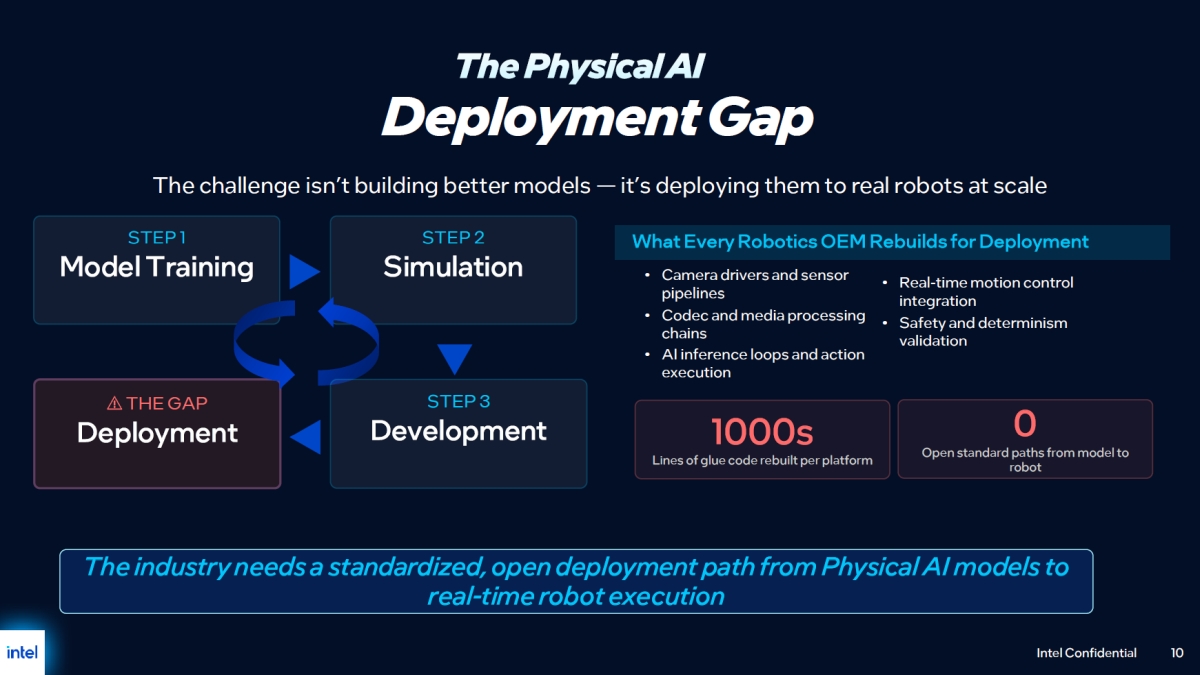
💡Optimize your robotics AI inference performance directly on Intel hardware with this new open-source framework.
⚡ 30-Second TL;DR
What Changed
OpenVINO Physical AI Framework is now part of the Robotics AI Suite
Why It Matters
This update lowers the barrier for developers to deploy high-performance AI models on edge robotics hardware. It strengthens Intel's position in the embodied AI market by leveraging its existing processor ecosystem.
What To Do Next
If you are building edge robotics, download the latest Robotics AI Suite and benchmark your current inference models using the new OpenVINO Physical AI Framework.
Key Points
- •OpenVINO Physical AI Framework is now part of the Robotics AI Suite
- •Provides inference runtimes specifically optimized for Intel hardware
- •Designed to streamline and solve common robotics development bottlenecks
🧠 Deep Insight
Background and context from public sources — not the original article. 16 sources cited.
🔑 Enhanced Key Takeaways
- •The OpenVINO Physical AI Framework is specifically designed to address what Intel identifies as the 'missing link' in deploying physical AI at scale, aiming to overcome the need for highly customized pipelines for each robot, which historically led to increased total cost of ownership (TCO) and maintenance complexity.
- •It leverages Vision-Language-Action (VLA) models, enabling physical systems such as robots, autonomous vehicles, and industrial machines to perceive their environment, make decisions, and execute actions in the real world, moving beyond traditional AI's digital-only outputs.
- •The framework is integrated into Intel's broader Robotics AI Suite, which encompasses specialized kits for Autonomous Mobile Robots, Stationary Robot Vision & Control, and Humanoid - Imitation Learning, all built upon the open-source ROS 2 (Robot Operating System 2).
- •Optimized for Intel Core Ultra processors (specifically Series 3 and above), the framework benefits from these processors' integrated CPU, GPU, and NPU on a single System-on-Chip (SoC), allowing for the consolidation of both real-time control and AI inference workloads.
- •Intel positions the OpenVINO Physical AI Framework as a unified, open, and scalable solution to accelerate the transition from AI experimentation to production-grade robots, offering a credible alternative to existing platforms like NVIDIA's Isaac, particularly for developers standardizing on x86 architecture.
📊 Competitor Analysis▸ Show
| Feature | Intel OpenVINO Physical AI Framework / Robotics AI Suite | NVIDIA Isaac / TensorRT | TensorFlow Lite |
|---|---|---|---|
| Target Hardware | Intel CPUs (Core, Xeon, Ultra), GPUs, NPUs, FPGAs, GNAs | NVIDIA GPUs (datacenter, edge) | Various (CPUs, GPUs, DSPs, NPUs) |
| Optimization Focus | High-performance, low-latency inference for physical AI (VLA models) and real-time control on Intel silicon. | High-performance deep learning inference, graph optimizations, low-latency for CV, GenAI, LLMs. | On-device machine learning inference, small model footprint, low latency for mobile/edge. |
| Ecosystem/Integration | Open-source (Apache 2.0), ROS 2 integration, Intel RealSense cameras, oneAPI, Intel Edge Software Device Qualification. | CUDA, ROS, Isaac SDK, Omniverse, broad partner ecosystem. | TensorFlow ecosystem, Keras, TFLite Converter, Android/iOS integration. |
| Key Use Cases | Autonomous Mobile Robots, Stationary Robot Vision & Control, Humanoid Imitation Learning, industrial automation, multi-agent physical AI. | Robotics simulation (Isaac Sim), autonomous machines, computer vision, generative AI, LLMs. | Mobile/embedded AI, on-device inference for various applications (e.g., image classification, object detection). |
| Open Source Status | Open-source (Apache License 2.0) | Proprietary SDK with open-source components (e.g., Isaac ROS) | Open-source (Apache License 2.0) |
| Pricing | Free for use (Apache 2.0 license), hardware costs apply. | Tied to NVIDIA hardware, SDKs generally free but commercial licenses for some components/support. | Free for use (Apache 2.0 license). |
| Benchmarks | Performance optimized for Intel Core Ultra Series 3 processors, up to 2.5x performance gain on 2nd token throughput for Intel Xeon Processors (OpenVINO GenAI). | Known for leading performance on NVIDIA GPUs. | Optimized for efficiency on edge devices. |
🛠️ Technical Deep Dive
- Physical AI Definition: Physical AI combines AI with physical systems like robots and autonomous vehicles, enabling them to perceive their environment, make decisions, and take actions in the real world using Vision-Language-Action (VLA) models.
- Robotics AI Suite Components: The OpenVINO Physical AI Framework is part of Intel's broader Robotics AI Suite, which includes three main kits/frameworks: Autonomous Mobile Robot (AMR), Stationary Robot Vision & Control (RVC), and Humanoid - Imitation Learning. These often leverage the open-source ROS 2 framework.
- Hardware Optimization: The framework is specifically optimized for Intel Core Ultra processors (Series 3 and above), which integrate CPU, GPU, and NPU on a single System-on-Chip (SoC). This integration allows for the consolidation of both real-time control and AI inference workloads on a single platform.
- OpenVINO Core Functionality: At its core, OpenVINO is an open-source toolkit that optimizes and deploys deep learning models from popular frameworks like TensorFlow, PyTorch, and ONNX. It converts models into an Intermediate Representation (IR) for efficient inference across various Intel hardware, including CPUs, integrated GPUs (iGPUs), Neural Processing Units (NPUs), Field-Programmable Gate Arrays (FPGAs), and Gaussian & Neural Accelerators (GNAs).
- Deployment Flexibility: Inference can be executed locally using the OpenVINO Runtime or served from a separate server or Kubernetes environment via the OpenVINO Model Server.
- Optimization Techniques: Key features include model compression techniques such as INT8 and INT4 quantization, which reduce model size and accelerate inference, particularly for large language models (LLMs).
- Real-time Control Integration: The Robotics AI Suite facilitates real-time control capabilities alongside AI inference, often utilizing ROS 2 and potentially lightweight hypervisors like Intel ACRN for consolidating multiple operating systems and workloads.
🔮 Future ImplicationsAI analysis grounded in cited sources
⏳ Timeline
📎 Sources (16)
Factual claims are grounded in the sources below. Forward-looking analysis is AI-generated interpretation.
Weekly AI Recap
Read this week's curated digest of top AI events →
👉Related Updates
AI-curated news aggregator. All content rights belong to original publishers.
Original source: ITmedia AI+ (日本) ↗
This is a summary, not the original. Read the source, or get the weekly briefing.
The weekly digest
One email a week. Unsubscribe anytime.