Intel Denies Abandoning Arc Desktop GPUs
💡Crucial for developers tracking hardware alternatives for local AI inference and compute-heavy workloads.
⚡ 30-Second TL;DR
What Changed
Intel reaffirms commitment to Arc desktop GPU market
Why It Matters
Intel's continued investment in discrete GPUs is vital for maintaining a competitive hardware ecosystem for AI development and local inference tasks.
What To Do Next
Monitor Intel's oneAPI toolkit updates to see how they optimize AI workloads on current Arc hardware.
Key Points
- •Intel reaffirms commitment to Arc desktop GPU market
- •Gaming GPUs remain a 'super important' part of PC strategy
- •Market skepticism persists due to lack of high-end desktop options
🧠 Deep Insight
Background and context from public sources — not the original article. 28 sources cited.
🔑 Enhanced Key Takeaways
- •Intel's recent GPU strategy has seen a notable shift towards integrated and mobile graphics, with the introduction of Arc G3 and Arc G3 Extreme processors for gaming handhelds, and newer Arc graphics being incorporated into Panther Lake laptop CPUs.
- •Despite Intel's reaffirmation, market skepticism persists due to the apparent cancellation of a high-end Battlemage gaming card (like the rumored B770) for the consumer market, with similar 'Big Battlemage' silicon instead being utilized for professional/workstation Arc Pro B70 and B65 cards.
- •Intel Arc discrete GPUs achieved a 1% market share in the desktop add-in board market in Q3 2025, marking a significant milestone after consistently hovering around half a percent since their initial launch.
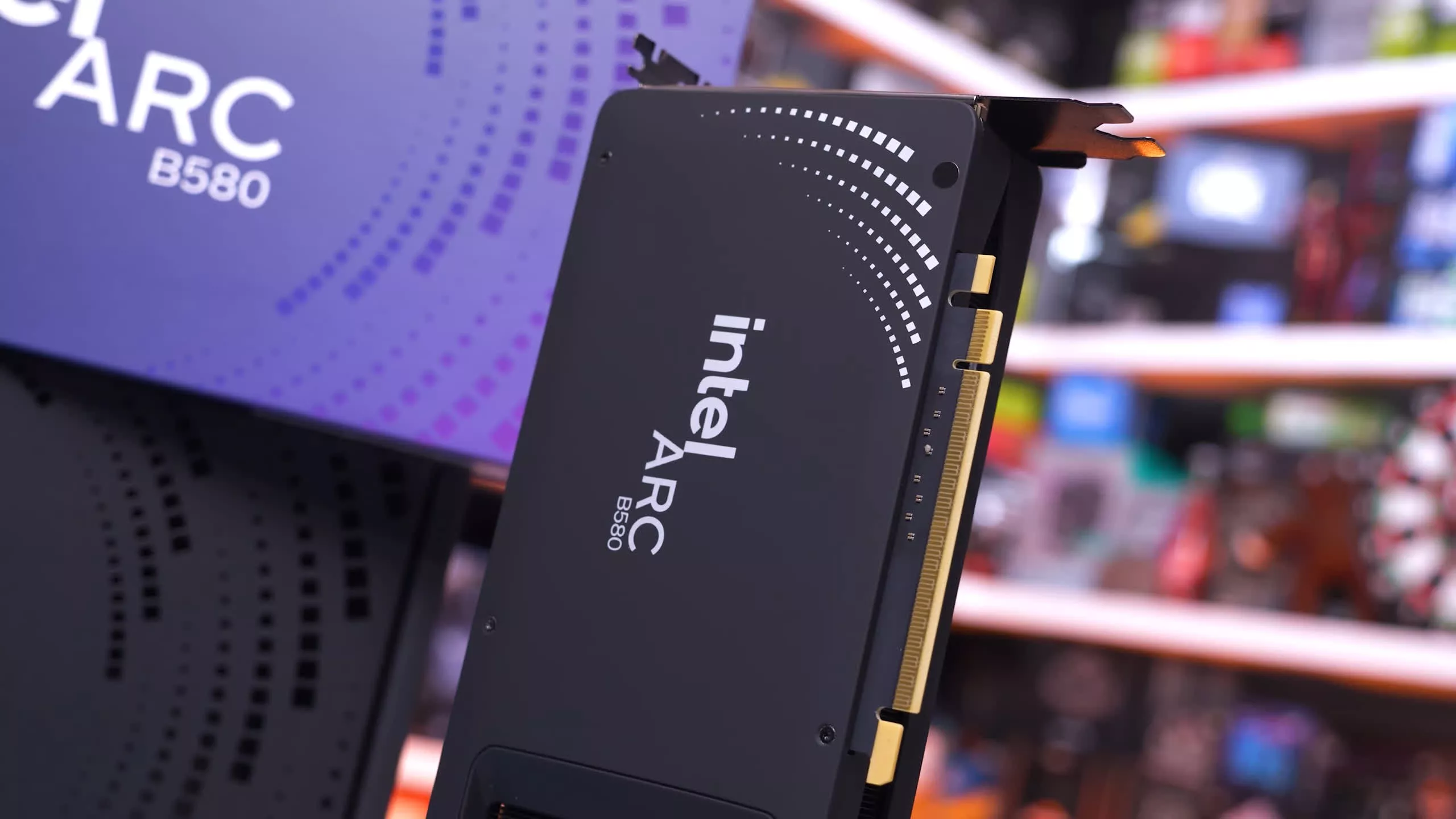
- •The Arc B580, released in December 2024, has been recognized for offering strong value in the budget segment, particularly due to its 12GB of VRAM, and has helped to rebuild confidence in Intel's more affordable GPU offerings.
- •Consistent driver updates have substantially improved the performance of Arc GPUs and addressed initial issues, including stuttering in older APIs, making them a more competitive option for budget-conscious PC gamers.
📊 Competitor Analysis▸ Show
While Intel Arc is making strides in the budget and mid-range segments, the discrete GPU market remains largely dominated by NVIDIA and AMD. NVIDIA maintains its premium position, especially for high-end gaming and ray tracing, while AMD often provides strong rasterization performance and more VRAM at competitive prices in the mid-range.
| Feature/Category | Intel Arc (e.g., B580, A770) | NVIDIA (e.g., RTX 40-series, 50-series) | AMD (e.g., RX 7000-series, 9000-series) |
|---|---|---|---|
| Market Focus | Budget to Mid-range gaming, content creation, AI (Pro series) | High-end gaming, superior ray tracing, AI (DLSS, Tensor Cores) | Mid-range value, rasterization performance, VRAM |
| Pricing (Consumer) | Generally competitive in budget/mid-range ($220-$350 for B570/B580/A770) | Premium pricing, higher for top-tier cards (e.g., RTX 4090, 5070 Ti) | Competitive, often more VRAM per dollar (e.g., RX 9070 XT) |
| Gaming Performance | Good value for 1080p/1440p, improved with driver updates | Leads in high-end, superior ray tracing, DLSS 3 for frame generation | Strong rasterization, good 1440p/4K, FSR upscaling |
| Ray Tracing | Supported, but generally lags behind NVIDIA | Industry leader, dedicated RT cores | Supported, but generally lags behind NVIDIA |
| Upscaling Technology | XeSS (AI-supersampling) | DLSS (AI-powered, frame generation) | FSR (FidelityFX Super Resolution) |
| Video Encoding | Industry-first AV1 hardware encoder | AV1 decoding, RTX 40-series with AV1 encoding | AV1 decoding |
| Market Share (Q3 2025) | 1% (desktop AIB) | 92% (desktop AIB) | 7% (desktop AIB) |
🛠️ Technical Deep Dive
- Architecture: Intel Arc GPUs are based on the Xe HPG (High Performance Gaming) graphics architecture, with the first generation codenamed 'Alchemist' (A-series) and the second generation 'Battlemage' (B-series).
- Xe-cores: The fundamental compute building block, each containing 16 vector engines (256-bit) and 16 matrix engines (1024-bit), along with an L1 cache.
- Render Slices: A collective of four Xe-cores, four Raytracing Units, and fixed-function hardware for geometry, rasterization, samplers, and pixel-backends.
- Ray Tracing Units: Dedicated fixed-function hardware for bounding-box intersection, ray traversal, and triangle intersection.
- XMX Engines: Xe Matrix eXtensions, 1024-bit matrix engines, are leveraged for AI processing tasks, including XeSS performance enhancement and real-time rendering applications like ray tracing de-noising.
- XeSS (Xe Super Sampling): An AI-supersampling feature that rivals NVIDIA's DLSS and AMD's FSR, rendering games at lower resolutions and using AI to reconstruct the image to near-native quality.
- AV1 Encoding: Arc GPUs feature a groundbreaking media engine with full support for 8K workloads and an industry-first AV1 hardware encoder, making them appealing for video creators.
- Memory: Alchemist cards like the A770 offer up to 16GB of GDDR6 memory with 560 GB/s bandwidth, while Battlemage B580 features 12GB GDDR6.
- Fabrication Process: Alchemist GPUs are manufactured by TSMC using their N6 (6 nm) process.
- Battlemage (B-series): The second generation, including models like the B580 and B570, which utilize a new architecture (BMG-G21 GPU for B580).
- Arc Pro Series: Professional workstation cards like the Arc Pro B70 and B65 feature 32GB of ECC GDDR6 memory and utilize Xe2 cores (32 Xe2 cores for B70, 20 for B65).
🔮 Future ImplicationsAI analysis grounded in cited sources
⏳ Timeline
📎 Sources (28)
Factual claims are grounded in the sources below. Forward-looking analysis is AI-generated interpretation.
- videocardz.com
- pcmag.com
- tomsguide.com
- techspot.com
- xda-developers.com
- techpowerup.com
- videocardz.com
- techpowerup.com
- kitguru.net
- pcgamer.com
- xda-developers.com
- youtube.com
- tomshardware.com
- elyamamastore.com
- hp.com
- youtube.com
- rockpapershotgun.com
- youtube.com
- techpowerup.com
- youtube.com
- wikipedia.org
- hothardware.com
- tomshardware.com
- wccftech.com
- linustechtips.com
- reddit.com
- tomsguide.com
- reddit.com
Weekly AI Recap
Read this week's curated digest of top AI events →
👉Related Updates
AI-curated news aggregator. All content rights belong to original publishers.
Original source: cnBeta (Full RSS) ↗
This is a summary, not the original. Read the source, or get the weekly briefing.
The weekly digest
One email a week. Unsubscribe anytime.