Intel Abandons P-Cores for Unified Design
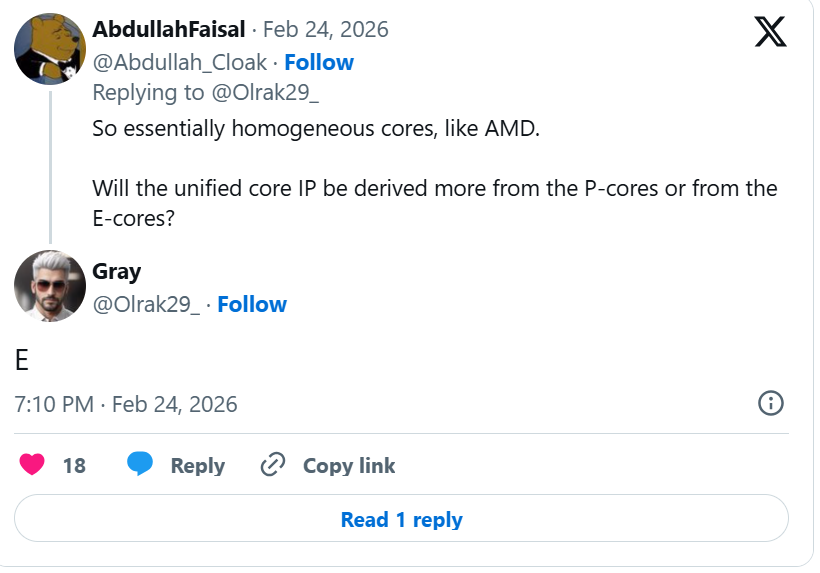
💡Intel CPU redesign favors E-cores for efficient AI inference—watch for server impacts
⚡ 30-Second TL;DR
What Changed
Job post exposes Intel's unified core strategy
Why It Matters
Unified cores could simplify AI software optimization on Intel CPUs, boosting E-core efficiency for inference tasks. May shift server designs away from hybrid complexity.
What To Do Next
Review Intel's oneAPI for E-core optimizations in your CPU-based AI inference workloads.
Key Points
- •Job post exposes Intel's unified core strategy
- •Drops P-cores, emphasizes E-cores post-12th gen
- •No details/official word; products years away
- •Hybrid P+E design's trade-offs well-known
🧠 Deep Insight
Background and context from public sources — not the original article. 6 sources cited.
🔑 Enhanced Key Takeaways
- •Intel's Unified Core design uses the same general core architecture and IP for P-cores, E-cores, and LP E-cores, differentiated primarily by power curves rather than entirely separate designs.[1]
- •The Unified Core is reportedly based on an evolution of Intel's efficiency-focused E-cores, which in Darkmont variants already outperform Raptor Cove P-cores at equivalent power levels.[1]
- •First leaks about Unified Core emerged in mid-July 2025, with speculation linking it to Jim Keller’s Royal Core Project and potential use in Titan Lake processors around 2028.[2]
📊 Competitor Analysis▸ Show
| Feature | Intel Unified Core | AMD Zen 5/Zen 5c |
|---|---|---|
| Core Design | Same architecture/IP for P/E/LP-E, tuned by power curve | Same microarchitecture/IPC, differ in size/clock speeds |
| Base Focus | E-core evolution for scalability | Unified Zen cores for hybrid-like setups |
| Benchmarks | No data yet (pre-silicon) | Zen 5 competitive in single/multi-thread [5] |
🛠️ Technical Deep Dive
- •Unified Core employs a single scalable architecture across core types (P, E, LP-E), with variations in allowed power consumption: highest for P-cores, moderate for E-cores, lowest for LP-E-cores.
- •Likely mimics AMD's Zen 5/Zen 5c approach, sharing microarchitecture and instructions-per-clock (IPC), but tuned for performance vs. density/efficiency.
- •Potentially enables scalability from entry-level client CPUs to datacenter processors, possibly integrating with Intel's 'Software Defined Supercore' for many small cores.
🔮 Future ImplicationsAI analysis grounded in cited sources
⏳ Timeline
📎 Sources (6)
Factual claims are grounded in the sources below. Forward-looking analysis is AI-generated interpretation.
- notebookcheck.net — Intel to Take Page Out of Amd S Book for Next Gen Cpus Using Unified Core Design.1233597.0
- Tom's Hardware — Intel Preps Cpus with Unified Core Architecture Job Listing Hints at Evolution Beyond Intels Hybrid Design
- windowscentral.com — Intel Unified Core Job Listing Rumors
- semiwiki.com — Rumours Around Intels Unified Core Future Chip Designs Are Swirling Once More
- youtube.com — Watch
- techspot.com — 111438 Intel Mysterious Unified Core Team Hints Major Cpu
Weekly AI Recap
Read this week's curated digest of top AI events →
👉Related Updates
AI-curated news aggregator. All content rights belong to original publishers.
Original source: cnBeta (Full RSS) ↗
This is a summary, not the original. Read the source, or get the weekly briefing.
Weekly AI briefing
One email a week. Unsubscribe anytime.