Inside Ulanqab’s AI Compute Boom
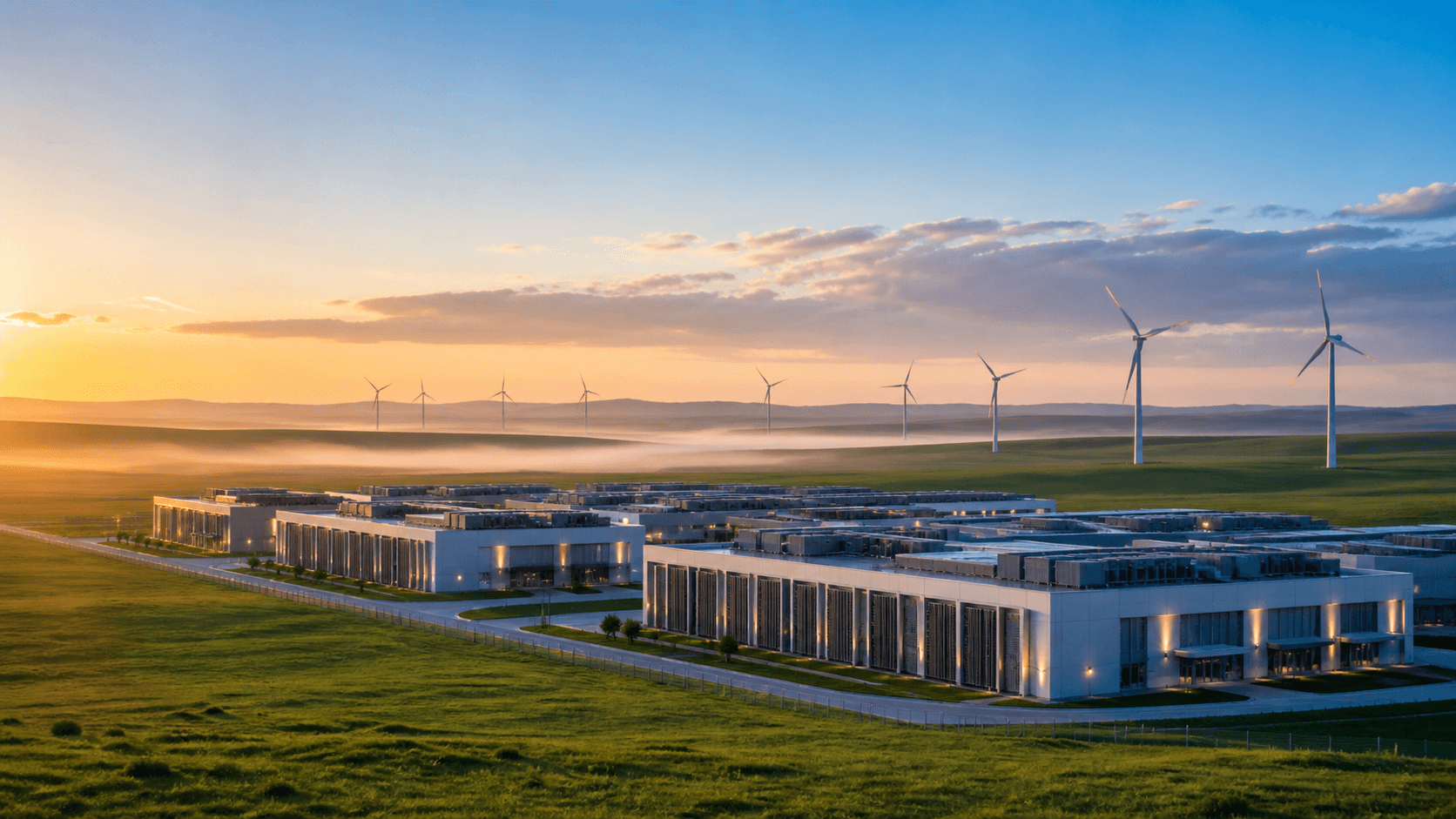
💡See why cheap green power and low latency are turning Ulanqab into a major AI compute hub.
⚡ 30-Second TL;DR
What Changed
Ulanqab leverages inexpensive renewable power to reduce the operating costs of AI data centers.
Why It Matters
The rise of Ulanqab highlights how power pricing, renewable energy availability, and network latency are becoming strategic differentiators for AI infrastructure. AI companies may gain additional options for scaling compute beyond established technology hubs, while regional data-center competition is likely to intensify.
What To Do Next
Benchmark your vLLM inference stack across candidate regions using identical models, batch sizes, latency targets, and power-cost assumptions before selecting a data-center location.
Key Points
- •Ulanqab leverages inexpensive renewable power to reduce the operating costs of AI data centers.
- •Low-latency connectivity strengthens the city’s appeal for training and inference workloads.
- •The Inner Mongolia city is developing into a significant AI compute hub serving China and the wider Asia-Pacific region.
🧠 Deep Insight
Background and context from public sources — not the original article. 8 sources cited.
🔑 Enhanced Key Takeaways
- •Ulanqab serves as a primary node in China's 'east data, west computing' national strategy, functioning as a specialized 'token factory' for large-scale AI model training.
- •The city's operational computing capacity reached 172,000 petaflops by mid-2026, with intelligent computing workloads comprising over 95% of the total infrastructure utilization.
- •Envision Group's Galaxy Campus, commissioned in August 2026, is engineered to support a massive density of up to 1 million AI accelerators in parallel.
- •Ulanqab maintains a competitive fiber-optic round-trip latency of 4.2 milliseconds to Beijing, enabling the city to host latency-sensitive inference tasks despite its geographic distance from the capital.
- •Data-center electricity consumption in the region spiked by 90% in the first half of 2026, reaching 3.3 terawatt-hours as a direct result of the rapid deployment of high-density AI hardware.
📊 Competitor Analysis▸ Show
| Feature | Ulanqab (Inner Mongolia) | Guiyang (Guizhou) | Beijing/Shanghai (Tier-1) |
|---|---|---|---|
| Electricity Cost | ~0.33-0.36 yuan/kWh | ~0.40-0.45 yuan/kWh | ~0.70-0.80+ yuan/kWh |
| Latency to Beijing | 4.2 ms | ~15-20 ms | < 1 ms |
| Renewable Mix | ~67% | ~50% | Low |
| Primary Use Case | Large-scale AI Training | Big Data/Storage | Real-time Inference |
🛠️ Technical Deep Dive
- Infrastructure density: The Envision Galaxy Campus supports up to 1 million AI accelerators in a single 120,000-square-meter facility.
- Power integration: Direct connection to renewable energy sources provides over 80% of the power for the Galaxy Campus under the Mission Gobi initiative.
- Network architecture: Deployment of high-speed fiber-optic backbones achieves a 4.2ms round-trip latency to Beijing, facilitating distributed training clusters.
- Capacity scaling: Total committed power capacity for the region grew from 3.3 GW in July 2025 to 12.5 GW by June 2026.
🔮 Future ImplicationsAI analysis grounded in cited sources
⏳ Timeline
📎 Sources (8)
Factual claims are grounded in the sources below. Forward-looking analysis is AI-generated interpretation.
Weekly AI Recap
Read this week's curated digest of top AI events →
👉Related Updates


AI-curated news aggregator. All content rights belong to original publishers.
Original source: Pandaily ↗
This is a summary, not the original. Read the source, or get the weekly briefing.
Weekly AI briefing
One email a week. Unsubscribe anytime.