Inner Mongolia Announces $27B AI Computing Buildout
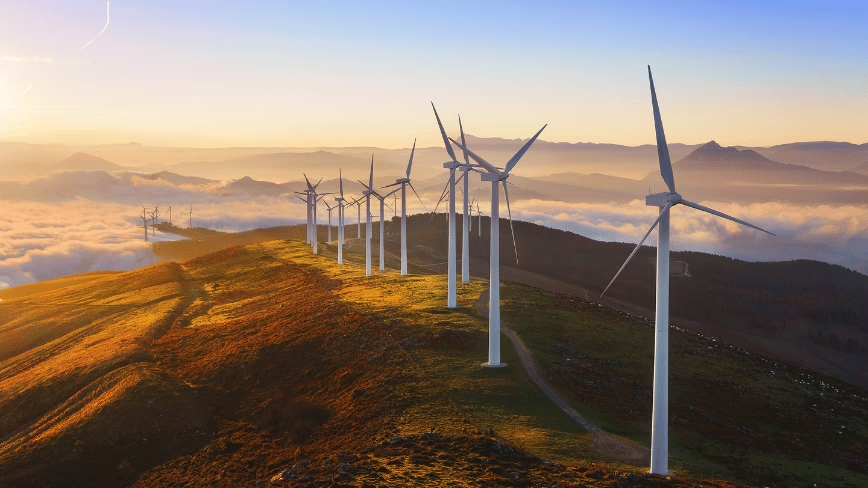
💡A $27B regional buildout could change compute availability and China’s overseas AI-service reach.
⚡ 30-Second TL;DR
What Changed
The 12 projects are valued at 186.46 billion yuan.
Why It Matters
The investment signals continued expansion of China's AI infrastructure capacity beyond major coastal technology hubs. Increased regional compute and overseas service distribution could create opportunities for cloud, model, and data-center providers.
What To Do Next
Map your AI workload's regional data, latency, and compliance requirements against potential Chinese cloud and compute providers before expanding internationally.
Key Points
- •The 12 projects are valued at 186.46 billion yuan.
- •The projects are positioned as green computing infrastructure.
- •A separate platform will support selling Chinese AI services abroad.
🧠 Deep Insight
Background and context from public sources — not the original article. 11 sources cited.
🔑 Enhanced Key Takeaways
- •The buildout is a direct implementation of the national 'Eastern Data, Western Computing' policy, which mandates that new data centers source at least 80% of their power from renewable energy.
- •Key industry participants include major Chinese tech entities such as Volcano Engine (ByteDance), Cambricon Technologies, and China Telecom.
- •The region currently maintains an operational capacity exceeding 320,000 petaflops, with intelligent computing comprising over 95% of that total.
- •Ulanqab's climate allows for direct outdoor air cooling for more than 200 days annually, resulting in a 20% reduction in operational cooling costs compared to traditional facilities.
- •The infrastructure is designed to support high-demand industrial applications, including autonomous driving algorithm training for EV manufacturers like XPeng and industrial LLM development for Sinopec.
🛠️ Technical Deep Dive
- Infrastructure utilizes high-density AI accelerator clusters, with the Envision Galaxy Campus designed to support up to one million AI accelerators.
- Power capacity for the Galaxy Campus is scaled for a peak load exceeding 2 gigawatts.
- Cooling architecture leverages natural air-cooling systems, optimized for the Ulanqab climate to minimize PUE (Power Usage Effectiveness).
- The regional network is integrated into the national 'Eastern Data, Western Computing' backbone to facilitate low-latency data transmission between western compute hubs and eastern demand centers.
🔮 Future ImplicationsAI analysis grounded in cited sources
⏳ Timeline
📎 Sources (11)
Factual claims are grounded in the sources below. Forward-looking analysis is AI-generated interpretation.
Weekly AI Recap
Read this week's curated digest of top AI events →
👉Related Updates


AI-curated news aggregator. All content rights belong to original publishers.
Original source: The Next Web (TNW) ↗
This is a summary, not the original. Read the source, or get the weekly briefing.
Weekly AI briefing
One email a week. Unsubscribe anytime.