Improving SFT reasoning with Self-Distilled Reasoning
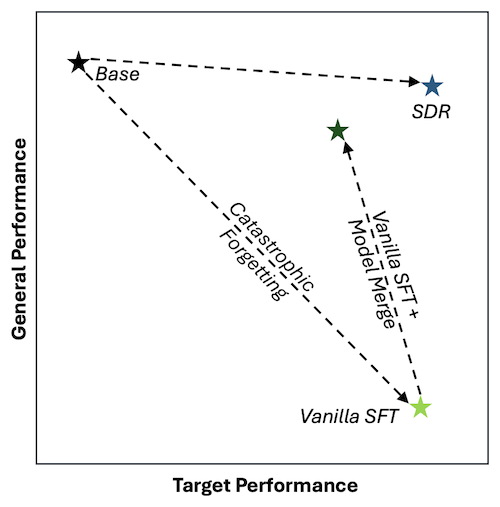
💡Learn how to inject reasoning into your fine-tuned models without needing expensive human-annotated reasoning traces.
⚡ 30-Second TL;DR
What Changed
Introduces Self-Distilled Reasoning (SDR) for datasets lacking reasoning traces.
Why It Matters
This research offers a scalable way to improve reasoning in fine-tuned models without needing massive human-annotated reasoning datasets. It allows developers to extract higher-quality logic from existing SFT workflows.
What To Do Next
Implement SDR on your next SFT job by generating reasoning traces for your training data to see if it improves complex query handling.
Key Points
- •Introduces Self-Distilled Reasoning (SDR) for datasets lacking reasoning traces.
- •Addresses the 'reasoning suppression' problem in SFT customization.
- •Validated across three benchmarks to ensure performance improvements.
- •Provides practical implementation recommendations for developers.
🧠 Deep Insight
AI-generated analysis for this event — not the original article.
🔑 Enhanced Key Takeaways
- •SDR utilizes a 'teacher' model to generate chain-of-thought (CoT) rationales for existing SFT datasets that originally contained only input-output pairs.
- •The method specifically mitigates the 'reasoning suppression' phenomenon where models trained on outcome-only data lose the ability to perform multi-step logical deduction.
- •Amazon Nova's implementation of SDR leverages a multi-stage distillation process that filters high-quality reasoning traces before fine-tuning to prevent noise injection.
- •Empirical results indicate that SDR-enhanced models show significant improvements in zero-shot reasoning tasks compared to models fine-tuned on raw, non-reasoning-augmented datasets.
- •The framework is designed to be model-agnostic, allowing developers to apply SDR techniques to various base models beyond the Amazon Nova family.
📊 Competitor Analysis▸ Show
| Feature | AWS Self-Distilled Reasoning | OpenAI Distillation (o1/GPT-4o) | Google DeepMind Distillation |
|---|---|---|---|
| Primary Focus | Reasoning injection for SFT | Model-to-model knowledge transfer | Research-led distillation |
| Accessibility | Amazon Nova / AWS Bedrock | API-based / Managed | Research papers / Vertex AI |
| Reasoning Traces | Synthetic generation for SFT | Native CoT / R1-style training | Varied (e.g., Chain-of-Thought) |
🛠️ Technical Deep Dive
- SDR operates by augmenting the training objective with a secondary loss term that penalizes deviations from the teacher-generated reasoning path.
- The process involves a filtering mechanism that discards reasoning traces with low confidence scores or logical inconsistencies before the SFT phase.
- It addresses the alignment tax by ensuring that the injected reasoning traces are consistent with the model's original pre-training distribution.
- Implementation involves a two-pass inference pipeline: first generating reasoning traces for the dataset, then performing supervised fine-tuning on the augmented dataset.
🔮 Future ImplicationsAI analysis grounded in cited sources
⏳ Timeline
Weekly AI Recap
Read this week's curated digest of top AI events →
👉Related Updates
AI-curated news aggregator. All content rights belong to original publishers.
Original source: AWS Machine Learning Blog ↗
This is a summary, not the original. Read the source, or get the weekly briefing.
The weekly digest
One email a week. Unsubscribe anytime.