來源AWS Machine Learning Blog•較早收集於 7m
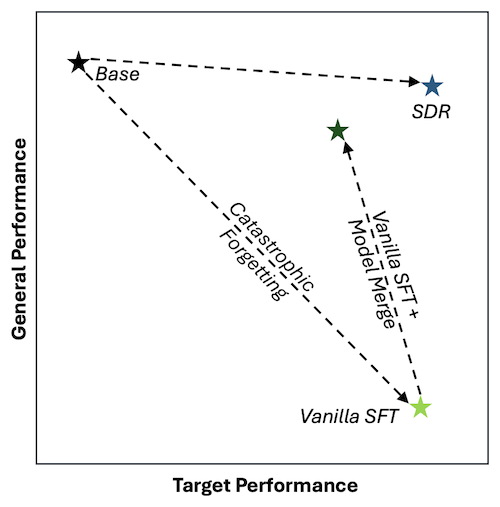
利用 Self-Distilled Reasoning 改進 SFT 推理能力
#fine-tuning#reasoning#sft#model-optimizationamazon-novaamazon novaaws
💡學習如何在無需昂貴人工標註推理軌跡的情況下,為您的微調模型注入推理能力。
⚡ 30 秒速覽
有什麼變化
引入 Self-Distilled Reasoning (SDR) 以處理缺乏推理軌跡的數據集。
為什麼重要
這項研究提供了一種可擴展的方法,無需大量人工標註的推理數據集即可提升微調模型的推理能力。它使開發者能夠從現有的 SFT 工作流程中提取更高品質的邏輯。
下一步行動
在下一次 SFT 任務中實作 SDR,透過為訓練數據生成推理軌跡,觀察其是否能改善複雜查詢的處理能力。
誰應關注:Researchers & Academics
關鍵要點
- •引入 Self-Distilled Reasoning (SDR) 以處理缺乏推理軌跡的數據集。
- •解決 SFT 客製化過程中的「推理抑制」問題。
- •通過三個基準測試驗證,確保性能提升。
- •為開發者提供實用的實作建議。
🧠 深度解析
本篇為 AI 生成分析,非原文內容。
🔑 增強重點摘要
- •SDR utilizes a 'teacher' model to generate chain-of-thought (CoT) rationales for existing SFT datasets that originally contained only input-output pairs.
- •The method specifically mitigates the 'reasoning suppression' phenomenon where models trained on outcome-only data lose the ability to perform multi-step logical deduction.
- •Amazon Nova's implementation of SDR leverages a multi-stage distillation process that filters high-quality reasoning traces before fine-tuning to prevent noise injection.
- •Empirical results indicate that SDR-enhanced models show significant improvements in zero-shot reasoning tasks compared to models fine-tuned on raw, non-reasoning-augmented datasets.
- •The framework is designed to be model-agnostic, allowing developers to apply SDR techniques to various base models beyond the Amazon Nova family.
📊 競品分析▸ Show
| Feature | AWS Self-Distilled Reasoning | OpenAI Distillation (o1/GPT-4o) | Google DeepMind Distillation |
|---|---|---|---|
| Primary Focus | Reasoning injection for SFT | Model-to-model knowledge transfer | Research-led distillation |
| Accessibility | Amazon Nova / AWS Bedrock | API-based / Managed | Research papers / Vertex AI |
| Reasoning Traces | Synthetic generation for SFT | Native CoT / R1-style training | Varied (e.g., Chain-of-Thought) |
🛠️ 技術深入
- SDR operates by augmenting the training objective with a secondary loss term that penalizes deviations from the teacher-generated reasoning path.
- The process involves a filtering mechanism that discards reasoning traces with low confidence scores or logical inconsistencies before the SFT phase.
- It addresses the alignment tax by ensuring that the injected reasoning traces are consistent with the model's original pre-training distribution.
- Implementation involves a two-pass inference pipeline: first generating reasoning traces for the dataset, then performing supervised fine-tuning on the augmented dataset.
🔮 前景展望基於引用來源的 AI 分析
Automated reasoning augmentation will become a standard requirement for enterprise SFT pipelines.
As models move toward agentic workflows, the demand for high-quality, verifiable reasoning traces in fine-tuning data will outpace human-annotated datasets.
SDR will reduce the reliance on massive, human-curated reasoning datasets.
By enabling models to self-generate high-quality traces, organizations can leverage their existing proprietary data without needing expensive manual annotation for reasoning.
⏳ 時間線
2024-11
AWS announces the Amazon Nova model family.
2025-03
AWS introduces enhanced fine-tuning capabilities for Amazon Nova on Bedrock.
2026-07
AWS publishes the Self-Distilled Reasoning (SDR) framework for SFT optimization.
📰
AI 週報
閱讀本週精選 AI 大事摘要 →
👉相關動態
AI 策展新聞聚合。所有內容版權歸原始發布者所有。
原始來源: AWS Machine Learning Blog ↗
每週電子報
每週一封,可隨時退訂。