IBM Builds Dual-ISA AI Mainframe Core
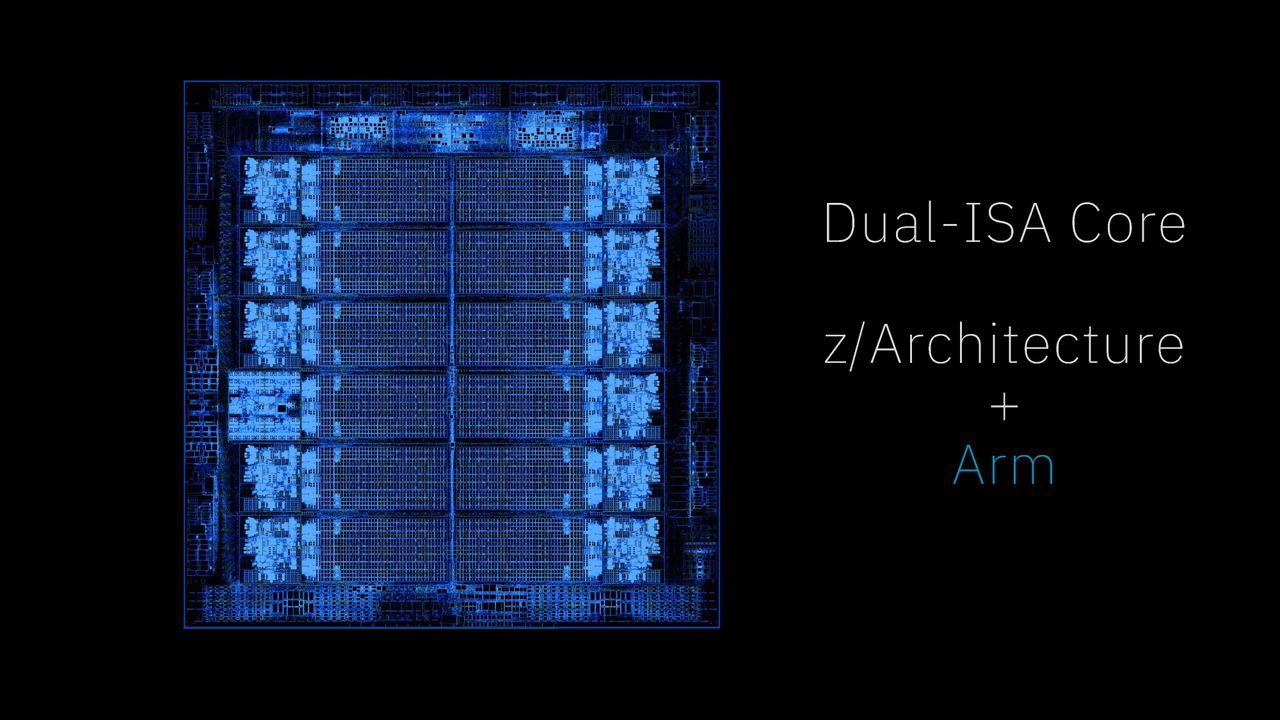
💡IBM’s dual-ISA core could let enterprise AI software run across ARM and mainframe environments more easily.
⚡ 30-Second TL;DR
What Changed
The processor core natively supports both ARM and z/Architecture instruction sets.
Why It Matters
Supporting both instruction sets in one core could expand the software options available on IBM mainframes, including workloads that use ARM-based AI tools. It may also reduce migration friction between traditional z/Architecture applications and newer cloud-native software.
What To Do Next
Test your mainframe AI dependencies for ARM compatibility and compare native execution with existing z/Architecture deployment paths before migration planning.
Key Points
- •The processor core natively supports both ARM and z/Architecture instruction sets.
- •The chip is built using a 2nm manufacturing process.
- •The design includes 11 cores operating at a 5.7 GHz base frequency.
🧠 Deep Insight
Background and context from public sources — not the original article. 6 sources cited.
🔑 Enhanced Key Takeaways
- •The dual-ISA capability is achieved via a unified core architecture rather than a heterogeneous multi-core approach, allowing dynamic switching between z/Architecture and AArch64 instructions in the nanosecond range.
- •IBM leverages the open-source KVM hypervisor to manage Arm instruction execution, extending the existing Linux-on-Z virtualization framework to support the new ISA integration.
- •The processor integrates dedicated AI inference accelerators, codenamed 'Spyre,' specifically optimized for low-latency enterprise tasks like real-time fraud detection.
- •The design maintains mainframe-grade reliability standards, including hardware-level fault detection and advanced encryption, to ensure 99.999999% uptime despite the increased architectural complexity.
- •The development is the first major hardware output resulting from the strategic partnership between IBM and Arm that was formally announced in April 2026.
📊 Competitor Analysis▸ Show
| Feature | IBM Dual-ISA Mainframe Core | Intel Xeon (Emerald/Diamond Rapids) | AMD EPYC (Turin) |
|---|---|---|---|
| ISA Support | Native z/Architecture + Arm | x86-64 | x86-64 |
| Primary Focus | Mission-critical Transactional | General Purpose Data Center | High-Density Compute |
| AI Acceleration | Integrated 'Spyre' Accelerators | AMX (Advanced Matrix Extensions) | AVX-512 / VNNI |
🛠️ Technical Deep Dive
- Core Architecture: Unified core design capable of native execution of both IBM Z and AArch64 instruction sets.
- Switching Mechanism: Nanosecond-range dynamic ISA switching with near-zero overhead.
- Manufacturing: 2nm process node.
- Frequency: 5.7 GHz base clock speed.
- AI Integration: Dedicated Spyre inference accelerators for in-transaction processing.
- Virtualization: KVM-based hypervisor management for Arm workloads.
🔮 Future ImplicationsAI analysis grounded in cited sources
⏳ Timeline
📎 Sources (6)
Factual claims are grounded in the sources below. Forward-looking analysis is AI-generated interpretation.
Weekly AI Recap
Read this week's curated digest of top AI events →
👉Related Updates
AI-curated news aggregator. All content rights belong to original publishers.
Original source: Tom's Hardware ↗
This is a summary, not the original. Read the source, or get the weekly briefing.
Weekly AI briefing
One email a week. Unsubscribe anytime.