Hyundai workers strike over humanoid robot integration fears
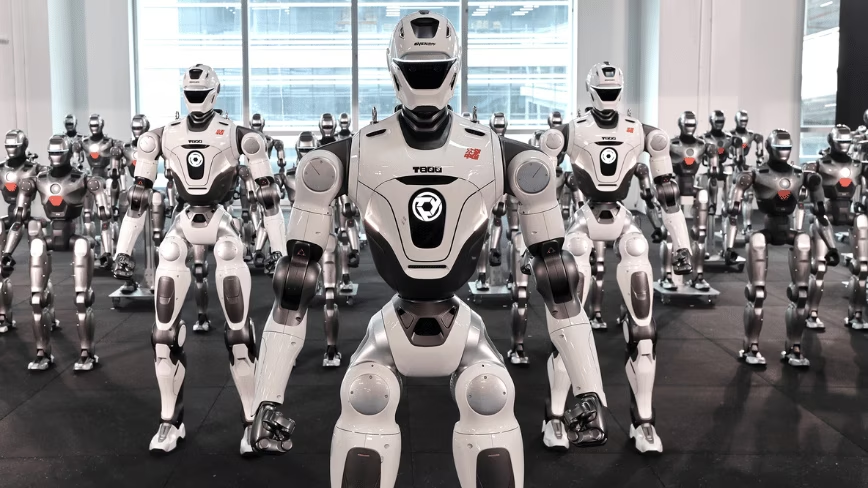
A critical look at the labor-AI friction as humanoid robots enter the factory floor.
30-Second TL;DR
What Changed
Hyundai union members authorized a strike citing fears of robot displacement.
Why It Matters
This dispute sets a precedent for how labor unions will interact with AI-driven robotics in manufacturing, potentially slowing adoption rates.
What To Do Next
If you are building industrial AI, incorporate human-in-the-loop and labor-augmentation narratives into your deployment strategy to mitigate workforce resistance.
Key Points
- •Hyundai union members authorized a strike citing fears of robot displacement.
- •This is the first major labor dispute involving humanoid robots at Hyundai.
- •The strike challenges management's control over factory floor automation.
Deep Insight
AI-generated analysis for this event — not the original article.
Enhanced Key Takeaways
- •The labor dispute centers on the deployment of Boston Dynamics' Atlas humanoid robots, which Hyundai acquired in 2021 and has been integrating into pilot programs at its Ulsan and Georgia manufacturing facilities.
- •Union demands include a 'Human-in-the-Loop' guarantee, requiring that any humanoid robot deployment must be subject to collective bargaining and cannot replace human roles in safety-critical assembly tasks.
- •Hyundai management has countered that the humanoid integration is focused on 'dull, dirty, and dangerous' tasks, specifically citing high-heat welding and heavy lifting in chassis assembly.
- •The strike authorization follows a breakdown in the 2026 wage and collective agreement negotiations, where automation clauses became the primary sticking point over traditional salary demands.
- •Industry analysts note that this is the first time a major automotive union has explicitly demanded 'technological sovereignty' clauses to prevent the unilateral replacement of human workers by embodied AI.
Competitor Analysis
- Hyundai (Boston Dynamics)
- Industrial/Logistics
- Tesla (Optimus)
- Mass-market/Domestic
- Toyota (Research Institute)
- Collaborative Robotics
- Hyundai (Boston Dynamics)
- Pilot/Factory Floor
- Tesla (Optimus)
- Internal Testing
- Toyota (Research Institute)
- R&D/Human-Support
- Hyundai (Boston Dynamics)
- High Conflict
- Tesla (Optimus)
- Non-Unionized
- Toyota (Research Institute)
- Mixed/Collaborative
| Feature | Hyundai (Boston Dynamics) | Tesla (Optimus) | Toyota (Research Institute) |
|---|---|---|---|
| Primary Focus | Industrial/Logistics | Mass-market/Domestic | Collaborative Robotics |
| Deployment Stage | Pilot/Factory Floor | Internal Testing | R&D/Human-Support |
| Union Status | High Conflict | Non-Unionized | Mixed/Collaborative |
Technical Deep Dive
- The integration utilizes the latest generation of the electric Atlas humanoid, which features enhanced force-sensing actuators for high-torque industrial tasks.
- The robots operate on a proprietary embodied AI architecture that allows for real-time path planning in dynamic, human-populated environments.
- Communication between the robots and the factory floor is managed via a private 5G network to ensure low-latency control and safety-stop synchronization.
- The system employs vision-language models (VLMs) to interpret complex assembly instructions, allowing for rapid task switching without manual reprogramming.
Future ImplicationsAI analysis grounded in cited sources
Timeline
- 2021-06Hyundai Motor Group completes the acquisition of Boston Dynamics from SoftBank.
- 2023-10Hyundai announces the establishment of the Boston Dynamics AI Institute to accelerate embodied AI research.
- 2025-04Hyundai begins pilot testing of humanoid robots in the Ulsan plant for quality control tasks.
- 2026-05Union leadership formally requests a moratorium on new humanoid robot installations during contract talks.
- 2026-06Hyundai workers vote to authorize a strike following the rejection of the company's automation proposal.
Weekly AI Recap
Read this week's curated digest of top AI events →
Related Updates
AI-curated news aggregator. All content rights belong to original publishers.
Original source: The Next Web (TNW) ↗
This is a summary, not the original. Read the source, or get the weekly briefing.
The weekly digest
One email a week. Unsubscribe anytime.