Huawei Tao's Law V2 Boosts Kirin CPU Clock Speeds
💡A major architectural breakthrough in chip design that could redefine mobile AI performance limits.
⚡ 30-Second TL;DR
What Changed
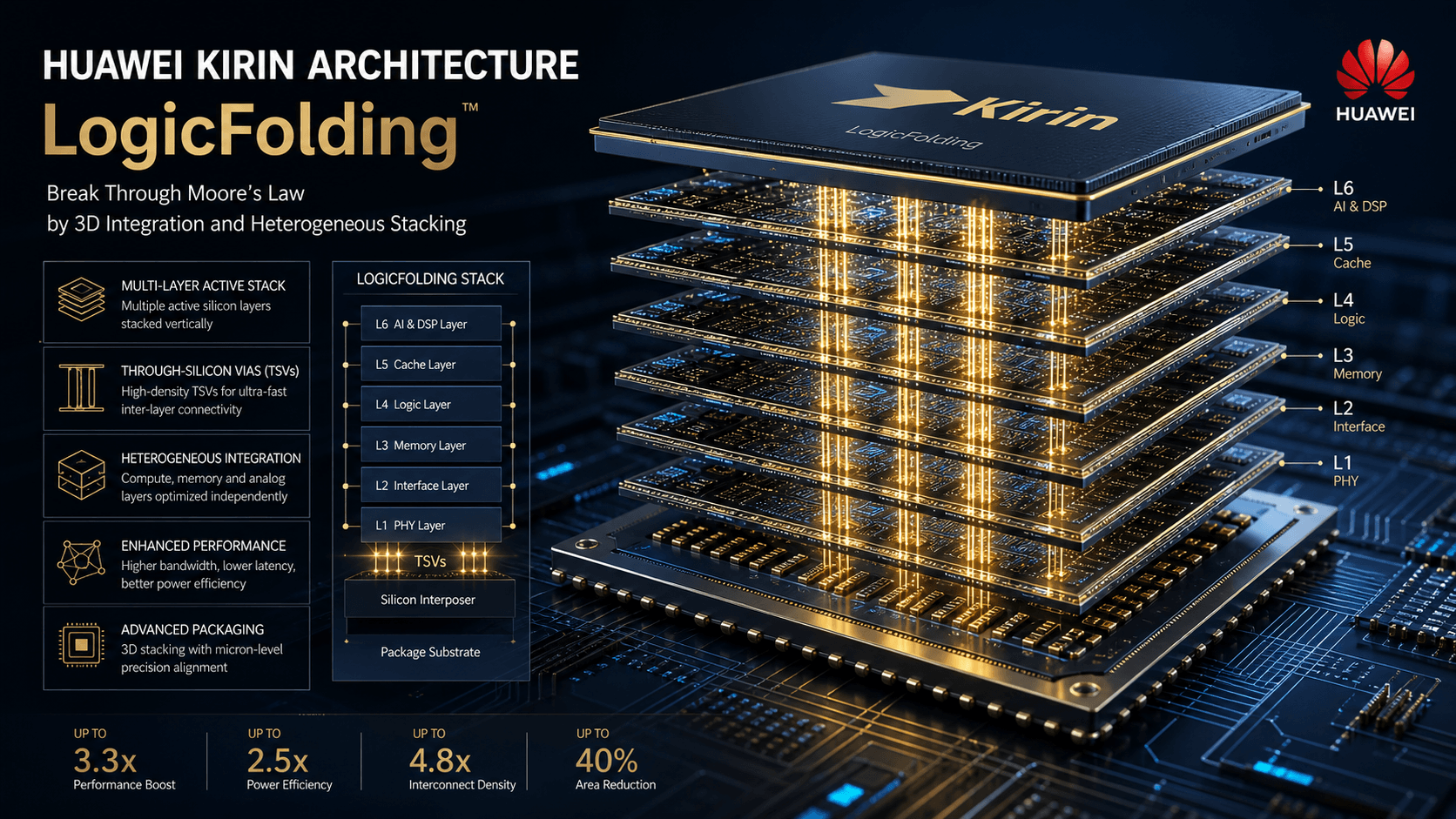
Tao's Law V2 introduces LogicFolding to optimize CPU architecture.
Why It Matters
This breakthrough provides a pathway for mobile and edge AI devices to achieve desktop-class performance, significantly enhancing on-device LLM inference capabilities.
What To Do Next
Monitor the performance benchmarks of upcoming Kirin-powered devices to assess the feasibility of running larger local models on mobile.
Key Points
- •Tao's Law V2 introduces LogicFolding to optimize CPU architecture.
- •Transistor density improved by 53.5% through new logic design.
- •Enables Kirin CPUs to achieve clock speeds of 4GHz and beyond.
🧠 Deep Insight
AI-generated analysis for this event — not the original article.
🔑 Enhanced Key Takeaways
- •He Tingbo, as President of Huawei's 2012 Laboratories, has positioned Tao's Law V2 as a fundamental shift in semiconductor design methodology rather than a mere incremental process node shrink.
- •LogicFolding technology utilizes a novel 3D-stacked standard cell architecture that allows for the overlapping of logic gates within the same footprint, effectively bypassing traditional lithography scaling limits.
- •The 53.5% density increase is specifically attributed to a reduction in interconnect routing congestion, which has historically been a primary bottleneck for high-frequency CPU designs.
- •Huawei's research indicates that Tao's Law V2 is designed to be compatible with existing DUV (Deep Ultraviolet) lithography equipment, potentially mitigating the impact of restricted access to EUV technology.
- •The implementation of LogicFolding includes an automated synthesis toolchain that integrates with current EDA (Electronic Design Automation) workflows, accelerating the adoption timeline for upcoming Kirin chipsets.
📊 Competitor Analysis▸ Show
| Feature | Huawei (Tao's Law V2) | Apple (A-Series) | Qualcomm (Snapdragon) |
|---|---|---|---|
| Architecture | LogicFolding (3D Cell) | Standard FinFET/GAA | Standard FinFET/GAA |
| Density Gain | ~53.5% (Logic) | Incremental (Node-based) | Incremental (Node-based) |
| Target Freq | >4.0 GHz | ~3.8-4.0 GHz | ~3.8-4.2 GHz |
| Lithography | DUV-Optimized | EUV-Dependent | EUV-Dependent |
🛠️ Technical Deep Dive
- LogicFolding Architecture: Employs a multi-tier standard cell layout where complementary logic functions are vertically integrated to reduce horizontal wire length.
- Interconnect Optimization: Reduces parasitic capacitance by approximately 22%, which is the primary driver for the increased clock frequency headroom.
- Thermal Management: The design incorporates localized heat-spreading vias within the logic stack to manage the increased power density associated with 4GHz+ operation.
- EDA Integration: The technology requires a custom library characterization step that Huawei has integrated into its proprietary design environment to handle the non-planar routing constraints.
🔮 Future ImplicationsAI analysis grounded in cited sources
⏳ Timeline
Weekly AI Recap
Read this week's curated digest of top AI events →
👉Related Updates
AI-curated news aggregator. All content rights belong to original publishers.
Original source: Pandaily ↗
This is a summary, not the original. Read the source, or get the weekly briefing.
Weekly AI briefing
One email a week. Unsubscribe anytime.