Huawei Sets Wi-Fi 7 Patent Royalty at $0.50
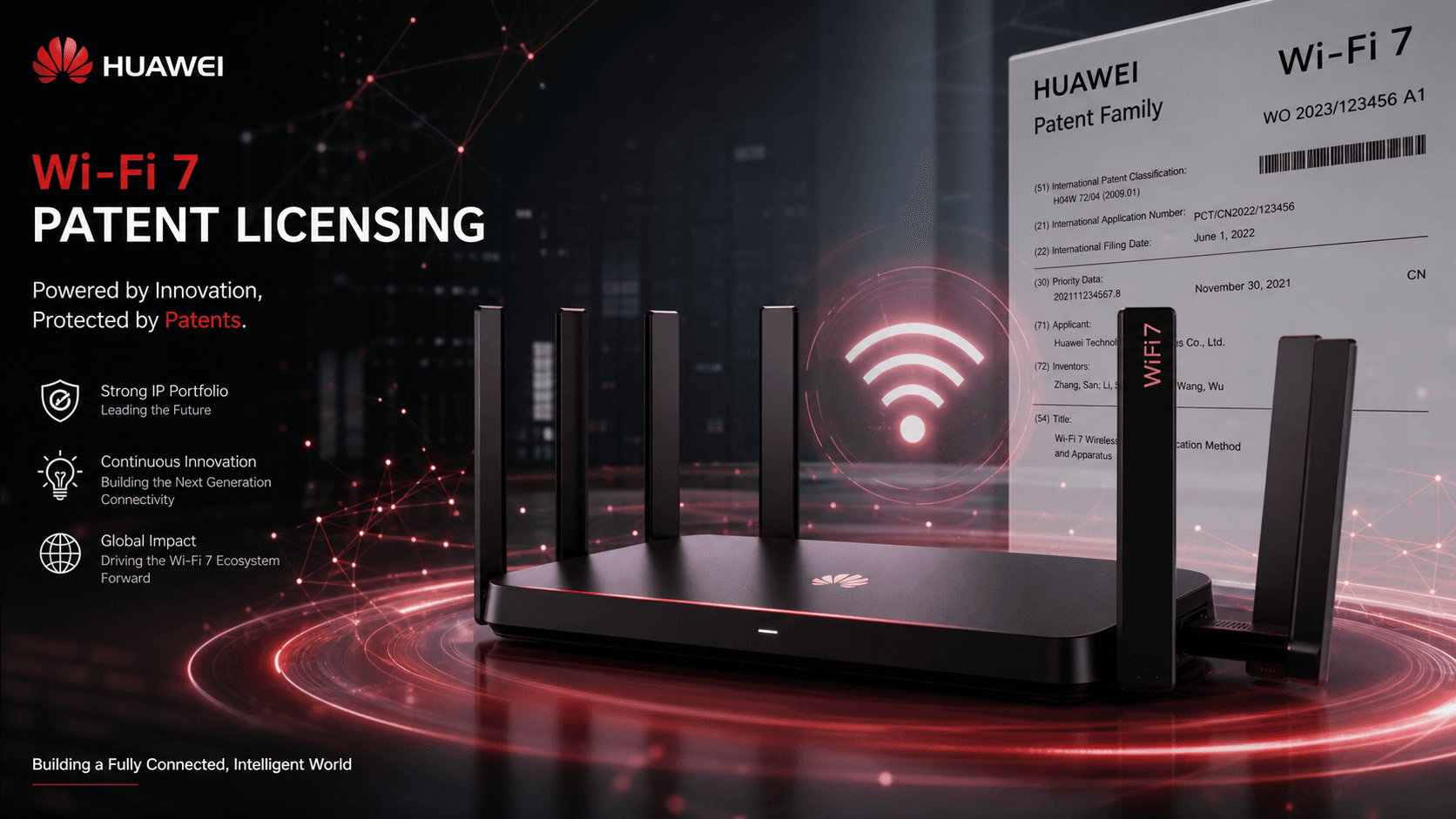
Understand the cost structure for Wi-Fi 7 hardware and how patent pools impact infrastructure deployment.
30-Second TL;DR
What Changed
Royalty rate established at US$0.5 per consumer device unit
Why It Matters
Standardizing royalty rates for Wi-Fi 7 helps accelerate the adoption of next-gen wireless infrastructure. This provides cost predictability for hardware manufacturers integrating high-speed connectivity.
What To Do Next
If you are building IoT or edge hardware, factor this $0.50 royalty into your BOM (Bill of Materials) calculations for Wi-Fi 7 enabled products.
Key Points
- •Royalty rate established at US$0.5 per consumer device unit
- •Huawei joins Sisvel patent pool as a founding member
- •Company manages a portfolio covering over 1.2 billion licensed devices
Deep Insight
AI-generated analysis for this event — not the original article.
Enhanced Key Takeaways
- •Huawei's royalty rate of $0.50 per device is positioned as a 'fair, reasonable, and non-discriminatory' (FRAND) offer to encourage broad industry adoption of Wi-Fi 7 standards.
- •The inclusion of Huawei's patents in the Sisvel Wi-Fi 7 pool allows manufacturers to obtain a single license covering essential patents from multiple contributors, reducing litigation risk.
- •Huawei has been a leading contributor to the IEEE 802.11be (Wi-Fi 7) standard, holding a significant share of the global standard-essential patents (SEPs) for the technology.
- •The licensing program covers a wide range of consumer electronics, including smartphones, tablets, laptops, and smart home devices that utilize Wi-Fi 7 connectivity.
- •By joining the Sisvel pool, Huawei aims to monetize its R&D investment while simultaneously simplifying the complex patent landscape for Wi-Fi 7, which involves numerous global patent holders.
Competitor Analysis
- Huawei (Wi-Fi 7)
- Fixed $0.50/unit
- Qualcomm (Wi-Fi 7)
- Portfolio-based/Percentage
- InterDigital (Wi-Fi 7)
- Patent Pool/Bilateral
- Huawei (Wi-Fi 7)
- Sisvel Pool Member
- Qualcomm (Wi-Fi 7)
- Direct Licensing
- InterDigital (Wi-Fi 7)
- Licensing/Pools
- Huawei (Wi-Fi 7)
- High (IEEE Contributor)
- Qualcomm (Wi-Fi 7)
- Very High (Market Leader)
- InterDigital (Wi-Fi 7)
- High (Research Focused)
| Feature/Metric | Huawei (Wi-Fi 7) | Qualcomm (Wi-Fi 7) | InterDigital (Wi-Fi 7) |
|---|---|---|---|
| Royalty Strategy | Fixed $0.50/unit | Portfolio-based/Percentage | Patent Pool/Bilateral |
| Market Approach | Sisvel Pool Member | Direct Licensing | Licensing/Pools |
| Patent Strength | High (IEEE Contributor) | Very High (Market Leader) | High (Research Focused) |
Technical Deep Dive
- Wi-Fi 7 (IEEE 802.11be) utilizes 320 MHz channel bandwidth to double the throughput compared to Wi-Fi 6E.
- Implementation of Multi-Link Operation (MLO) allows devices to transmit and receive data across multiple bands simultaneously, reducing latency and increasing reliability.
- 4096-QAM (4K-QAM) modulation increases data density by 20% over 1024-QAM, enabling higher peak data rates.
- Preamble Puncturing technology allows for more efficient spectrum utilization by blocking out interference within a channel while still using the remaining bandwidth.
Future ImplicationsAI analysis grounded in cited sources
Timeline
- 2024-01Huawei announces its intent to license Wi-Fi 7 patents under FRAND terms.
- 2025-05Huawei officially joins the Sisvel Wi-Fi 7 patent pool as a founding member.
- 2026-06Huawei confirms the $0.50 per unit royalty rate for its Wi-Fi 7 patent portfolio.
Weekly AI Recap
Read this week's curated digest of top AI events →
Related Updates



AI-curated news aggregator. All content rights belong to original publishers.
Original source: Pandaily ↗
This is a summary, not the original. Read the source, or get the weekly briefing.
The weekly digest
One email a week. Unsubscribe anytime.