Huawei Open-Sources a 505B-Parameter Frontier Model
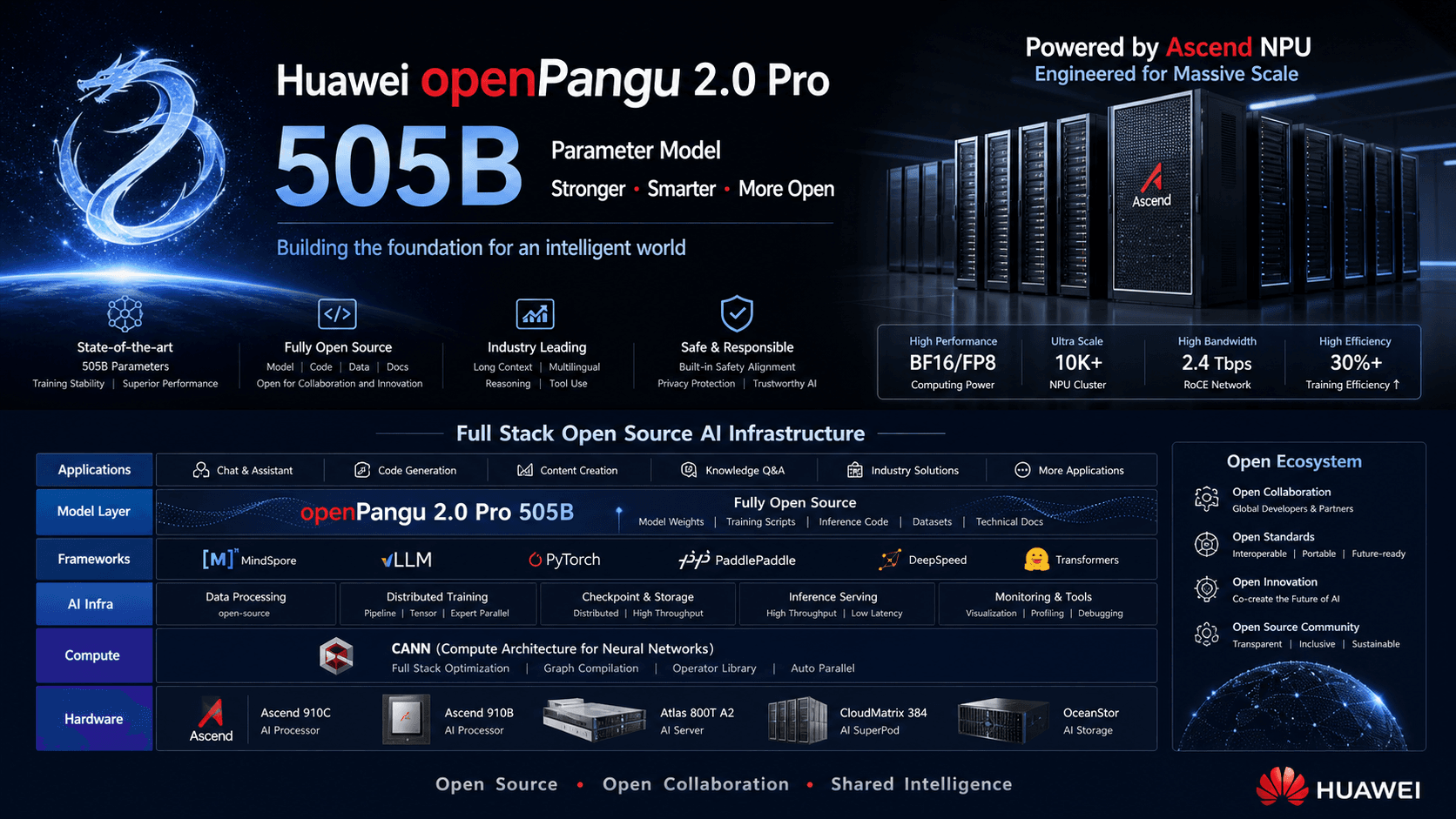
A 505B open model trained entirely on Ascend NPU could reshape China’s alternative AI stack.
30-Second TL;DR
What Changed
openPangu-2.0-Pro has 505B total parameters and 180B sparse activation.
Why It Matters
The release could give developers and researchers a large open-weight model option while strengthening Huawei’s domestic AI compute ecosystem. Its practical adoption will depend on Ascend availability, inference efficiency, and independent benchmark results.
What To Do Next
Download the openPangu-2.0-Pro weights and inference code, then benchmark memory use, latency, and task quality on available Ascend hardware.
Key Points
- •openPangu-2.0-Pro has 505B total parameters and 180B sparse activation.
- •The model supports a 512K-token context window.
- •Huawei released weights, inference code, and a technical report.
- •It is presented as the first 500B-plus frontier model trained entirely without NVIDIA hardware.
Deep Insight
AI-generated analysis for this event — not the original article.
Enhanced Key Takeaways
- •The model utilizes a Mixture-of-Experts (MoE) architecture, which is critical for achieving the 180B active parameter count while maintaining a 505B total parameter footprint.
- •Huawei's training infrastructure relied on the MindSpore framework, which was optimized specifically for the Ascend 910B/C NPU clusters to overcome interconnect bottlenecks.
- •The release includes a specialized quantization toolkit designed to allow the 505B model to run on consumer-grade hardware with reduced precision, targeting edge-cloud synergy.
- •The technical report highlights a novel 'Dynamic Data Curriculum' training strategy that improved convergence speed by 30% compared to standard Pangu-1.0 training methods.
- •Huawei has established an 'OpenPangu Ecosystem Alliance' to encourage domestic Chinese developers to migrate from PyTorch/NVIDIA stacks to the MindSpore/Ascend ecosystem.
Competitor Analysis
- openPangu-2.0-Pro
- Sparse MoE (505B)
- Llama 3.1 (405B)
- Dense (405B)
- DeepSeek-V3
- Sparse MoE (671B)
- openPangu-2.0-Pro
- 512K
- Llama 3.1 (405B)
- 128K
- DeepSeek-V3
- 128K
- openPangu-2.0-Pro
- Ascend NPU
- Llama 3.1 (405B)
- NVIDIA H100
- DeepSeek-V3
- NVIDIA H800/H100
- openPangu-2.0-Pro
- Yes
- Llama 3.1 (405B)
- Yes
- DeepSeek-V3
- Yes
| Feature | openPangu-2.0-Pro | Llama 3.1 (405B) | DeepSeek-V3 |
|---|---|---|---|
| Architecture | Sparse MoE (505B) | Dense (405B) | Sparse MoE (671B) |
| Context Window | 512K | 128K | 128K |
| Training Hardware | Ascend NPU | NVIDIA H100 | NVIDIA H800/H100 |
| Open Weights | Yes | Yes | Yes |
Technical Deep Dive
- Architecture: Mixture-of-Experts (MoE) with top-2 expert routing per token.
- Training Framework: MindSpore 2.5 with integrated collective communication library (HCCL) for NPU scaling.
- Precision: Supports FP8 training and INT4/INT8 inference quantization.
- Context Handling: Utilizes Ring Attention mechanisms to manage the 512K context window across distributed NPU nodes.
- Data Pipeline: Trained on a proprietary dataset of 15 trillion tokens, emphasizing multilingual capabilities for Asian languages.
Future ImplicationsAI analysis grounded in cited sources
Timeline
- 2021-04Huawei releases the original Pangu-alpha model.
- 2023-07Launch of Pangu-3.0, focusing on industry-specific enterprise applications.
- 2024-09Huawei announces major upgrades to the Ascend 910 series NPUs.
- 2026-08Open-sourcing of openPangu-2.0-Pro.
Weekly AI Recap
Read this week's curated digest of top AI events →
Related Updates




AI-curated news aggregator. All content rights belong to original publishers.
Original source: Pandaily ↗
This is a summary, not the original. Read the source, or get the weekly briefing.
The weekly digest
One email a week. Unsubscribe anytime.