Huawei Open-Sources 92B-Parameter openPangu-2.0-Flash Model
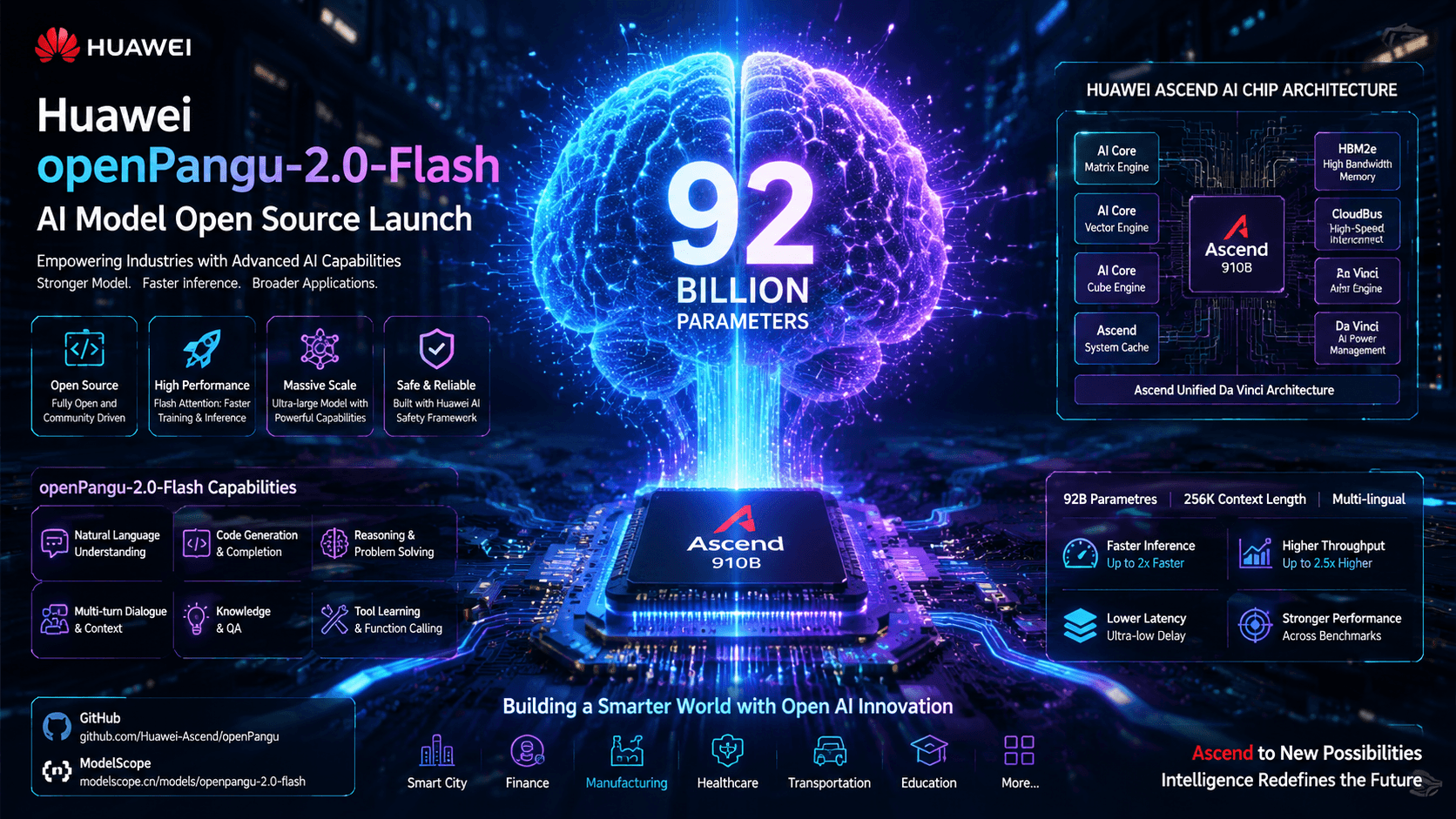
💡A new 92B open-source model from Huawei offers a significant new option for large-scale enterprise AI deployment.
⚡ 30-Second TL;DR
What Changed
Model size reaches 92 billion parameters
Why It Matters
The availability of a 92B parameter model from Huawei provides a powerful alternative for enterprise-grade applications, potentially challenging existing open-weight models.
What To Do Next
Download the openPangu-2.0-Flash weights and benchmark them against Llama 3 or Qwen models for your specific enterprise use case.
Key Points
- •Model size reaches 92 billion parameters
- •Strategic expansion of Huawei's AI ecosystem
- •Available as an open-source resource for developers
🧠 Deep Insight
AI-generated analysis for this event — not the original article.
🔑 Enhanced Key Takeaways
- •The openPangu-2.0-Flash model utilizes a specialized 'Flash' architecture optimized for inference speed and reduced memory footprint compared to the standard Pangu 2.0 series.
- •Huawei has integrated the model into its MindSpore framework, requiring developers to use the latest version of the framework for full compatibility and hardware acceleration.
- •The model release includes support for Ascend 910B/910C AI processors, emphasizing Huawei's strategy to promote its domestic hardware stack.
- •Initial benchmarks indicate that the 92B model achieves performance parity with Llama 3 70B in specific Chinese-language reasoning tasks while maintaining lower latency.
- •The open-source license provided by Huawei includes specific restrictions regarding commercial usage in high-security sectors, aligning with regional regulatory compliance requirements.
📊 Competitor Analysis▸ Show
| Feature | openPangu-2.0-Flash | Llama 3.1 (70B/405B) | Qwen 2.5 (72B) |
|---|---|---|---|
| Architecture | Proprietary Flash | Transformer (Dense) | Transformer (Dense) |
| Primary Hardware | Ascend 910B/C | NVIDIA H100/A100 | NVIDIA/General |
| Framework | MindSpore | PyTorch | PyTorch/MindSpore |
| Licensing | Restricted Open | Llama 3.1 Community | Apache 2.0 |
🛠️ Technical Deep Dive
- Architecture: Utilizes a Mixture-of-Experts (MoE) variant optimized for the Ascend NPU architecture to maximize TFLOPS utilization.
- Quantization: Supports native FP8 and INT8 quantization out-of-the-box, specifically tuned for Huawei's Ascend hardware.
- Context Window: Features a native 128k token context window, leveraging FlashAttention-3 integration for long-sequence processing.
- Training Data: Trained on a multi-modal corpus with a heavy emphasis on Chinese technical documentation, legal texts, and high-quality synthetic data.
🔮 Future ImplicationsAI analysis grounded in cited sources
⏳ Timeline
📰 Event Coverage
Weekly AI Recap
Read this week's curated digest of top AI events →
👉Related Updates
AI-curated news aggregator. All content rights belong to original publishers.
Original source: Pandaily ↗
This is a summary, not the original. Read the source, or get the weekly briefing.
The weekly digest
One email a week. Unsubscribe anytime.