LandSpace Zhuque-3 Completes Successful Static Fire Test
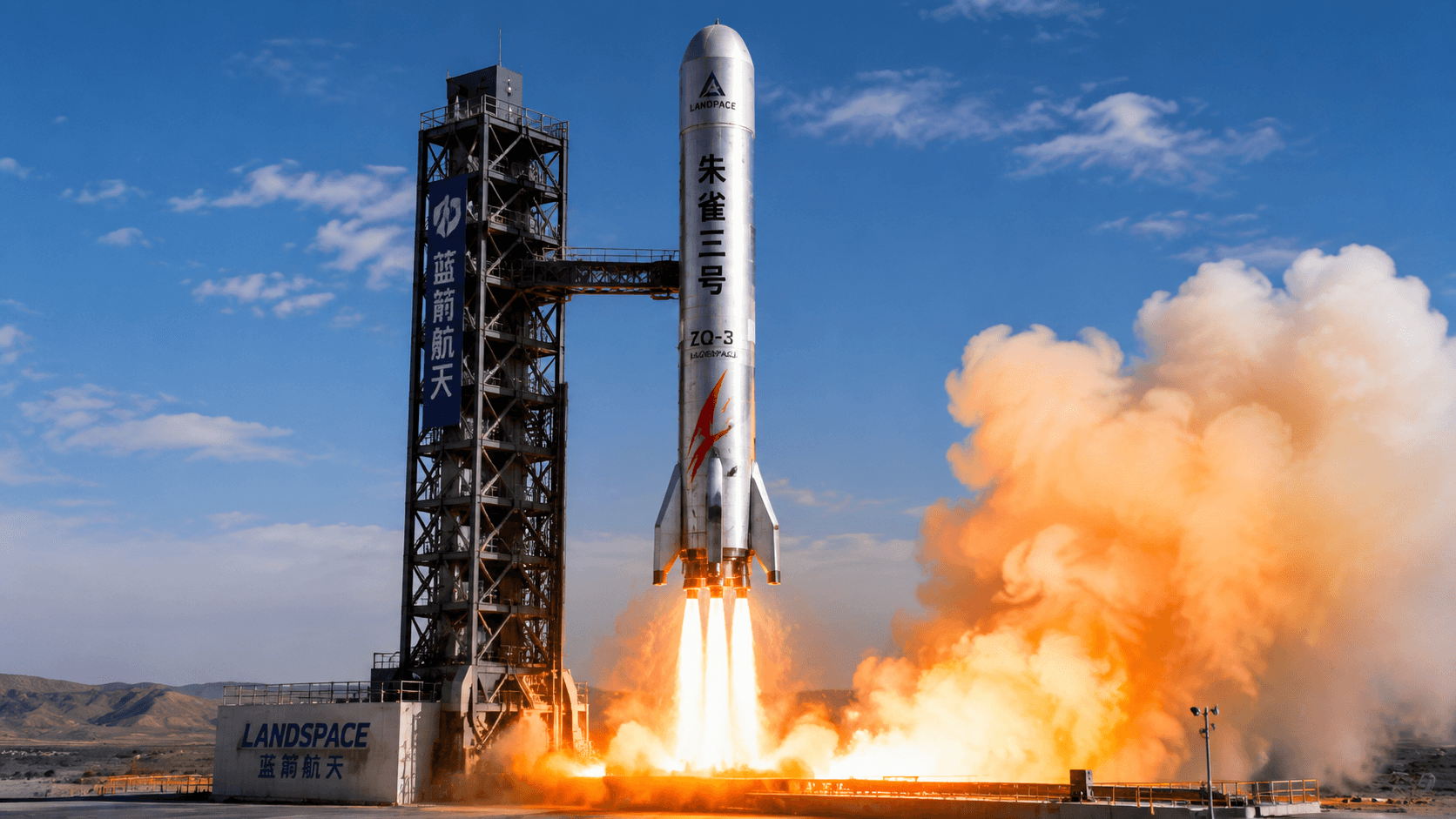
💡A major milestone for reusable rocket tech in China, impacting future space-based infrastructure and launch costs.
⚡ 30-Second TL;DR
What Changed
Zhuque-3 reusable rocket passed static fire test at Dongfeng zone
Why It Matters
The success of Zhuque-3 signals a shift toward lower-cost, high-frequency orbital launches in China. This will likely increase the availability of launch capacity for satellite constellations.
What To Do Next
Monitor LandSpace's upcoming orbital launch schedule to assess potential cost reductions for future payload deployments.
Key Points
- •Zhuque-3 reusable rocket passed static fire test at Dongfeng zone
- •Demonstrates progress in China's commercial launch vehicle development
- •Validates core propulsion and structural systems for reusability
🧠 Deep Insight
AI-generated analysis for this event — not the original article.
🔑 Enhanced Key Takeaways
- •The Zhuque-3 is designed as a stainless steel, liquid oxygen-methane (methalox) launch vehicle, mirroring the material choice of SpaceX's Starship.
- •The static fire test specifically validated the TQ-12A engine's deep-throttling capabilities, which are essential for vertical takeoff and vertical landing (VTVL) maneuvers.
- •LandSpace aims for the Zhuque-3 to achieve a rapid turnaround time, targeting up to 20 flights per vehicle to significantly reduce launch costs.
- •The rocket features a grid fin control system and landing legs integrated into the first stage to facilitate precise recovery at the launch site or downrange.
- •This test campaign was conducted at the Jiuquan Satellite Launch Center's dedicated commercial test facilities, marking a shift toward more frequent commercial testing cycles in China.
📊 Competitor Analysis▸ Show
| Feature | LandSpace Zhuque-3 | SpaceX Starship | Galactic Energy Pallas-1 |
|---|---|---|---|
| Propellant | Methalox | Methalox | Kerosene/LOX |
| Reusability | First Stage | Full Stack | First Stage |
| Material | Stainless Steel | Stainless Steel | Carbon Fiber/Alloy |
| Status | Testing | Operational/Testing | Development |
🛠️ Technical Deep Dive
- Engine: TQ-12A liquid oxygen-methane engine with high-thrust and deep-throttling capability.
- Material: High-strength stainless steel alloy for improved thermal resistance during atmospheric reentry.
- Recovery System: Grid fins for aerodynamic control and landing legs for VTVL operations.
- Payload Capacity: Designed to carry approximately 18-20 tons to Low Earth Orbit (LEO) in reusable configuration.
- Architecture: Two-stage launch vehicle with a focus on first-stage recovery and refurbishment.
🔮 Future ImplicationsAI analysis grounded in cited sources
⏳ Timeline
Weekly AI Recap
Read this week's curated digest of top AI events →
👉Related Updates
AI-curated news aggregator. All content rights belong to original publishers.
Original source: Pandaily ↗
This is a summary, not the original. Read the source, or get the weekly briefing.
Weekly AI briefing
One email a week. Unsubscribe anytime.