How to Generate SBOMs for Container Workflows
Master container security by automating SBOM generation to ensure full visibility into your software supply chain.
30-Second TL;DR
What Changed
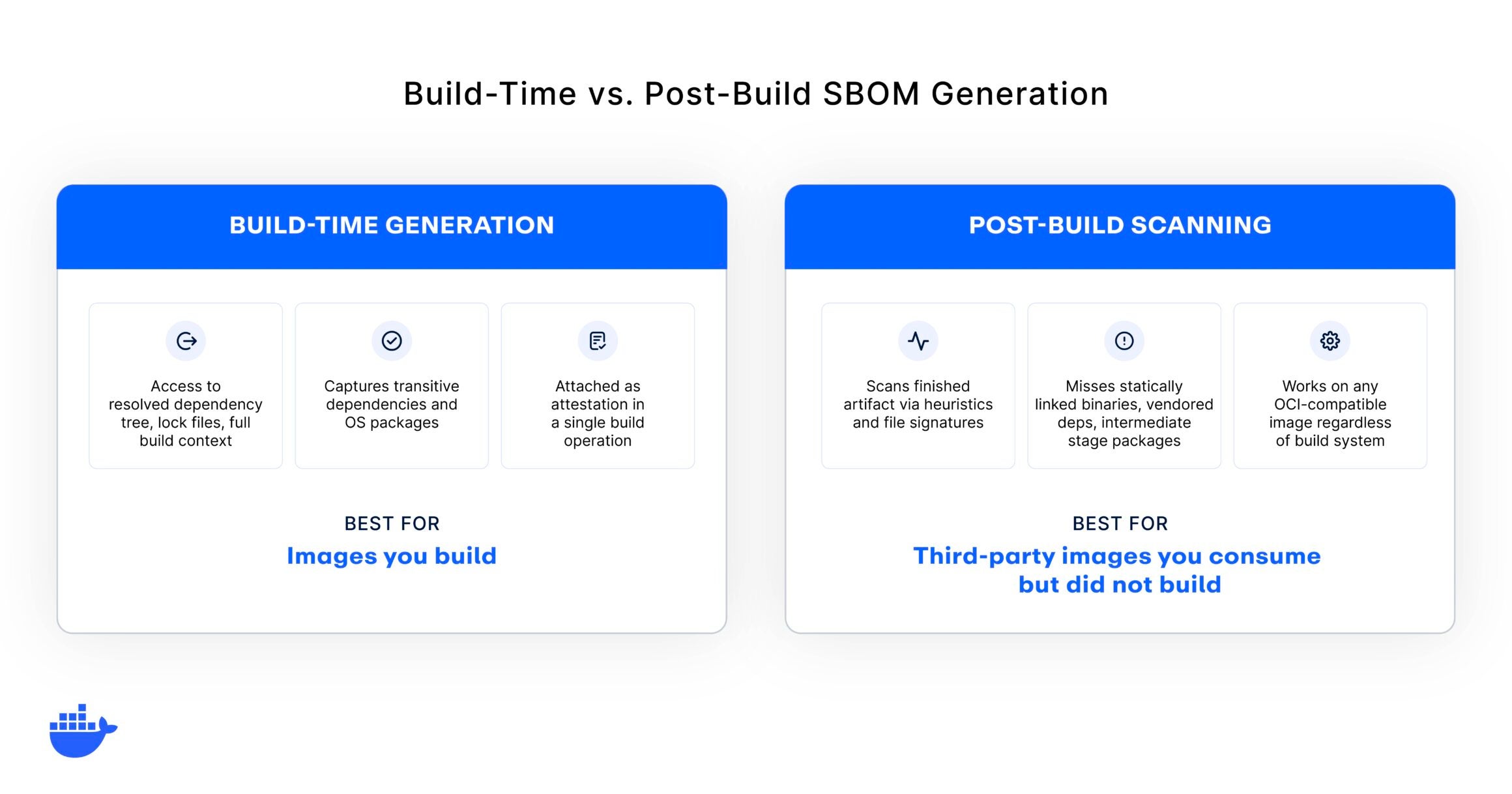
Comparison of build-time vs. post-build SBOM generation
Why It Matters
Implementing SBOMs is critical for supply chain security and meeting modern regulatory requirements. It enables faster vulnerability identification in complex containerized environments.
What To Do Next
Integrate an SBOM generation step into your GitHub Actions or GitLab CI pipeline using Docker Buildx.
Key Points
- •Comparison of build-time vs. post-build SBOM generation
- •Quality criteria for effective container SBOMs
- •Seamless integration strategies into existing CI/CD pipelines
Deep Insight
AI-generated analysis for this event — not the original article.
Enhanced Key Takeaways
- •The adoption of the CycloneDX and SPDX standards has become the industry benchmark for SBOM interoperability, moving beyond proprietary formats to ensure cross-tool compatibility.
- •Vulnerability Exploitability eXchange (VEX) is increasingly paired with SBOMs to reduce noise by confirming whether a detected vulnerability is actually reachable or exploitable in a specific container context.
- •Regulatory mandates, such as the U.S. Executive Order 14028, have shifted SBOM generation from a 'best practice' to a mandatory requirement for vendors supplying software to the federal government.
- •Modern SBOM generation tools now leverage binary analysis techniques to detect dependencies that are statically linked or bundled, which traditional manifest-based scanners often miss.
- •The integration of SBOMs into container registries allows for 'continuous monitoring,' where images are re-scanned against new CVE databases without requiring a full rebuild of the container.
Competitor Analysis
- Docker Scout
- Native Docker Integration
- Snyk Container
- Developer-First Security
- Anchore Enterprise
- Policy & Compliance
- Syft/Grype (Open Source)
- CLI-based Scanning
- Docker Scout
- Freemium (Pro/Team tiers)
- Snyk Container
- Tiered (Free/Paid)
- Anchore Enterprise
- Enterprise Licensing
- Syft/Grype (Open Source)
- Free (Apache 2.0)
- Docker Scout
- SPDX, CycloneDX
- Snyk Container
- SPDX, CycloneDX
- Anchore Enterprise
- SPDX, CycloneDX
- Syft/Grype (Open Source)
- SPDX, CycloneDX
- Docker Scout
- Deep registry integration
- Snyk Container
- High developer adoption
- Anchore Enterprise
- Advanced policy engine
- Syft/Grype (Open Source)
- High performance/speed
| Feature | Docker Scout | Snyk Container | Anchore Enterprise | Syft/Grype (Open Source) |
|---|---|---|---|---|
| Primary Focus | Native Docker Integration | Developer-First Security | Policy & Compliance | CLI-based Scanning |
| Pricing | Freemium (Pro/Team tiers) | Tiered (Free/Paid) | Enterprise Licensing | Free (Apache 2.0) |
| SBOM Standards | SPDX, CycloneDX | SPDX, CycloneDX | SPDX, CycloneDX | SPDX, CycloneDX |
| Key Benchmark | Deep registry integration | High developer adoption | Advanced policy engine | High performance/speed |
Technical Deep Dive
- SBOM generation typically utilizes static analysis of package managers (e.g., apt, apk, npm) and binary fingerprinting to identify components.
- Tools like Syft use recursive scanning to inspect layers within a container image to reconstruct the full dependency graph.
- Integration often relies on OCI (Open Container Initiative) artifacts to store SBOMs alongside images in the same registry, using the same authentication and transport mechanisms.
- VEX documents are implemented as JSON-LD files that reference the SBOM's unique identifier to provide status updates (e.g., 'not_affected', 'fixed') for specific vulnerabilities.
Future ImplicationsAI analysis grounded in cited sources
Timeline
- 2021-05U.S. Executive Order 14028 mandates SBOMs for software supply chain security.
- 2021-10Docker announces initial support for SBOM generation via integration with Syft.
- 2023-03Docker launches Docker Scout to provide integrated supply chain security and SBOM management.
- 2024-09Docker expands Scout to include automated policy enforcement based on SBOM data.
Weekly AI Recap
Read this week's curated digest of top AI events →
AI-curated news aggregator. All content rights belong to original publishers.
Original source: Docker Blog ↗
This is a summary, not the original. Read the source, or get the weekly briefing.
The weekly digest
One email a week. Unsubscribe anytime.