Hormuz Strait blockade risks record oil prices
Understand how potential energy supply shocks could impact global market volatility and algorithmic trading strategies.
30-Second TL;DR
What Changed
Market consensus on a June reopening of the Strait of Hormuz is considered 'magical thinking'.
Why It Matters
Macroeconomic instability driven by energy shocks could force a shift in capital allocation and increase volatility for AI-driven algorithmic trading strategies.
What To Do Next
Incorporate real-time geopolitical risk indices and energy commodity price feeds into your market prediction models to adjust risk parameters.
Key Points
- •Market consensus on a June reopening of the Strait of Hormuz is considered 'magical thinking'.
- •Continued supply disruption could push oil prices toward 2008 peaks, causing significant inflation.
- •High oil prices and rising bond yields pose a severe risk to equity market valuations.
Deep Insight
Background and context from public sources — not the original article. 17 sources cited.
Enhanced Key Takeaways
- •The Strait of Hormuz is a critical global chokepoint, through which approximately 20 million barrels per day (mb/d) of crude oil and oil products were shipped in 2025, accounting for about 25% of the world's seaborne oil trade.
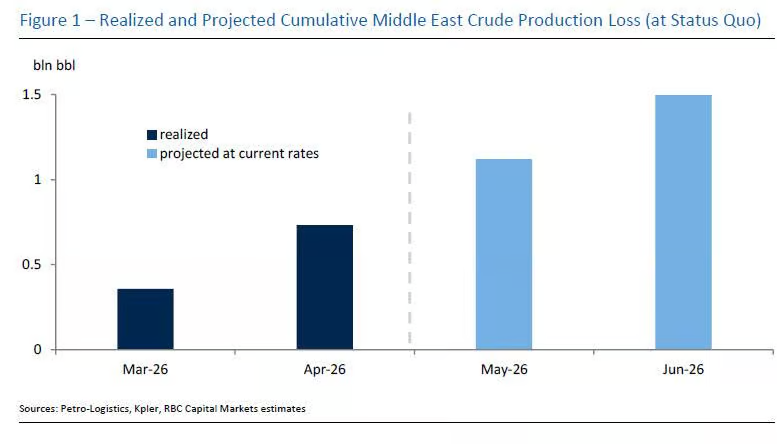
- •The current disruption in the Strait of Hormuz, which commenced around February 28, 2026, following US-Israel strikes on Iran, has led to a near standstill in shipping, with tanker traffic dropping significantly.
- •While Saudi Arabia and the UAE possess alternative pipeline routes to bypass the Strait, their combined capacity is limited to an estimated 3.5 to 5.5 mb/d, which is insufficient to fully offset a prolonged closure.
- •RBC analyst Helima Croft emphasizes that the magnitude of the current oil supply disruption has already surpassed the shocks experienced in the 1970s.
- •The 2008 oil price peak, which saw crude reach $147.30 per barrel, was primarily driven by soaring global demand, stagnating non-OPEC supply, and financial speculation, rather than a physical supply disruption of the current scale.
Technical Deep Dive
- The Strait of Hormuz is only 29 nautical miles (54 km) wide at its narrowest point, featuring two 2-mile-wide navigable channels for shipping, separated by a 2-mile-wide buffer zone.
- Approximately 80% of the oil transiting the Strait is destined for Asian markets, with China, India, and Japan being major importers.
- The Strait is also vital for global natural gas trade, handling nearly 20% of global LNG exports, predominantly from Qatar and the UAE, for which no alternative shipping routes exist.
- The impact of disruptions on oil prices is significantly amplified when global oil inventories are low, as the market lacks a physical buffer to absorb supply shocks.
Future ImplicationsAI analysis grounded in cited sources
Timeline
- 1980-1988Iran-Iraq 'Tanker War' disrupts Strait of Hormuz shipping
- 2011-2012Iran threatens to close Strait of Hormuz over nuclear sanctions
- 2019U.S. Navy blames Iran for limpet mine attacks near the Strait
- 2025-06Iran reportedly threatens to block Strait during 12-day war with Israel
- 2026-02-28Strait of Hormuz disrupted following US-Israel strikes on Iran
- 2026-03Brent crude oil prices surge to $126/barrel, largest monthly increase in history
Sources (17)
Factual claims are grounded in the sources below. Forward-looking analysis is AI-generated interpretation.
Weekly AI Recap
Read this week's curated digest of top AI events →
AI-curated news aggregator. All content rights belong to original publishers.
Original source: 虎嗅 ↗
This is a summary, not the original. Read the source, or get the weekly briefing.
The weekly digest
One email a week. Unsubscribe anytime.