🗾ITmedia AI+ (日本)•Stalecollected in 38m
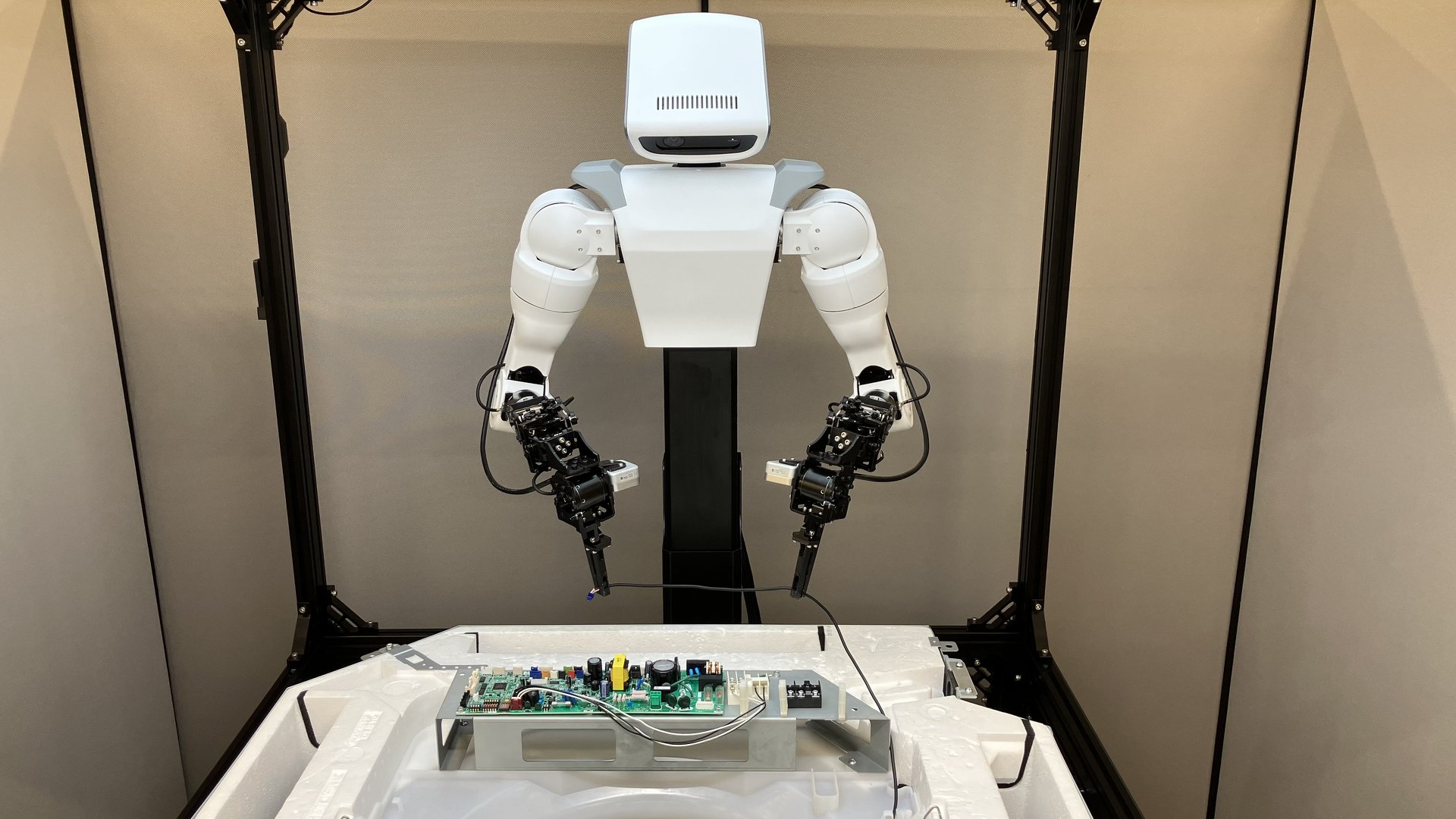
Hitachi Physical AI Hits 100 Actions/Second
💡10x faster physical AI control unlocks responsive industrial robots
⚡ 30-Second TL;DR
What Changed
Action instructions increased 10x from 10 to 100 per second
Why It Matters
This could accelerate real-time control in robotics and automation, reducing latency in industrial operations and enabling more responsive AI-driven machinery.
What To Do Next
Attend Hitachi's Lumada events to demo physical AI for manufacturing integration.
Who should care:Enterprise & Security Teams
🧠 Deep Insight
AI-generated analysis for this event.
🔑 Enhanced Key Takeaways
- •The 100 actions/second milestone is achieved through a proprietary 'Physical AI' architecture that integrates real-time sensor fusion with high-speed inference engines, specifically designed to reduce latency in robotic control loops.
- •Hitachi is positioning this technology as a core component of its 'Lumada' digital transformation platform, aiming to enable autonomous mobile robots (AMRs) to perform complex, non-repetitive tasks in dynamic environments without human intervention.
- •The demonstration highlighted a specific 'self-correction' capability where the AI adjusts robotic arm trajectories in milliseconds when encountering unexpected obstacles, a significant improvement over previous rule-based industrial automation systems.
📊 Competitor Analysis▸ Show
| Competitor | Feature | Benchmarks | Pricing |
|---|---|---|---|
| FANUC | Industrial Robotics/AI | High reliability; lower real-time inference speed | Enterprise/Custom |
| ABB | YuMi/Collaborative Robots | Advanced safety; slower control loop frequency | Enterprise/Custom |
| NVIDIA | Isaac Robotics Platform | High-performance simulation/training | Software Licensing |
🛠️ Technical Deep Dive
- Architecture: Utilizes a hierarchical control system where high-level task planning is decoupled from low-level motor control, allowing for the 100Hz update rate.
- Sensor Fusion: Employs multi-modal input processing (LiDAR, depth cameras, and tactile sensors) synchronized via a time-sensitive networking (TSN) protocol.
- Inference Engine: Optimized for edge deployment on specialized industrial controllers, minimizing data round-trip time to the cloud.
- Latency Reduction: Achieved by implementing a predictive model that anticipates physical state changes, allowing the controller to issue commands before the physical movement completes.
🔮 Future ImplicationsAI analysis grounded in cited sources
Hitachi will integrate this technology into its standard factory automation product line by Q4 2026.
The successful demonstration at Lumada Innovation Hub indicates the technology has moved past the R&D phase and is ready for commercial productization.
The 100Hz control loop will enable robots to handle fragile or irregularly shaped objects in logistics.
Higher frequency control allows for more precise force feedback and trajectory adjustment, which is critical for handling non-standardized items.
⏳ Timeline
2023-05
Hitachi announces the expansion of its Lumada AI portfolio for industrial automation.
2024-11
Hitachi publishes research on high-speed robotic control using edge-based AI.
2026-03
Hitachi demonstrates 100 actions/second Physical AI at Lumada Innovation Hub Tokyo.
📰
Weekly AI Recap
Read this week's curated digest of top AI events →
👉Related Updates
AI-curated news aggregator. All content rights belong to original publishers.
Original source: ITmedia AI+ (日本) ↗
