Haier Launches AI-Powered Exoskeleton W3 for Home Use
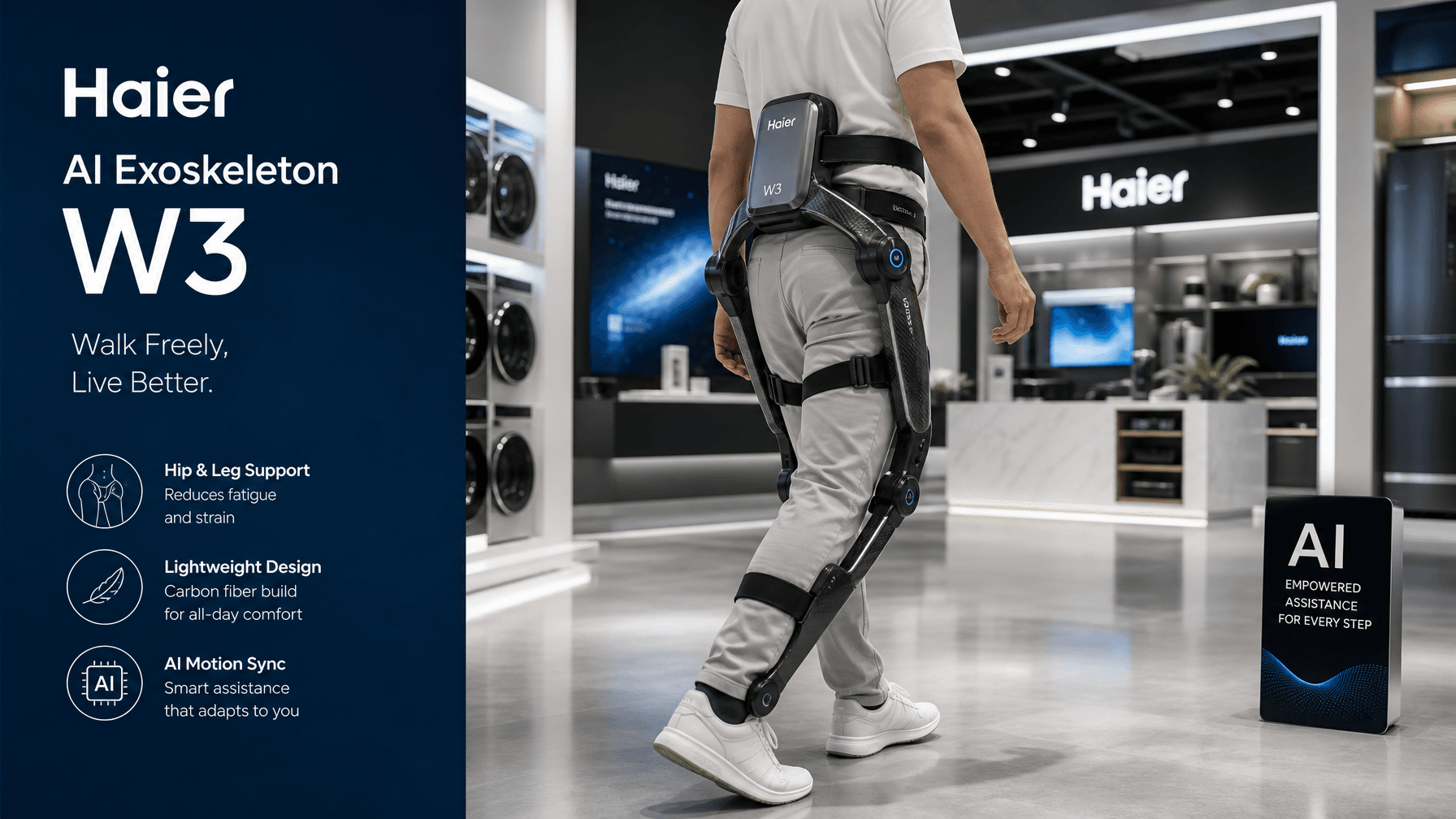
💡A rare consumer-ready AI exoskeleton that uses real-time gait learning to adapt to human movement.
⚡ 30-Second TL;DR
What Changed
Features real-time AI gait learning for personalized movement assistance
Why It Matters
The W3 represents a significant step in bringing embodied AI and assistive robotics into the consumer home, demonstrating the feasibility of lightweight, adaptive wearable hardware.
What To Do Next
Study the integration of low-latency edge AI in wearable devices to understand how to optimize real-time inference for human-machine interaction.
Key Points
- •Features real-time AI gait learning for personalized movement assistance
- •Ultra-lightweight design at 1.75 kg for comfortable home wearability
- •Priced at $2,200, targeting the consumer-ready wearable robotics market
🧠 Deep Insight
AI-generated analysis for this event — not the original article.
🔑 Enhanced Key Takeaways
- •The W3 utilizes a proprietary 'Neuro-Adaptive' sensor array that monitors muscle activation signals (EMG) in addition to gait kinematics to reduce latency in movement assistance.
- •Haier has integrated the W3 with its 'Smart Home Brain' ecosystem, allowing the exoskeleton to communicate with home IoT devices to adjust environmental settings based on user fatigue levels.
- •The device utilizes a high-density solid-state battery pack that supports rapid charging, achieving 80% capacity in 20 minutes.
- •Haier is partnering with local rehabilitation clinics in Guangzhou to offer a 'prescribed-to-home' model, where the W3 is calibrated by physical therapists before consumer use.
- •The exoskeleton chassis is constructed from a carbon-fiber-reinforced polymer (CFRP) composite, which provides the necessary structural rigidity while maintaining the 1.75 kg weight profile.
📊 Competitor Analysis▸ Show
| Feature | Haier W3 | Cyberdyne HAL (Home) | Wandercraft Atalante X |
|---|---|---|---|
| Weight | 1.75 kg | ~10 kg | >50 kg |
| Primary Use | Consumer/Home | Medical/Rehab | Clinical/Hospital |
| Pricing | $2,200 | Subscription-based | $100,000+ |
| AI Integration | Real-time Gait Learning | Bio-signal processing | Pre-programmed gaits |
🛠️ Technical Deep Dive
- Actuation: Dual-motor micro-actuators located at the hip joints providing up to 15Nm of torque.
- Sensor Fusion: 9-axis IMU (Inertial Measurement Unit) combined with pressure-sensitive foot insoles for gait phase detection.
- Connectivity: Bluetooth 5.4 for smartphone app integration and OTA firmware updates.
- Processor: Custom Haier-designed 'H-Core' AI chip optimized for low-power edge computing and real-time motion prediction.
- Safety: Integrated mechanical hard-stops and emergency 'soft-lock' mode triggered by sudden loss of balance.
🔮 Future ImplicationsAI analysis grounded in cited sources
⏳ Timeline
Weekly AI Recap
Read this week's curated digest of top AI events →
👉Related Updates


AI-curated news aggregator. All content rights belong to original publishers.
Original source: Pandaily ↗
This is a summary, not the original. Read the source, or get the weekly briefing.
The weekly digest
One email a week. Unsubscribe anytime.