Guizhen Chip Demonstrates On-Chip Quantum Computing Milestone
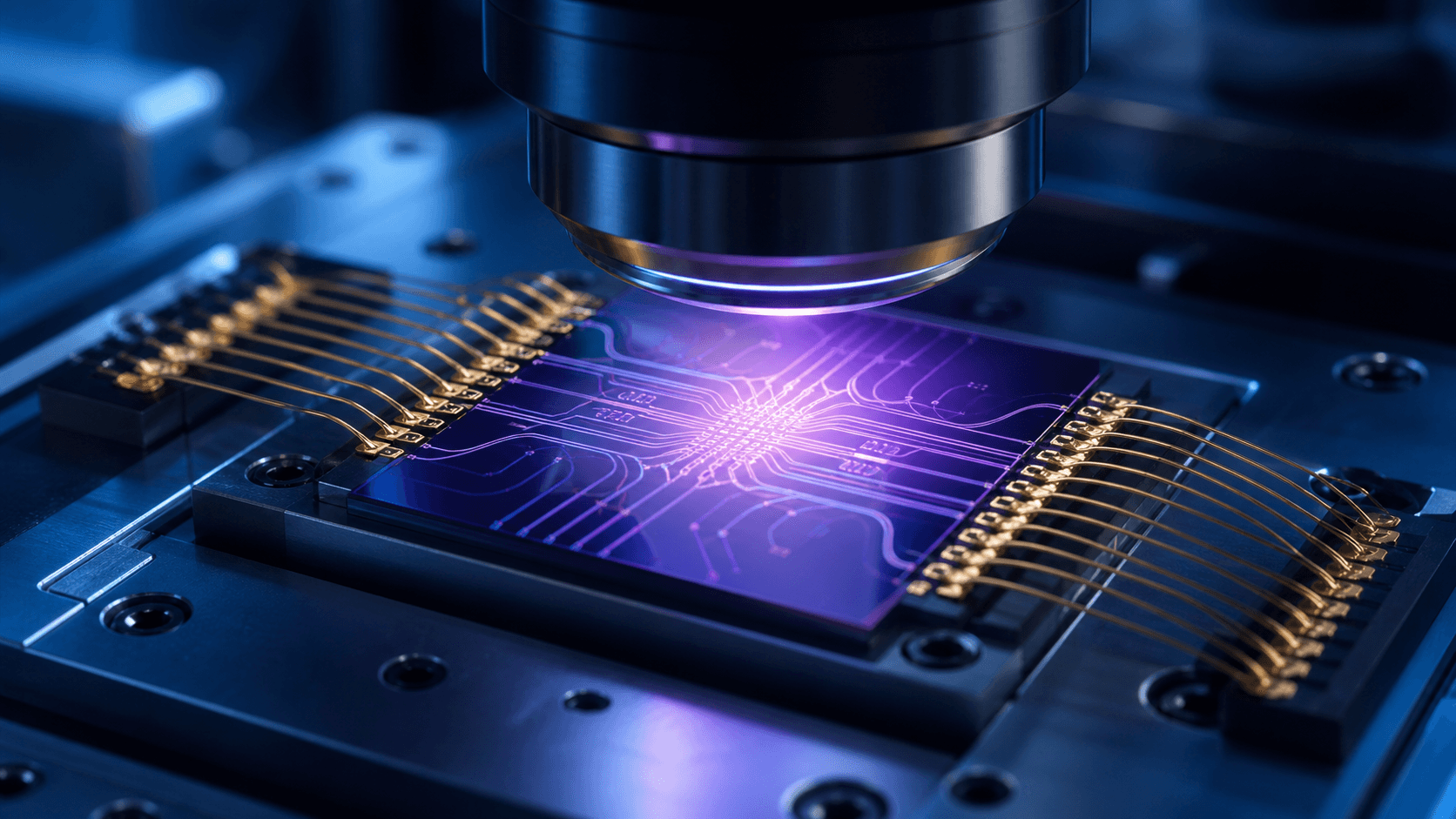
A rare on-chip demonstration combines 16-qubit entanglement with a validated quantum search.
30-Second TL;DR
What Changed
Generated a 4-photon, 16-qubit GHZ state directly on-chip
Why It Matters
The demonstration could help move optical quantum computing from laboratory assemblies toward more integrated and scalable hardware. For AI and quantum researchers, it signals potential future access to higher-throughput photonic processors, although substantial engineering remains before million-qubit systems are practical.
What To Do Next
Review the reported photonic circuit architecture and benchmark its state-generation fidelity against the requirements of your quantum simulation or optimization workload.
Key Points
- •Generated a 4-photon, 16-qubit GHZ state directly on-chip
- •Demonstrated a 4-qubit cluster state for measurement-based quantum computing
- •Achieved a 0.987 average identification probability in Grover search
- •The work strengthens the feasibility of scalable integrated photonic quantum systems
Deep Insight
AI-generated analysis for this event — not the original article.
Enhanced Key Takeaways
- •The Guizhen chip utilizes a programmable silicon photonic architecture that integrates high-efficiency photon sources with reconfigurable interferometers to minimize optical loss.
- •This research represents a significant shift from bulk-optic quantum experiments to monolithic integration, which is essential for reducing the footprint of quantum processors.
- •The 16-qubit GHZ state generation was achieved by encoding multiple degrees of freedom (path and polarization) onto the 4-photon system, effectively expanding the Hilbert space.
- •The Grover search algorithm implementation on this chip demonstrates high-fidelity gate operations, which are critical for error-resilient measurement-based quantum computing (MBQC).
- •The collaboration between Guizhen Chip Technology and USTC leverages advanced CMOS-compatible fabrication processes, paving the way for mass-producible quantum photonic circuits.
Competitor Analysis
- Guizhen Chip (Photonic)
- Silicon Photonic / MBQC
- Xanadu (X-Series)
- Squeezed State / CV
- PsiQuantum (Q1)
- Silicon Photonic / Fusion
- Guizhen Chip (Photonic)
- Path/Polarization
- Xanadu (X-Series)
- Continuous Variable
- PsiQuantum (Q1)
- Dual-Rail Photonic
- Guizhen Chip (Photonic)
- Integrated GHZ/Cluster
- Xanadu (X-Series)
- Cloud Quantum Computing
- PsiQuantum (Q1)
- Fault-Tolerant Scaling
| Feature | Guizhen Chip (Photonic) | Xanadu (X-Series) | PsiQuantum (Q1) |
|---|---|---|---|
| Architecture | Silicon Photonic / MBQC | Squeezed State / CV | Silicon Photonic / Fusion |
| Qubit Encoding | Path/Polarization | Continuous Variable | Dual-Rail Photonic |
| Primary Focus | Integrated GHZ/Cluster | Cloud Quantum Computing | Fault-Tolerant Scaling |
Technical Deep Dive
- Architecture: Monolithic silicon photonic integrated circuit (PIC) utilizing Mach-Zehnder Interferometer (MZI) arrays for state manipulation.
- Encoding: Hybrid encoding scheme combining path and polarization degrees of freedom to achieve 16-qubit dimensionality from 4 photons.
- Source: On-chip spontaneous four-wave mixing (SFWM) used for high-purity photon pair generation.
- Performance: Grover search identification probability of 0.987 indicates high-fidelity state preparation and measurement (SPAM) capabilities.
- Scalability: Design supports modular expansion through the integration of additional photonic waveguides and phase shifters on a single substrate.
Future ImplicationsAI analysis grounded in cited sources
Timeline
- 2024-05Guizhen Chip Technology founded to commercialize USTC photonic research.
- 2025-09Initial validation of high-efficiency on-chip photon sources.
- 2026-07Successful demonstration of 16-qubit GHZ state and Grover search on the Guizhen platform.
Weekly AI Recap
Read this week's curated digest of top AI events →
Related Updates



AI-curated news aggregator. All content rights belong to original publishers.
Original source: Pandaily ↗
This is a summary, not the original. Read the source, or get the weekly briefing.
The weekly digest
One email a week. Unsubscribe anytime.