Groq Raises $350M as Nvidia Joins Round
Groq’s funding and Nvidia’s backing reveal how the AI-inference chip market is reshaping.
30-Second TL;DR
What Changed
Groq raised $350 million in a Series A financing round.
Why It Matters
Nvidia’s participation may validate Groq’s inference-focused hardware while also signaling closer ties between a challenger and the market leader. The lower valuation could pressure AI-chip startups to prove stronger commercial traction and unit economics.
What To Do Next
Benchmark Groq’s inference platform against your current GPU stack on latency, throughput, and cost per generated token before planning a migration.
Key Points
- •Groq raised $350 million in a Series A financing round.
- •The company is now valued at $3.5 billion, down from $6.9 billion.
- •Nvidia joined the round despite Groq’s positioning as an alternative to Nvidia.
- •The funding supports Groq’s AI-inference chip business.
Deep Insight
AI-generated analysis for this event — not the original article.
Enhanced Key Takeaways
- •Groq's LPU (Language Processing Unit) architecture utilizes a deterministic, software-defined hardware approach that eliminates the need for traditional instruction scheduling found in GPUs.
- •The participation of Nvidia in this round is widely interpreted by analysts as a strategic hedge, allowing Nvidia to maintain visibility into alternative inference-focused architectures.
- •Despite the valuation reset, Groq has significantly expanded its 'GroqCloud' developer platform, which provides API access to open-source models like Llama 3 and Mixtral at high throughput.
- •The funding round follows a period of intense capital expenditure for Groq as it scaled its data center footprint to meet demand for low-latency inference services.
- •Groq's hardware design specifically targets the 'memory wall' bottleneck by utilizing SRAM-based architecture, which offers significantly higher bandwidth than the HBM used in standard GPU accelerators.
Competitor Analysis
- Groq (LPU)
- Low-latency Inference
- Nvidia (H100/B200)
- Training & Inference
- Cerebras (WSE-3)
- Massive Model Training
- Groq (LPU)
- Deterministic/SRAM
- Nvidia (H100/B200)
- CUDA/HBM
- Cerebras (WSE-3)
- Wafer-Scale/SRAM
- Groq (LPU)
- Ultra-Low (Tokens/sec)
- Nvidia (H100/B200)
- Moderate
- Cerebras (WSE-3)
- Low (High Throughput)
- Groq (LPU)
- Token-based API
- Nvidia (H100/B200)
- Hardware/Cloud Rental
- Cerebras (WSE-3)
- System/Cluster Rental
| Feature | Groq (LPU) | Nvidia (H100/B200) | Cerebras (WSE-3) |
|---|---|---|---|
| Primary Focus | Low-latency Inference | Training & Inference | Massive Model Training |
| Architecture | Deterministic/SRAM | CUDA/HBM | Wafer-Scale/SRAM |
| Latency | Ultra-Low (Tokens/sec) | Moderate | Low (High Throughput) |
| Pricing Model | Token-based API | Hardware/Cloud Rental | System/Cluster Rental |
Technical Deep Dive
- Architecture: Groq utilizes a proprietary LPU (Language Processing Unit) design that is fundamentally different from GPU architectures.
- Deterministic Execution: The compiler manages data movement and timing, removing the need for dynamic scheduling hardware, which reduces overhead and latency.
- Memory Hierarchy: Instead of relying on HBM (High Bandwidth Memory), Groq uses massive amounts of on-chip SRAM, providing extremely high memory bandwidth and predictable performance.
- Software Stack: The GroqWare suite includes a compiler that maps models directly to the hardware, optimizing for specific tensor operations without the complexity of CUDA kernels.
Future ImplicationsAI analysis grounded in cited sources
Timeline
- 2016-12Groq is founded by former Google engineers who worked on the original TPU.
- 2021-04Groq announces the first generation of its LPU architecture.
- 2024-02Groq gains significant public attention for its high-speed inference performance on LLMs.
- 2024-03Groq launches GroqCloud to provide developers with API access to LPU-powered inference.
- 2026-08Groq raises $350M in a Series A round with participation from Nvidia.
Event Coverage
Weekly AI Recap
Read this week's curated digest of top AI events →
Related Updates

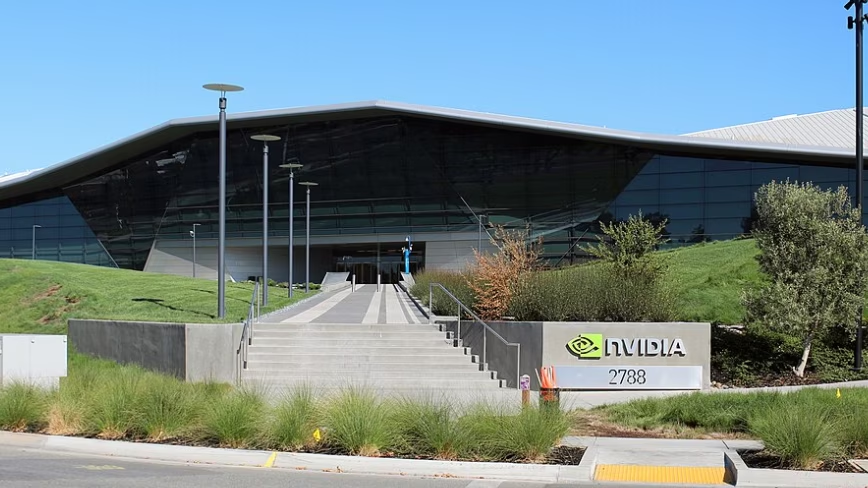

AI-curated news aggregator. All content rights belong to original publishers.
Original source: The Next Web (TNW) ↗
This is a summary, not the original. Read the source, or get the weekly briefing.
The weekly digest
One email a week. Unsubscribe anytime.