GraphWorkflow’s 62.5% Speedup Exposes Swarm Bottlenecks
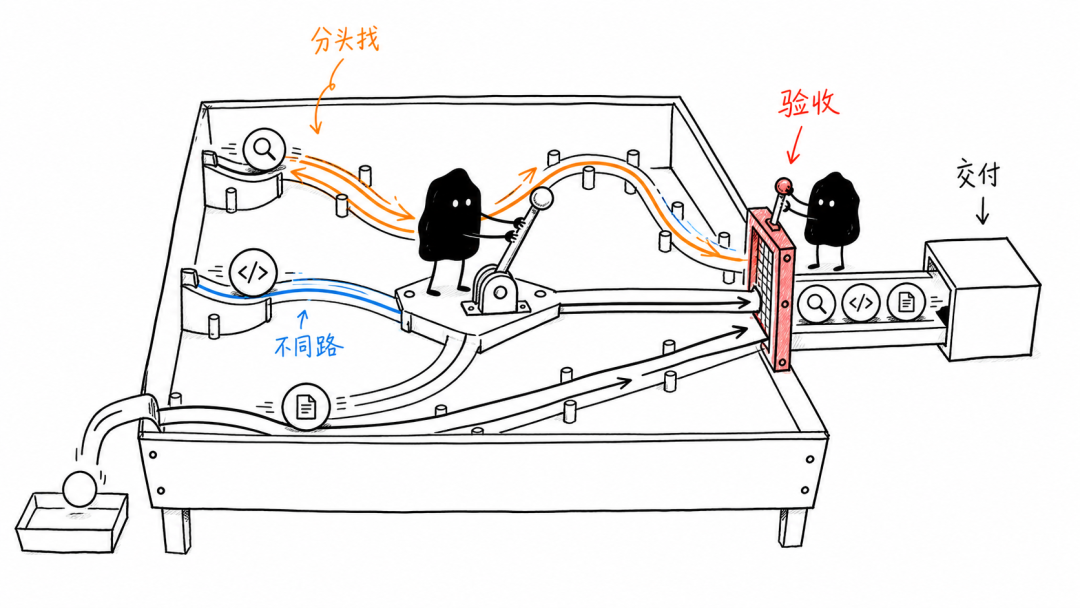
💡A 62.5% orchestration gain reveals why adding more agents can create new system bottlenecks.
⚡ 30-Second TL;DR
What Changed
GraphWorkflow compiles predefined multi-agent task graphs once and reuses them to reduce runtime orchestration overhead.
Why It Matters
The main implication is that scaling agents out requires an orchestration layer capable of minimizing coordination waste, not merely more concurrent model calls. Teams should treat multi-agent deployment as a tradeoff among search breadth, latency, reliability, and token cost.
What To Do Next
Prototype one representative workflow in GraphWorkflow and LangGraph, then compare end-to-end latency, token usage, failure recovery, and result quality rather than scheduler speed alone.
Key Points
- •GraphWorkflow compiles predefined multi-agent task graphs once and reuses them to reduce runtime orchestration overhead.
- •The benchmark used single-machine, synchronous, static DAGs with up to 200 nodes, so the results do not represent end-to-end model latency or token throughput.
- •Multi-agent architectures can improve broad, parallel research tasks, but may hurt performance on sequential or tightly coupled workflows.
- •Anthropic’s cited research system improved an internal benchmark by 90.2% over a single-agent setup, while consuming about 15x the tokens.
- •Dynamic swarms such as Kimi Agent Swarm are exploring runtime task decomposition and coordination at much larger scales.
🧠 Deep Insight
Background and context from public sources — not the original article. 5 sources cited.
🔑 Enhanced Key Takeaways
- •GraphWorkflow utilizes Rustworkx as a high-performance backend to handle large-scale graph execution, providing a significant performance advantage over pure Python-based graph libraries.
- •The framework incorporates automated cycle detection during the compilation phase, preventing infinite loops in complex multi-agent task graphs before execution begins.
- •The 7.0x geometric-mean speedup is specifically attributed to the reduction of runtime overhead in managing task dependencies and state transitions within the orchestration layer.
- •GraphWorkflow supports native JSON serialization for workflow definitions, enabling developers to version control and audit complex agent interaction patterns as code.
- •The system employs topological sorting algorithms to maximize parallel execution of independent nodes, effectively minimizing the critical path latency in static DAG configurations.
📊 Competitor Analysis▸ Show
| Feature | GraphWorkflow | LangGraph | Kimi Agent Swarm |
|---|---|---|---|
| Orchestration Approach | Compile-once static DAG | Dynamic runtime graph | Runtime task decomposition |
| Primary Backend | Rustworkx / NetworkX | Python-based | Proprietary / Dynamic |
| Performance Focus | Orchestration overhead | Flexibility / Statefulness | Large-scale coordination |
| Benchmark (vs LangGraph) | 7.0x (Geo-mean) | Baseline | N/A |
🛠️ Technical Deep Dive
- Compile-once execution model: Pre-compiles task graphs into optimized execution plans to eliminate runtime overhead.
- Backend flexibility: Supports both NetworkX for compatibility and Rustworkx for high-performance, multi-threaded graph processing.
- Topological sorting: Automatically identifies and schedules independent nodes for parallel execution to reduce total workflow latency.
- Cycle detection: Built-in validation logic to identify and reject circular dependencies in agent task graphs prior to runtime.
- State management: Decouples orchestration logic from model inference, allowing for granular control over shared state across agent nodes.
🔮 Future ImplicationsAI analysis grounded in cited sources
⏳ Timeline
📎 Sources (5)
Factual claims are grounded in the sources below. Forward-looking analysis is AI-generated interpretation.
Weekly AI Recap
Read this week's curated digest of top AI events →
👉Related Updates
AI-curated news aggregator. All content rights belong to original publishers.
Original source: 虎嗅 ↗
This is a summary, not the original. Read the source, or get the weekly briefing.
Weekly AI briefing
One email a week. Unsubscribe anytime.