China’s Frontier Models Face a Sustainability Test
💡Three Chinese model companies are taking radically different paths to scale frontier intelligence—and survive financiall
⚡ 30-Second TL;DR
What Changed
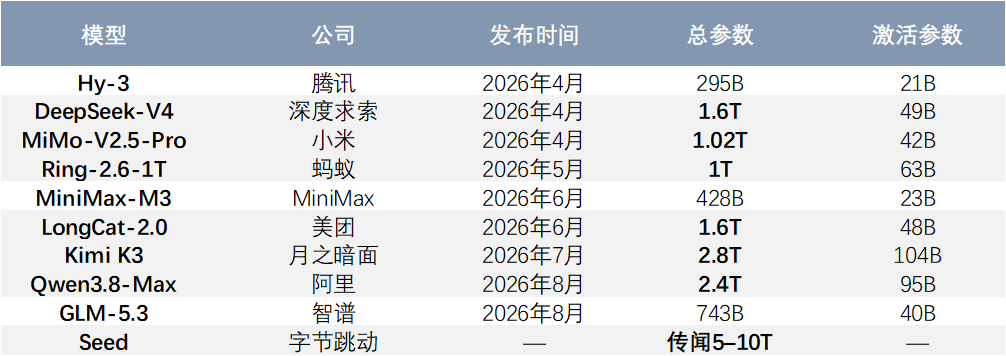
China’s open-source models are entering trillion-parameter and multi-trillion-parameter scaling competition, driving demand for GW-scale data centers.
Why It Matters
For AI founders and infrastructure teams, frontier performance is increasingly inseparable from capital efficiency, hardware availability, and monetization. Chinese open-source models may become more globally embedded, but their long-term viability depends on converting adoption into recurring revenue rather than relying on repeated fundraising.
What To Do Next
Benchmark DeepSeek, GLM, and Kimi models on your production workload, then compare inference cost, hardware requirements, licensing terms, and achievable enterprise revenue before committing to a model provider.
Key Points
- •China’s open-source models are entering trillion-parameter and multi-trillion-parameter scaling competition, driving demand for GW-scale data centers.
- •The three companies face a major value-capture gap: their combined AI ARR is estimated at slightly above $2 billion, far below OpenAI and Anthropic’s combined ARR.
- •Kimi K3 is returning to larger-scale pretraining, Zhipu is emphasizing long-horizon reinforcement learning and post-training, while DeepSeek is optimizing infrastructure and exploring self-designed chips.
- •Overseas deployment, model routing, enterprise integrations, and licensing are becoming essential ways for Chinese open-source models to generate revenue.
🧠 Deep Insight
Background and context from public sources — not the original article. 7 sources cited.
🔑 Enhanced Key Takeaways
- •As of July 2026, Chinese firms dominate the global open-weight model market, with the five most-used models on platforms like OpenRouter originating from China.
- •Moonshot AI's Kimi K3, released in July 2026, holds the record for the world's largest open-weight AI system at 2.8 trillion parameters.
- •Zhipu's GLM-5.3 model has demonstrated superior performance in offensive and defensive cybersecurity tasks compared to U.S. counterparts on the CyberGym benchmark.
- •The U.S. Commerce Department’s CAISI has identified significant gaps in safety guardrails within Chinese frontier models, noting instances where they assist in prohibited activities like hacking.
- •Chinese regulators introduced specific security and standardization frameworks for agentic AI in early 2026 following the widespread adoption of systems like OpenClaw.
📊 Competitor Analysis▸ Show
| Feature | DeepSeek | Zhipu (GLM-5.3) | Moonshot (Kimi K3) |
|---|---|---|---|
| Primary Focus | Infrastructure Efficiency | Long-horizon RL | Large-scale Pretraining |
| Parameter Count | Proprietary | High (Frontier) | 2.8 Trillion |
| Key Strength | Compute Optimization | Cybersecurity/Safety | Open-weight Scale |
🛠️ Technical Deep Dive
- Kimi K3 utilizes a 2.8 trillion parameter architecture, currently the largest in the open-weight category.
- GLM-5.3 employs specialized training for long-horizon reinforcement learning, enabling advanced performance in multi-step cybersecurity scenarios.
- Chinese labs are increasingly utilizing algorithmic efficiency and model routing to circumvent hardware limitations imposed by export controls.
- Agentic frameworks like OpenClaw have necessitated new regulatory-compliant guardrails for autonomous task execution.
🔮 Future ImplicationsAI analysis grounded in cited sources
⏳ Timeline
📎 Sources (7)
Factual claims are grounded in the sources below. Forward-looking analysis is AI-generated interpretation.
Weekly AI Recap
Read this week's curated digest of top AI events →
👉Related Updates


AI-curated news aggregator. All content rights belong to original publishers.
Original source: 虎嗅 ↗
This is a summary, not the original. Read the source, or get the weekly briefing.
Weekly AI briefing
One email a week. Unsubscribe anytime.