Google Loses Final Appeal Against €4.1 Billion EU Fine
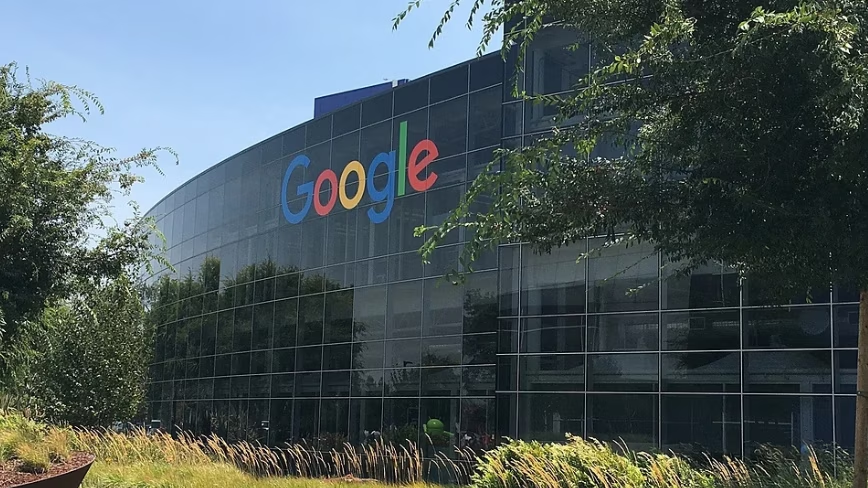
💡Major antitrust ruling against Google sets a legal precedent for how tech giants bundle software and AI services.
⚡ 30-Second TL;DR
What Changed
Google's final appeal against the €4.1 billion fine was dismissed.
Why It Matters
This sets a significant precedent for how big tech companies can bundle AI services into mobile operating systems in the future.
What To Do Next
Review your product's distribution strategy to ensure compliance with evolving antitrust regulations regarding bundled software.
Key Points
- •Google's final appeal against the €4.1 billion fine was dismissed.
- •The fine relates to Android's bundling of search and browser services.
- •The ruling marks the end of an eight-year legal dispute.
- •The penalty remains fully intact.
🧠 Deep Insight
AI-generated analysis for this event — not the original article.
🔑 Enhanced Key Takeaways
- •The European Commission originally imposed the record-breaking fine in 2018, alleging Google used Android to cement its dominant position in general internet search.
- •The Court of Justice of the European Union (CJEU) ruling is final, meaning there are no further legal avenues for Google to challenge the decision within the EU court system.
- •The case centered on three specific practices: requiring manufacturers to pre-install Google Search and Chrome to access the Play Store, paying manufacturers to exclusively pre-install Google Search, and preventing manufacturers from selling devices running 'forked' versions of Android.
- •While the fine was originally set at €4.34 billion, the General Court of the EU had previously reduced it slightly to €4.125 billion in 2022, a figure the CJEU has now upheld.
- •This ruling reinforces the European Commission's aggressive stance on 'gatekeeper' platforms under the Digital Markets Act (DMA), which now imposes stricter ex-ante regulations on companies like Alphabet.
📊 Competitor Analysis▸ Show
| Feature | Google (Android) | Apple (iOS) | Alternative OS (e.g., GrapheneOS) |
|---|---|---|---|
| Search Default | Google Search (Mandatory/Bundled) | Google Search (Paid Placement) | User Choice (Neutral) |
| Browser Engine | Chromium (Blink) | WebKit (Mandatory) | Various |
| App Distribution | Play Store (Bundled) | App Store (Closed) | F-Droid / Sideloading |
| Regulatory Status | High Scrutiny (DMA Gatekeeper) | High Scrutiny (DMA Gatekeeper) | N/A |
🛠️ Technical Deep Dive
- The antitrust concerns focused on the Mobile Application Distribution Agreement (MADA), which contractually obligated OEMs to pre-install the Google Search app and Chrome browser as a condition for licensing the Google Play Store.
- The 'Anti-Fragmentation Agreement' (AFA) prohibited OEMs from manufacturing devices based on non-compatible versions of the Android Open Source Project (AOSP), effectively preventing the proliferation of 'forked' Android ecosystems.
- The technical bundling mechanism utilized the Google Mobile Services (GMS) package, a proprietary layer that sits atop the open-source Android framework, which Google leveraged to maintain control over the user experience and default service selection.
🔮 Future ImplicationsAI analysis grounded in cited sources
⏳ Timeline
Weekly AI Recap
Read this week's curated digest of top AI events →
👉Related Updates



AI-curated news aggregator. All content rights belong to original publishers.
Original source: The Next Web (TNW) ↗
This is a summary, not the original. Read the source, or get the weekly briefing.
Weekly AI briefing
One email a week. Unsubscribe anytime.