Google Lets Users Personalize Search Sources
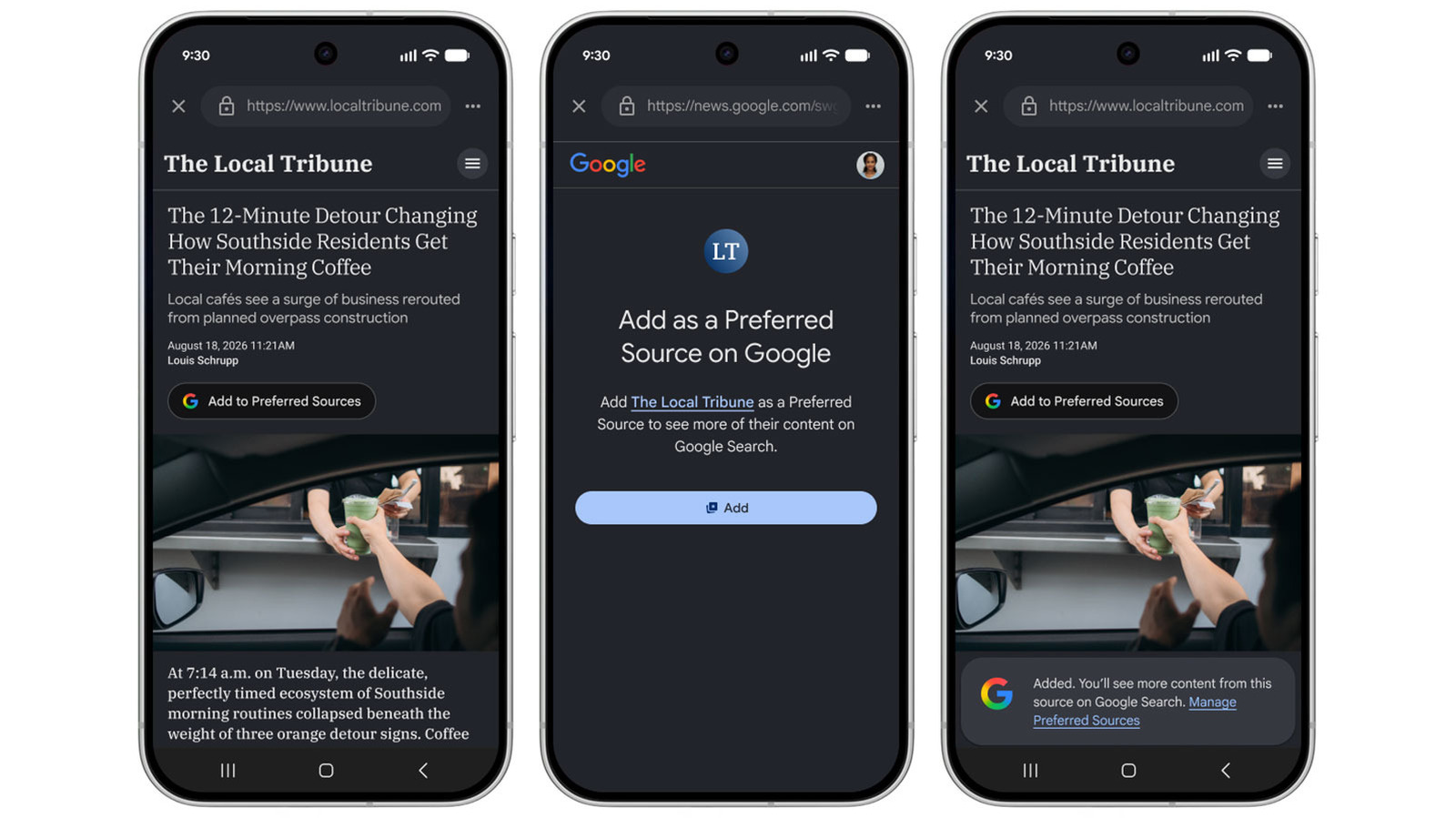
💡Google is changing how users discover trusted sources—useful for AI search and recommendation builders.
⚡ 30-Second TL;DR
What Changed
Users can add preferred news sources to Google Search
Why It Matters
For publishers and AI product teams, source preferences could influence how users discover news and evaluate recommendation quality. It may also increase the importance of publisher visibility within Google’s personalized surfaces.
What To Do Next
Review your news or content product’s Google Search visibility and test whether preferred-source personalization changes referral patterns.
Key Points
- •Users can add preferred news sources to Google Search
- •The customization also applies to the Discover experience
- •The feature gives users more control over personalized content
🧠 Deep Insight
Background and context from public sources — not the original article. 30 sources cited.
🔑 Enhanced Key Takeaways
- •The new feature includes an interactive 'Preferred Sources' button that publishers can embed directly on their websites, allowing readers to add the site as a preferred source without leaving the page.
- •Users can now refine their Discover feed by using natural language prompts to specify exactly what topics or links they want to see more or less of, with Google potentially asking follow-up questions for further tuning.
- •Google News on Android will offer customizable daily audio briefings, enabling users to select specific topics across various categories like Headlines, Business, Entertainment & lifestyle, Sports, Science & technology, and more.
- •The 'Preferred Sources' functionality helps prioritize selected publishers' content, making it more likely to appear in 'Top Stories,' 'AI Overviews,' and 'AI Mode' within Google Search results, sometimes highlighted with a 'preferred' badge.
- •These personalization updates are part of Google's ongoing efforts to provide users with greater control over their content experience, following recent changes in May-June 2026 to separate privacy settings for 'Search Services History' and 'Personalized Recommendations' from the broader 'Web & App Activity'.
📊 Competitor Analysis▸ Show
| Feature / Platform | Google News / Search / Discover | Feedly | Apple News | Inoreader | |
|---|---|---|---|---|---|
| Source Selection/Customization | Explicit 'Preferred Sources' button, natural language Discover controls, follow/unfollow topics/sources, customize audio briefings. | Users choose topics and sources; social sharing. | Highly customizable with themes, layouts, RSS feed integration, topic-based curation. | Curated experience with editorially selected and algorithm-driven content. | Build custom newsfeeds from websites, RSS, social media (Facebook, Telegram, Mastodon, Reddit, YouTube), keywords; filters and rules. |
| Content Curation Method | Automated systems and AI-powered personalization based on activity, location, and explicit user preferences; 'Full Coverage' for diverse perspectives. | Machine learning algorithms and user preferences; visually appealing magazine-style layout. | User-driven curation, RSS feeds, and topic-based organization. | Blend of human editors and algorithms. | Automated monitoring feeds, AI-powered article summaries (paid plans), and curated collections. |
| Availability | Google app (Android/iOS), Chrome, google.com. | App (iOS/Android), web. | App (iOS/Android), web. | Apple devices (iOS/macOS). | App (iOS/Android), web. |
🛠️ Technical Deep Dive
- Google's personalization systems leverage user data including search history, browsing history, location data (GPS from Android, IP address), and other activity saved in the Google Account's 'Web & App Activity' settings.
- The Discover feed operates on an entirely algorithm-based system, drawing from user activity across the Google ecosystem, including YouTube watch history.
- The new natural language controls for Discover suggest the integration of advanced Natural Language Processing (NLP) capabilities, potentially powered by Google's Gemini chatbot, to interpret and act on user input.
- Google's news algorithms identify top stories based on factors such as prominence, freshness, and authoritativeness of sources, and then select specific content to surface.
- Google News utilizes automated systems rather than human editors to curate and personalize news feeds at scale, drawing from over 145,000 different sources.
🔮 Future ImplicationsAI analysis grounded in cited sources
⏳ Timeline
📎 Sources (30)
Factual claims are grounded in the sources below. Forward-looking analysis is AI-generated interpretation.
- blog.google
- searchenginejournal.com
- engadget.com
- 9to5google.com
- androidauthority.com
- zdnet.com
- rebelmouse.com
- techresearchonline.com
- seroundtable.com
- bleepingcomputer.com
- 9to5google.com
- reddit.com
- blog.google
- google.com
- google.com
- missiontolearn.com
- thewhitelabelagency.com
- inoreader.com
- gadgetstouse.com
- google.com
- slicedbread.agency
- google.com
- juicer.io
- wikipedia.org
- cardsplug.com
- portent.com
- reddit.com
- facebook.com
- gadgethacks.com
- blog.google
Weekly AI Recap
Read this week's curated digest of top AI events →
👉Related Updates

AI-curated news aggregator. All content rights belong to original publishers.
Original source: Engadget ↗
This is a summary, not the original. Read the source, or get the weekly briefing.
Weekly AI briefing
One email a week. Unsubscribe anytime.