Google and UK Trial AI-Powered Contrail Avoidance
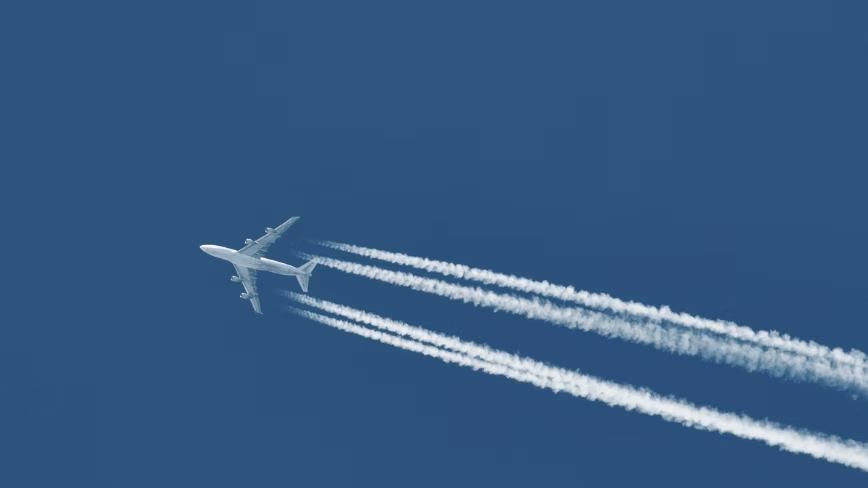
💡See how AI forecasts are moving from climate research into real-time aviation control.
⚡ 30-Second TL;DR
What Changed
Operation Blue Skies is a joint trial by Google and the UK government.
Why It Matters
The project demonstrates a high-impact use of AI forecasting to optimize aviation operations and reduce non-CO₂ climate effects. If successful, it could create demand for reliable environmental prediction systems that integrate with real-time control workflows.
What To Do Next
Prototype a flight-routing simulator that combines contrail-risk forecasts with route cost and fuel constraints, then measure climate reduction against operational overhead.
Key Points
- •Operation Blue Skies is a joint trial by Google and the UK government.
- •AI forecasts will identify areas where warming contrails are likely to form.
- •Air traffic controllers will nudge aircraft around predicted contrail zones.
- •The trial covers the North Atlantic and is described as the first ocean-wide effort of its kind.
🧠 Deep Insight
AI-generated analysis for this event.
🔑 Enhanced Key Takeaways
- •The initiative leverages Google's 'Contrail Project,' which utilizes satellite imagery, weather data, and flight path information to train deep learning models.
- •Research indicates that while contrails account for only a small percentage of flights, they are responsible for approximately 35% of the aviation industry's total climate impact.
- •The trial integrates with NATS (National Air Traffic Services) in the UK to operationalize flight path adjustments within existing air traffic control workflows.
- •Previous smaller-scale tests conducted by Google Research demonstrated that AI-guided flight adjustments could reduce contrail formation by up to 50% with minimal fuel consumption increases.
- •The North Atlantic region was selected due to its high density of transoceanic flights and specific atmospheric conditions that frequently lead to persistent, heat-trapping contrail formation.
📊 Competitor Analysis▸ Show
| Feature | Google (Operation Blue Skies) | Breakthrough Energy (Contrail Impact) | SATAVIA |
|---|---|---|---|
| Primary Approach | AI-driven flight path optimization | Scientific research & policy advocacy | DECISIONX platform (AI/Atmospheric modeling) |
| Integration | Air Traffic Control (NATS) | Industry partnerships | Airline operational software |
| Focus | Real-time oceanic rerouting | Long-term climate mitigation | Predictive maintenance & contrail avoidance |
🛠️ Technical Deep Dive
- The underlying model utilizes a convolutional neural network (CNN) architecture to process multi-spectral satellite imagery from GOES-16 and GOES-17 satellites.
- The system calculates the Contrail Radiative Forcing (CRF) to prioritize the avoidance of contrails that have the highest warming potential during specific times of day.
- Implementation involves ingesting real-time meteorological data, including humidity and temperature profiles at cruise altitudes, to predict ice supersaturated regions (ISSRs).
- The optimization algorithm balances the trade-off between fuel burn (CO2 emissions) and contrail avoidance to ensure net-positive climate benefits.
🔮 Future ImplicationsAI analysis grounded in cited sources
⏳ Timeline
Weekly AI Recap
Read this week's curated digest of top AI events →
👉Related Updates




AI-curated news aggregator. All content rights belong to original publishers.
Original source: The Next Web (TNW) ↗