China Orders Early Windows 10 Removal
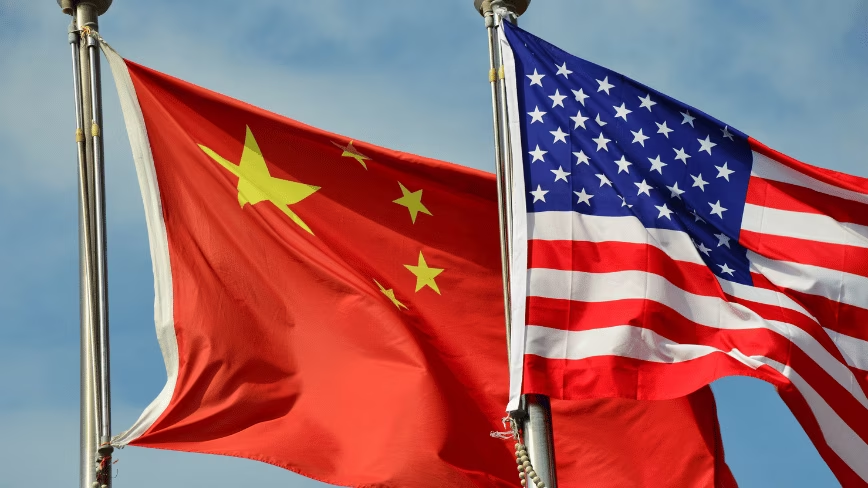
💡China's early Windows removal signals rising security and vendor-dependency risks for enterprise AI deployments.
⚡ 30-Second TL;DR
What Changed
Some Chinese state-linked organizations were told to remove customized Windows 10 software.
Why It Matters
The decision could accelerate migration away from Microsoft software in sensitive Chinese government environments. For AI teams operating in regulated settings, it highlights the need to evaluate endpoint security, data residency, and vendor dependency.
What To Do Next
Run Microsoft Defender and endpoint-compliance audits on Windows hosts handling AI data, then document a migration plan for unsupported or high-risk systems.
Key Points
- •Some Chinese state-linked organizations were told to remove customized Windows 10 software.
- •The removal is happening earlier than originally planned.
- •Data security concerns reportedly triggered the instruction, with no specific vulnerabilities disclosed.
🧠 Deep Insight
AI-generated analysis for this event.
🔑 Enhanced Key Takeaways
- •The directive is part of a broader 'Xinchuang' (IT Application Innovation) strategy aimed at replacing foreign technology with domestic alternatives in critical sectors.
- •This specific version of Windows 10 was a joint venture product developed by Microsoft and China Electronics Technology Group (CETC) to meet government security standards.
- •The acceleration of the removal timeline is linked to heightened geopolitical tensions and new cybersecurity regulations regarding 'secure and controllable' supply chains.
- •State-linked entities are being encouraged to migrate to domestic operating systems based on the Linux kernel, such as Kylin OS or UOS.
- •Microsoft has faced recurring scrutiny in China over the years, with previous investigations by the State Administration for Market Regulation (SAMR) regarding antitrust and compatibility concerns.
📊 Competitor Analysis▸ Show
| Feature | Windows 10 (China Gov) | Kylin OS | UOS (UnionTech) |
|---|---|---|---|
| Kernel | Windows NT | Linux (Ubuntu-based) | Linux (Debian-based) |
| Ecosystem | Legacy Win32 Apps | Wine/Compatibility Layer | Wine/Compatibility Layer |
| Security | Proprietary/Black Box | Open Source/Auditable | Open Source/Auditable |
| Pricing | Licensing Fees | Government Subsidized | Government Subsidized |
🛠️ Technical Deep Dive
- The customized Windows 10 version utilized specific Group Policy Objects (GPOs) to disable telemetry and cloud-based services that transmit data outside of China.
- Integration with local identity management systems and hardware-based Trusted Platform Modules (TPM) was mandated to ensure data sovereignty.
- Migration efforts involve the use of containerization and virtualization layers to run legacy Windows applications on Linux-based domestic operating systems.
- Domestic OS alternatives utilize the LoongArch or Phytium CPU architectures, requiring a shift away from x86-64 instruction sets for critical infrastructure.
🔮 Future ImplicationsAI analysis grounded in cited sources
⏳ Timeline
Weekly AI Recap
Read this week's curated digest of top AI events →
👉Related Updates


AI-curated news aggregator. All content rights belong to original publishers.
Original source: The Next Web (TNW) ↗