Baidu Revenue Falls for Fifth Quarter
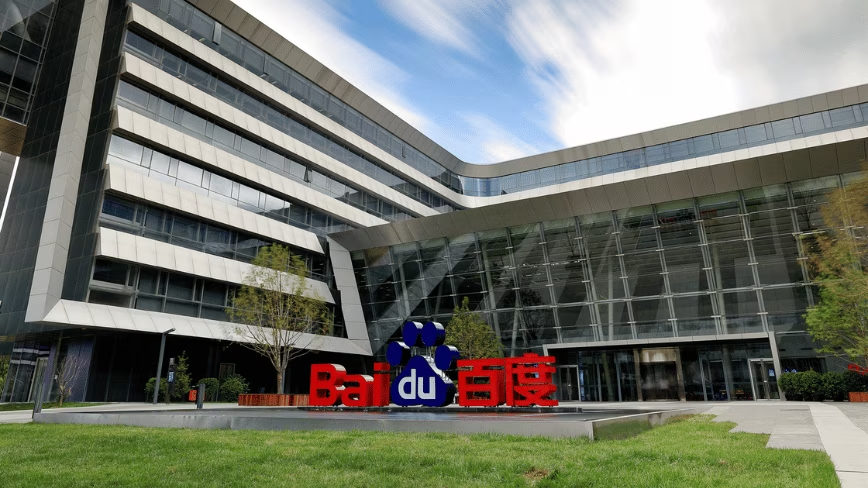
💡Baidu's AI growth is being tested as a shrinking ad business drags revenue down for a fifth quarter.
⚡ 30-Second TL;DR
What Changed
Baidu reported second-quarter revenue of RMB31.3 billion ($4.62 billion).
Why It Matters
The results suggest Baidu's AI growth has not yet offset weakness in its core advertising business. This may increase pressure to monetize AI products while managing a broader decline in search advertising.
What To Do Next
Review Baidu's next earnings segment disclosures before allocating budget to its AI services, focusing on AI revenue growth and monetization metrics.
Key Points
- •Baidu reported second-quarter revenue of RMB31.3 billion ($4.62 billion).
- •Revenue declined 4% year over year and 2% quarter over quarter.
- •Advertising revenue continued to contract faster than the AI business expanded.
🧠 Deep Insight
AI-generated analysis for this event.
🔑 Enhanced Key Takeaways
- •Baidu's core online marketing revenue, which historically anchors the company's financial performance, faced significant headwinds due to a weak macroeconomic environment in China and reduced spending from key sectors like healthcare and real estate.
- •The company's 'AI Cloud' segment, while growing, has faced intense price competition as major Chinese tech firms engage in a 'price war' to capture market share for large language model (LLM) API services.
- •Baidu's autonomous driving unit, Apollo Go, has reached a critical inflection point, achieving significant cost reductions per unit through the deployment of its sixth-generation robotaxis, though it remains a long-term investment rather than a near-term profit driver.
- •Operating margins have been pressured by increased capital expenditure requirements related to the massive compute infrastructure needed to train and serve the Ernie Bot foundation models.
- •The company has initiated a strategic pivot toward 'AI-native' applications, attempting to integrate generative AI features directly into its search and mobile ecosystem to stem the decline in user engagement.
📊 Competitor Analysis▸ Show
| Feature | Baidu (Ernie/Apollo) | Alibaba (Qwen/Cloud) | Tencent (Hunyuan) |
|---|---|---|---|
| Primary AI Model | Ernie Bot | Qwen | Hunyuan |
| Cloud Strategy | AI-First / Vertical Integration | Ecosystem / Enterprise SaaS | Social / Gaming / Cloud |
| Autonomous Driving | Apollo (Leader) | Limited / Partner-based | Limited / Partner-based |
| Revenue Model | Ad-heavy / Cloud / Mobility | E-commerce / Cloud / Fintech | Social / Gaming / Cloud |
🛠️ Technical Deep Dive
- Ernie 4.0 Turbo: Utilizes a mixture-of-experts (MoE) architecture to optimize inference latency and reduce compute costs for high-concurrency enterprise applications.
- Apollo 6.0: Features a centralized computing architecture that reduces vehicle hardware costs by 60% compared to previous generations, utilizing a more streamlined sensor suite.
- PaddlePaddle Framework: Baidu's proprietary deep learning platform continues to serve as the foundational infrastructure for its model training, emphasizing high-throughput distributed training capabilities.
- Model Compression: Implementation of advanced quantization and distillation techniques to deploy large-scale models on edge devices and mobile environments.
🔮 Future ImplicationsAI analysis grounded in cited sources
⏳ Timeline
Weekly AI Recap
Read this week's curated digest of top AI events →
👉Related Updates


AI-curated news aggregator. All content rights belong to original publishers.
Original source: The Next Web (TNW) ↗