Global supply chain faces 2021-level crisis
💡Critical insights on AI hardware supply chain constraints and the rapid rise of domestic AI chip alternatives.
⚡ 30-Second TL;DR
What Changed
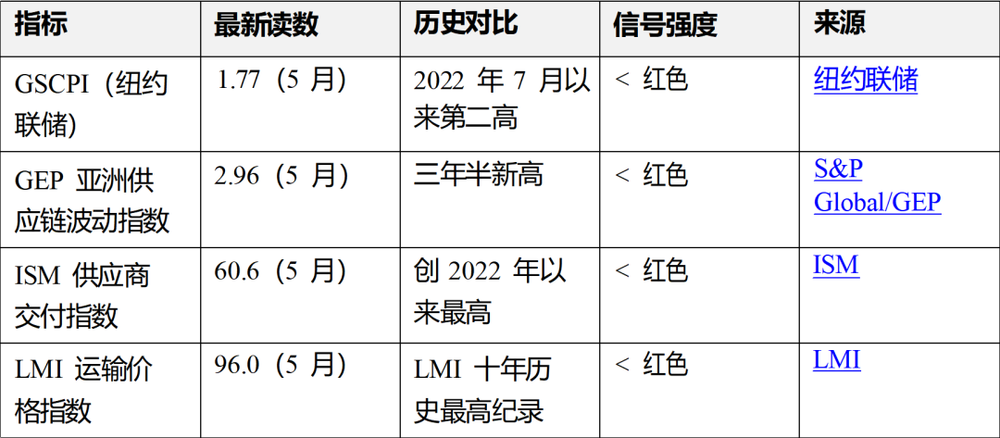
GSCPI index hit levels not seen since 2022, indicating severe supply chain pressure.
Why It Matters
AI hardware developers must account for longer lead times and higher costs for GPUs and HBM. The shift toward domestic AI chip alternatives in China will reshape the global competitive landscape.
What To Do Next
Diversify your hardware procurement strategy and evaluate domestic AI chip alternatives for non-critical inference workloads.
Key Points
- •GSCPI index hit levels not seen since 2022, indicating severe supply chain pressure.
- •AI chip demand is driving HBM and advanced process shortages, with delivery times exceeding 6 months.
- •China's AI chip self-sufficiency rose from 10% in 2021 to 41% in 2025, projected to reach 85% by 2030.
🧠 Deep Insight
AI-generated analysis for this event — not the original article.
🔑 Enhanced Key Takeaways
- •The EU's Carbon Border Adjustment Mechanism (CBAM) has entered its definitive phase, imposing significant administrative and financial burdens on non-EU manufacturers exporting carbon-intensive goods.
- •Logistics costs have been exacerbated by the ongoing rerouting of maritime traffic away from the Red Sea, adding an average of 10-14 days to transit times between Asia and Europe.
- •Advanced packaging technologies, specifically CoWoS (Chip-on-Wafer-on-Substrate), remain the primary bottleneck for AI chip production, limiting the output of major foundries despite increased wafer capacity.
- •Recent trade policy shifts have led to a 'fragmentation of standards,' where regional supply chains are increasingly adopting localized technical protocols to bypass cross-border regulatory friction.
- •Inventory-to-sales ratios in the semiconductor sector have reached a historical low, as companies shift from 'just-in-time' to 'just-in-case' procurement strategies to mitigate geopolitical volatility.
🛠️ Technical Deep Dive
- HBM3e and HBM4 memory architectures are currently the critical path for AI performance, requiring TSV (Through-Silicon Via) stacking processes that are highly sensitive to yield fluctuations.
- The shift toward chiplet-based architectures allows for the integration of heterogeneous dies, which is a key strategy for Chinese manufacturers to circumvent limitations in extreme ultraviolet (EUV) lithography access.
- CBAM compliance requires granular Scope 1 and Scope 2 emission data tracking at the product level, necessitating new digital product passport (DPP) implementations across global supply chains.
🔮 Future ImplicationsAI analysis grounded in cited sources
⏳ Timeline
Weekly AI Recap
Read this week's curated digest of top AI events →
👉Related Updates

AI-curated news aggregator. All content rights belong to original publishers.
Original source: 虎嗅 ↗
This is a summary, not the original. Read the source, or get the weekly briefing.
Weekly AI briefing
One email a week. Unsubscribe anytime.